


 NEWS
NEWS
NEWS
NEWS
NEWS

In 247 days, about the beginning of next year’s autumn, NASA’s newest robotic observer, Curiosity, will land on Martian soil. Any science fiction reader who has studied astronomy and followed humanity’s ever expanding interest in the sky and of our neighboring planets, will probably have read things like the Martian Chronicles by Ray Bradbury and the Mars Trilogy by Kim Stanley Robinson. Although colonization of such place like Mars is possibly still decades (or perhaps centuries) away, it still astounds and inspires the imagination to know more about Earth’s red sibling.
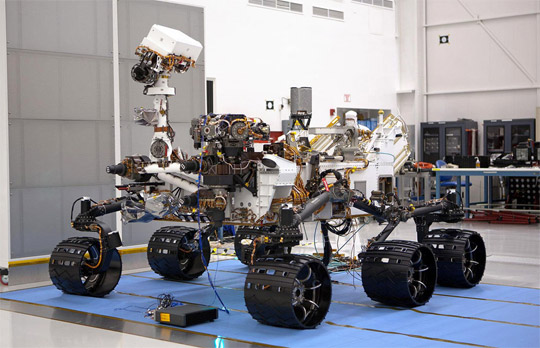
As NASA’s eponymous project and robot rover, Curiosity is a marvel of modern science.
 More photos available at The Atlantic (in high definition).
This beautiful robotic laboratory, dubbed the Mars Science Laboratory, launched November 26 on the tip of a United Launch Alliance Atlas V rocket. It’s been locked and loaded with the best technology and equipment that a government funded space program can procure and weighs about 1 tonne—with a scientific payload 10 times more massive than previous instrument sets taken to the Martian landscape.
“This is a vehicle on Mars, cruising around, drilling into rocks, chipping away at stuff to see what that planet’s made out of,” said Omar Baez, the launch director of the MSL mission. “And even if it didn’t do that, if it just cruised around Mars and took pictures, the value in that is tremendous.”
According to the documentation on the rover, it eschews solar panels for a much more powerful power generation system: a multi-mission radioisotope thermoelectric generator, or MMRTG. The nuclear-powercore is solid state and converts heat from its radioactive plutonium fuel into about 110 watts of power.
Among Curiosity’s analytical equipment, the rover is equipped with a 7-foot-long waldo arm for collection and manipulation, it also has an on-board spectrographic analyzer capable of reading emission spectra from vaporized minerals. The device, known as the “ChemCam” is described by some as a laser ray gun, but it serves the specific scientific purpose of flash-frying rocks so that the flash of their destruction can be analyzed to determine what’s in them.

This is how NASA describes the death-ray science process, “”The pinhead-size spot hit by ChemCam’s laser gets as much power focused on it as a million light bulbs, for five one-billionths of a second. Light from the resulting flash comes back to ChemCam through the instrument’s telescope, mounted beside the laser high on the rover’s camera mast. The telescope directs the light down an optical fiber to three spectrometers inside the rover. The spectrometers record intensity at 6,144 different wavelengths of ultraviolet, visible and infrared light. Different chemical elements in the target emit light at different wavelengths.””
Past rovers have been unable to detect the concentrations of lighter elements such as carbon, oxygen, hydrogen, lithium and boron; however, the ChemCam on Curiosity would be able to identify carbon in one laser blast.
The Curiosity will be landing in a region on Mars known as Gale Crater, a 96-mile-diameter geological feature with a 3-mile-high sediment mountain in the middle. Images of the region taken from orbit show layers of minerals banded through the region similar to those on the walls of the Grand Canyon. As a result, the location was chosen because it would give the rover the best chance to pick through entire strata of Martian geological history.
Still curious about Curiosity? Be sure to read as much as you can on NASA’s pages about the Mars Science Laboratory project.
My high hopes and expectations are with you, Curiosity. Make us proud.
Support our mission to keep content open and free by engaging with theCUBE community. Join theCUBE’s Alumni Trust Network, where technology leaders connect, share intelligence and create opportunities.
Founded by tech visionaries John Furrier and Dave Vellante, SiliconANGLE Media has built a dynamic ecosystem of industry-leading digital media brands that reach 15+ million elite tech professionals. Our new proprietary theCUBE AI Video Cloud is breaking ground in audience interaction, leveraging theCUBEai.com neural network to help technology companies make data-driven decisions and stay at the forefront of industry conversations.