



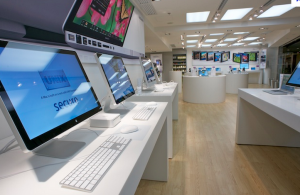
 If you want an Apple product, where’s the first place you go to? An Apple Store. There are hundreds of them scattered all over the world, and this has given them the edge over competition, creating a space to learn and play with their products.
Sure, competitors have their store where they showcase their products, but an Apple Store is different. Apple Stores are very simple, mostly made up of glass so all you’ll focus on is their products. Other stores seem to have a lot going on so when you step inside, overwhelming the senses. You’ll find a lot of retail stores booming music, hanging banners, and loads of flyers. Apple Stores have none of those. If you want to know about a certain product, you don’t have to read different flyers about them, you can just use the device hands on. That’s why they have interactive displays so you can try it out before you spend your money. That’s the beauty of the Apple Store.
That single feature of the Apple Store is what drove many consumers to buy their products, and now competitors see the benefits of an interactive store. The problem is, could competitors be copying not only their store strategy but their entire retail experience?
Samsung recently opened a Samsung Experience store in Sydney, Australia. It’s an interactive store that features glass doors, desks with products you can play with, simple wall displays, and a general, minimalistic design. Sounds familiar? Yes, it greatly resembles the Apple Store, as if Apple needs another reason to accuse Samsung of copying.
But that’s not the only thing that Experience has. There’s also “Samsung Smart Tutors,” which are equal to Apple’s Geniuses — the all-knowing geeks that will calmly walk you through any product in the store.
Microsoft has also taken a shine on copying Apple’s store design. Their first retail store, known as microsoftSF, was owned and operated by Sony Retail Entertainment, and ran from 1999-2001. But it wasn’t until 2009 that they cut the ribbon to a Microsoft “Retail Experience Center” which also has a striking similarity to the Apple Store. Aside from the minimalistic design and interactive displays, they also have “Technical Advisors,” similar to Apple’s Geniuses.
So even if competitors deny it, you can’t hide the fact that the Apple Store inspired them in designing their very own stores. Though this may upset Apple, who’s quick to point out others lacking innovation, maybe they should just accept it. After all, isn’t imitation the sincerest form of flattery?
Support our mission to keep content open and free by engaging with theCUBE community. Join theCUBE’s Alumni Trust Network, where technology leaders connect, share intelligence and create opportunities.
Founded by tech visionaries John Furrier and Dave Vellante, SiliconANGLE Media has built a dynamic ecosystem of industry-leading digital media brands that reach 15+ million elite tech professionals. Our new proprietary theCUBE AI Video Cloud is breaking ground in audience interaction, leveraging theCUBEai.com neural network to help technology companies make data-driven decisions and stay at the forefront of industry conversations.