


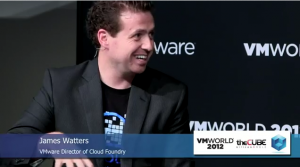
 John Furrier continues SiliconANGLE’s exclusive VMworld coverage with a panel on Cloud Foundry. James Watters, VMware Director of Cloud Foundry and Lucas Carlson, Appfog CEO, discuss their experiences and perspectives on how the DevOps world changed with the changing demand of cloud, big data’s impact on the cloud, top uses cases for PaaS clouds, whether platform as a service is really a “race to zero,” and the overall value of multi-cloud. The panelists conclude by discussing their biggest surprises and prediction for future disruptions in the industry.
Noting excitement for the public cloud, Furrier, asks how big data has changed the cloud equation and, specifically, DevOps. As a multitude of different technologies like Node and Python are increasingly put onto cloud, Carlson notes that Cloud Foundry has been critical in bringing public and private clouds together. Watters believes DevOps will be important to how organizations “differentiate and think about themselves” given that the old silo style model (involving running one app, with run person to run that app, etc.) has passed. Carlson notes that platform as a service will allow standardization amongst large DevOps teams.
Furrier also asks how big data is effecting the PaaS world. According to Carlson, “you can have developers trying to approach the DevOps solution for big data, but what PaaS has in the box, is the ability to scale out a system [where] you consume big data over thousands of instances very quickly.” Carlson says the top use cases for the PaaS clouds are mobile applications, social applications and consumer web. He suggests that the transition to the user cloud has been a 10 year trend, stating: “You couldn’t get a virtual machine outside of core IT, now you have many places where you can rent these machines, and in fact, you’re encouraged to.”
Furrier raises the popularly circulating idea that platform as a service is a “race to zero,” as people don’t want to go back to the hosting model, to drive down and get lower and cheaper positioning. The panelists argue that the reality is more complicated. Watters explains the problem with such a perspective is that it “excludes the human factor from the equation,” ignoring that the human costs associated with the operations are actually “immense.” Also, Cloud Foundry drives significant value to businesses. Watters adds, “The organizational change that these concepts drive [i.e. DevOps and PaaS] are going to unleash fifty to sixty percent savings or more, and they’re also going to attack agility in a way that no one has.”
Furrier concurs that PaaS is actually not a race to zero, but “an enabling opportunity” and asks the panelists, what enabling processes are occurring around PaaS that will create more opportunity and disruption. Carlson says, “What has been slowing down development is that traditionally when you create applications, it can typically take six weeks to just get your Ops guys to deploy the code…those time frames aren’t possible to sustain anymore…that rapid development is exactly what PaaS enables.” Carlson believes the biggest misconception of PaaS “is that it’s just a feature on top of infrastructure.” In reality, he argues, it’s not yet another sort of resource, but a different way of thinking: “When you’re deploying and managing apps with services, and services have to talk to those applications, and knowing how to scale each of those independently, that’s not just another kind of resource, [and] it’s a layer that is very thick on top of the infrastructure.”
Carlson believes the trajectory for PaaS in the industry is “exponential.” He cites that last year users totaled 10,000, a month ago numbers reached 40,000, and now there are 60,000. According to Carlson, the primary drive of growth is the simple fact that developers like using PaaS. What developers enjoy most is the ability to get their applications out faster and then scale them.
Watters believes there is huge opportunity for standardization with PaaS, noting: “PaaS lets you bake in a lot of things automatically, whereas a normal developer working alone out on Amazon is setting a bunch of configuration files himself, and PaaS lets you do that automatically, [taking] away decisions from individuals that they don’t need to make.” Watters suggests that “more and more is going to come into the PaaS abstraction over time…you’re going to say, why am I configuring all of these VM’s to run applications, when I can just deploy an application to a platform.”
Watters also believes that multi-cloud is key to Cloud Foundry given that clients want solutions that are both hosted and in-house. “It’s by getting the multi-cloud, it’s by getting the opportunity and choice to bring it wherever you want that we’re really going to unleash this an economic force.” Positive consequences of multi-cloud deployment may include large POs being cut.
The panelists conclude by discussing surpises in the industry and their predictions for future trends. Carlson says the biggest surprise he’s noted over the last year has been “not seeing platform as a service yet adopted.” Looking forward to the next eighteen months, he believes we’ll see more “enterprises adopt private cloud as a service from vendors like VMware and Appfog, [enabling] the next generation of developers to build great companies.” The misperception that data centers would not continue to be privately operated was a major surprise for Watters. Many industry leaders thought that the cloud and hosted CRM were the future, and thus, “underestimated how much software defined data centers, and how much fully automated data centers, are going to really rock the economic house…They’ve over-pivoted to ‘hosting solves all’.”
Support our mission to keep content open and free by engaging with theCUBE community. Join theCUBE’s Alumni Trust Network, where technology leaders connect, share intelligence and create opportunities.
Founded by tech visionaries John Furrier and Dave Vellante, SiliconANGLE Media has built a dynamic ecosystem of industry-leading digital media brands that reach 15+ million elite tech professionals. Our new proprietary theCUBE AI Video Cloud is breaking ground in audience interaction, leveraging theCUBEai.com neural network to help technology companies make data-driven decisions and stay at the forefront of industry conversations.