


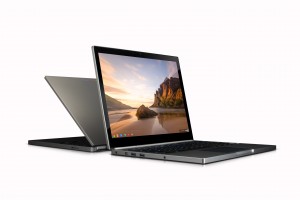
 If you’re lucky enough to snag a ticket to Google I/O 2013 then you’re probably jumping for joy or bragging your heart out because you just received your free, $1,300-worth Chromebook Pixel. Yup, Google just gave away a Chromebook Pixel to each attendee of this year’s I/O event. Why? Because they want to, and they can. And maybe because not many have bought the device since it’s an overpriced web-enabled, ultra powerful netbook, so the best way to get users is to literally give them away.
The Chromebook Pixel was unveiled last February and quickly went on sale. It features a 12.85” Gorilla Glass multi-touch screen with the highest pixel density (239 pixels per inch), an Intel Core i5 Processor and a solid state Flash memory architecture, 4GB DDR3 RAM, 32GB solid state drive (64GB on LTE model), Integrated 720p HD camera, industry-leading WiFi range thanks to carefully positioned antennas and dual-band support, LTE engineered directly into the machine to enable super fast connectivity to Verizon’s 4G network, backlit keyboard, glass touchpad, one terabyte of Google Drive storage will come with the purchase of the machine.
The only problem with the Chromebook Pixel, aside from it being overpriced, is that it’s a very powerful device with not much purpose. Yes, you can create and share documents, send e-mails, and all the activities you can do on a browser, but that’s just it, it has little offline usage. So if you don’t have an internet connection, you’re screwed.
There’s more to Pixel’s purpose
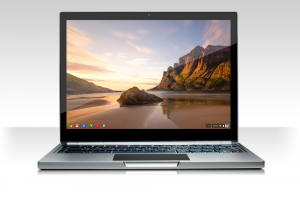 But did Google really make a powerful useless machine? I think not. Google is thinking about the future, and it’s expected that a huge update put to use all the powerful little pieces inside the Chromebook Pixel.
With Sundar Pichai heading both Chrome and Android, and his statement regarding more synergy between the two, we can expect that soon, the Chromebook Pixel will be able to run Android apps. This will put the 12.85” multi-touch screen to good use.
“[T]he biggest and most anticipated development could be the ability to run Android tablet apps on ChromeOS, especially on the multitouch Chromebook Pixel. While there would be some key details to overcome—most notably screen resolution—the addition of these large screen Android apps would immediately bring a welcome set of expanded capabilities,” Jason Hiner of ZDNet wrote in a blog post.
Aside from stunning attendees with a free Chromebook Pixel, Google announced updates to its services.
Pinterest + Instagram copycat?
 Google unveiled the redesigned Google+ page. Change is not always good, and this may be one of those instances, especially with the fact that Google+ now looks a lot more like Pinterest with its boxes and columns. The only good thing that came out of it is that the photos and videos are now dynamic, “sometimes spreading out over the entire column view.”
And the hashtags are now more intrusive, as Google+ can decide to put hashtags on related posts or photos. You can of course delete the hashtags, and if you’d rather be positive about the intrusion, think of it as a new discovery tool.
Unified messaging across Apps + devices
The search giant has also improved its messaging service with a unified approach. Now, you can chat with friends via Hangouts by using Gmail, Google+, iOS and Android devices, and the Chrome browser. It beats the hell out of other chat services since these platforms all have a huge user base.
Refreshed Search + Google Now
Google also announced the enhancements coming to Search and Now. Google’s Amit Singhal stated in a keynote that Search needs to be able to answer, converse and anticipate, and Google is already working on these and demonstrated doing search using voice. Aside from that, statistical answers and graphs are coming to Search. So searching for the population of India, for example, would return results that includes a graph of India’s population over time as well as comparison to population of other countries.
Google will also be adding Polish, Turkish and simplified and traditional Chinese to the languages where its knowledge graph is active. Google Now will also be updated with reminders, public transit information, upcoming TV shows and information on other entertainment types such as books and video games, which will enhance its informations at a glance offering.
Other announcements include the preview of its new Maps and the next-generation video codec VP9 for faster video-streaming performance.
Support our mission to keep content open and free by engaging with theCUBE community. Join theCUBE’s Alumni Trust Network, where technology leaders connect, share intelligence and create opportunities.
Founded by tech visionaries John Furrier and Dave Vellante, SiliconANGLE Media has built a dynamic ecosystem of industry-leading digital media brands that reach 15+ million elite tech professionals. Our new proprietary theCUBE AI Video Cloud is breaking ground in audience interaction, leveraging theCUBEai.com neural network to help technology companies make data-driven decisions and stay at the forefront of industry conversations.