

 NEWS
NEWS
NEWS
NEWS
NEWS

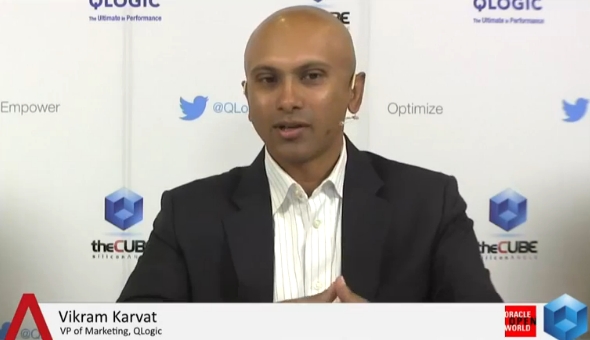
 Live from the Moscone Center in San Francisco, theCUBE co-hosts Dave Vellante and Stu Miniman kicked off Day 2 with Vikram Karvat, VP of Marketing with QLogic at Oracle OpenWorld 2013.
“There’s a lot of excitement and there’s a lot happening in the industry, both with databases and the enterprise in general, as well as around storage,” noted Karvat. “It’s a level of industry excitement that hasn’t probably been there for a couple of years now. People are re-engaging, at end user technology and deployment level.”
Since he was eager to track changes, Vellante asked for those relevant to QLogic, and for examples on capitalizing these emerging opportunities.
“There’s two kind of trends: there are the technology trends and then what’s important to end users and you have to be careful to differentiate between those two,” warned Karvat.
“From the technology side, there’s a lot of activity around SSDs, low latency transports, more CPU cores – meaning more scalability going into server nodes, driving I/O requirements, increasing virtualization. From the end user point of view, they are looking into getting more out of existing infrastructure, or trying to reinvigorate it – and the vendors that can help them leveraging their existing infrastructure are more likely to win.”
At this time Vellante notes that “more cores and processing power and virtualization creates the I/O blender, then Flash speeds everything up, creating massive amounts of I/O. That, along with data growth, presents a real challenge. What role does QLogic play in addressing that stress point in the industry?” he asked.
Watch the full interview below:
“You can optimize any piece of an equation, but, even if you take it to zero, unless you’ve done something with the rest of it, it doesn’t make a whole lot of difference,” replied Karvat. “Identifying the real bottlenecks of the infrastructure is what we’re doing in regards to some of our fabric cash products. We are not necessarily going to optimize for a particular micro-benchmark, but we’re trying to see what it takes to optimize an application’s performance.”
Stu Miniman asked Karvat how he viewed the change in dynamic in the way Google and Facebook build architecture. He wanted to know how he perceived the path the enterprise was going and how did QLogic fit in the picture?
“I think you have to view Googles and Facebooks as part of the cloud, but not the entire cloud. Everyone can roll their own solutions. As the cloud model begins to manifest itself, managing the storage is going to become important. All the things that we brought to the enterprise are still relevant in the cloud environment, albeit maybe with a slightly different complexion. We’re focusing on how to maintain the SLAs, the security, the reliability, the performance scalability in the enterprise cloud environments,” explained Karvat.
Pondering upon the advantages of working with open systems and ecosystems versus building their own ecosystem around what they want to do, Vikram Karvat states the QLogic is driven by the promise that “having an open system approach, where you’re working with your ecosystems partners is the right way to go.”
Last question of the interview inquired about the Milestones that QLogic intends to hit in the near future.
“You are going to see accelerated rates of innovation. We have 32Gb fiber channel on the rise and 128Gb fiber channel coming after that. People’s view has changed, compared to 4-5 years ago, when they thought that 16 Gb was the end of the line and the Ethernet is always going to be there. Now there’s room for FCoE and iSCSI. You are going to see us innovating in all directions,” promised Karvat.
Support our mission to keep content open and free by engaging with theCUBE community. Join theCUBE’s Alumni Trust Network, where technology leaders connect, share intelligence and create opportunities.
Founded by tech visionaries John Furrier and Dave Vellante, SiliconANGLE Media has built a dynamic ecosystem of industry-leading digital media brands that reach 15+ million elite tech professionals. Our new proprietary theCUBE AI Video Cloud is breaking ground in audience interaction, leveraging theCUBEai.com neural network to help technology companies make data-driven decisions and stay at the forefront of industry conversations.