



 NEWS
NEWS
NEWS
NEWS
NEWS

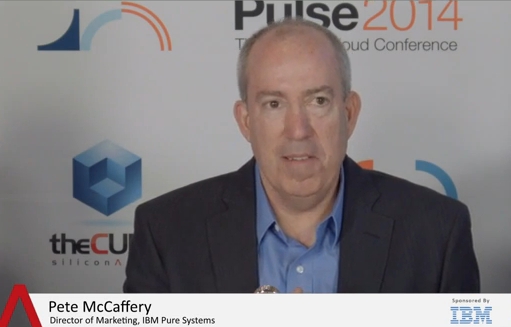 TheCUBE traveled again to Nevada, attending the IBM Pulse Conference in Las Vegas in order to deliver the hottest news in the tech industry. Joining John Furrier and Dave Vellante in the studio, Peter McCaffery, Director of Marketing with IBM PureSystems, agreed to give an in-depth lowdown on IBM’s latest unfolding success stories.
“What’s the news?” asked theCUBE co-hosts.
“We are taking our pattern technology, which was originally deployed on our PureApplication System family, and we’re moving it to SoftLayer, giving the clients flexibility to deploy either on-premise or off-premise,” began McCaffery.
“The big message we’re hearing is ‘Cloud equals growth.’ What are the benefits of the SoftLayer Pure integration? asked Furrier.
“It starts with the Pattern itself; it’s like a blueprint for the applications. You capture that blueprint and the configuration behind the application,” said McCaffery. “Previously, you would deploy that on-premise, using PureApplication System. Now you can take the same pattern and move it to an infrastructure that runs on SoftLayer. This opens up to a lot of interesting use-cases.”
Basically, clients running 15 application instances on-premise, (some of them probably lightly utilized) can now optimize the environment, putting the lightly utilized instances on public cloud and moving the pattern back and forth. “You write the pattern once and you deploy it where you need to. What a great way to capture and optimize and existing application,” commented McCaffery.
“What’s changed since IoD in the expert integrated systems? What’s getting traction?” inquired Vellante.
“The market is measured by IDCs and it is growing at a 70% year over year. Within that market IBM was growing almost two and a half times. We established a great deal of momentum in that market place and we continue to build on that momentum with the kind of announcements you hear here at Pulse,” replied Peter McCaffery.
Pure Systems has three offerings:
.
.
“The last two will remain unchanged. The PureFlex will have a couple of different modules: an X86 based module (that will go to Lenovo when the acquisition is closed), a Power based module that we call hybrid, which is a combination of Power and X86,” said McCaffery.
He added: “We continue to be very invested in the integrated systems market. We’re focusing on the higher value offers around big data and cloud, extending our capabilities to the off-premise environment.”
.
Vellante asked: “The more you get integrated up the stack, the more value your customers seem to achieve. Has your experiences pointed that out? What are you seeing in terms of full stack integration vs the converged infrastructure and the IaaS layer?”
“It’s almost mirroring the cloud market itself,” thinks McCaffery. “The cloud marked originated around IaaS and it continued to move up the stack; the same seems to be happening with the integrated systems market. A segment of that market is very focused on integrated infrastructure (a next generation Blade platform), but there’s also a fast growing segment of the market that’s really about optimizing for the specific workload. That workload might be an analytics based workload, requiring different levels of integration and content, or it might be an application platform, requiring the right development & environment and the underlying automation that goes with it.”
“Do you see this as an evolution of the server business or more like a disruptive revolution?” asked Vellante.
“A little bit of each,” replied McCaffery. A health-care business client once confessed he felt like working in manufacturing because he had to take all the components and run them through an assembly line – that was the IT organization. The client just couldn’t afford that business model anymore. He needed to be more agile and quicker-to-market.
“These clients see these systems as a higher level building block, with a different level of value, offering a better starting point and allowing them to get to the end game much quicker.”
.
“What is the end-game? Focusing more on adding value? Shifting skill-sets?” Vellante asked McCaffery to provide more details.
“That is one of the consequences,” McCaffery went on. “Many of the traditional IT organizations today are structured around technology silos (server specialists, middleware specialists). When you bring in something like an integrated system, because a lot of those technologies elements are integrated together, it frees your staff to be more general in terms of value they can bring to the organization. They can focus a little higher up the stack, trying to better serve the business as a whole and some of the things the business is trying to accomplish, instead of maintaining the existing environment.”
“Are the customers qualified to focus higher up?” asked Vellante.
“The customers are smart. Freeing them up from maintaining that existing environment can be really creative,” thinks McCaffery.
.
Furrier directed the talk around DevOps: “How are you going to nurture the developers to build the ecosystem?” he wanted to know.
“We’re doing that by providing a continuum of capability. You have to have a way of bringing forward that existing application investment. Then there’s a whole new generation set of apps being built in the cloud; providing the means to move forward the existing workloads.”
“What’s your ‘elevator pitch’ to the developer?” joked Furrier.
“The tools that you want and the type of services that are important to you, we are supporting them. We have what you want and we make it very consummable and easy to use.”
“Go-to-market is important. How do you keep those developers in business?” asked Furrier.
“We give them what they need to be successful: the right tooling, access to the right environment, the opportunity to deploy quickly… It’s all about speed,” summarized McCaffery.
Asked to comment the state and the trend of the industry, Peter said: “The industry as a whole is going through a major transition right now. I don’t remember ever seeing anything quite like this. There’s so much energy and excitement in terms of extending the enterprise onto the cloud. There’s this sense of ‘wow! this is really happening!’right in the middle of this transformation, and it’s exciting.”
Support our mission to keep content open and free by engaging with theCUBE community. Join theCUBE’s Alumni Trust Network, where technology leaders connect, share intelligence and create opportunities.
Founded by tech visionaries John Furrier and Dave Vellante, SiliconANGLE Media has built a dynamic ecosystem of industry-leading digital media brands that reach 15+ million elite tech professionals. Our new proprietary theCUBE AI Video Cloud is breaking ground in audience interaction, leveraging theCUBEai.com neural network to help technology companies make data-driven decisions and stay at the forefront of industry conversations.