
 NEWS
NEWS
NEWS
NEWS
NEWS

Among the representative attendees at the ServiceNow Knowledge16 event taking place this week, several are from companies which have partnered together, with a number of these partnerships brought together by working with ServiceNow’s utilities.
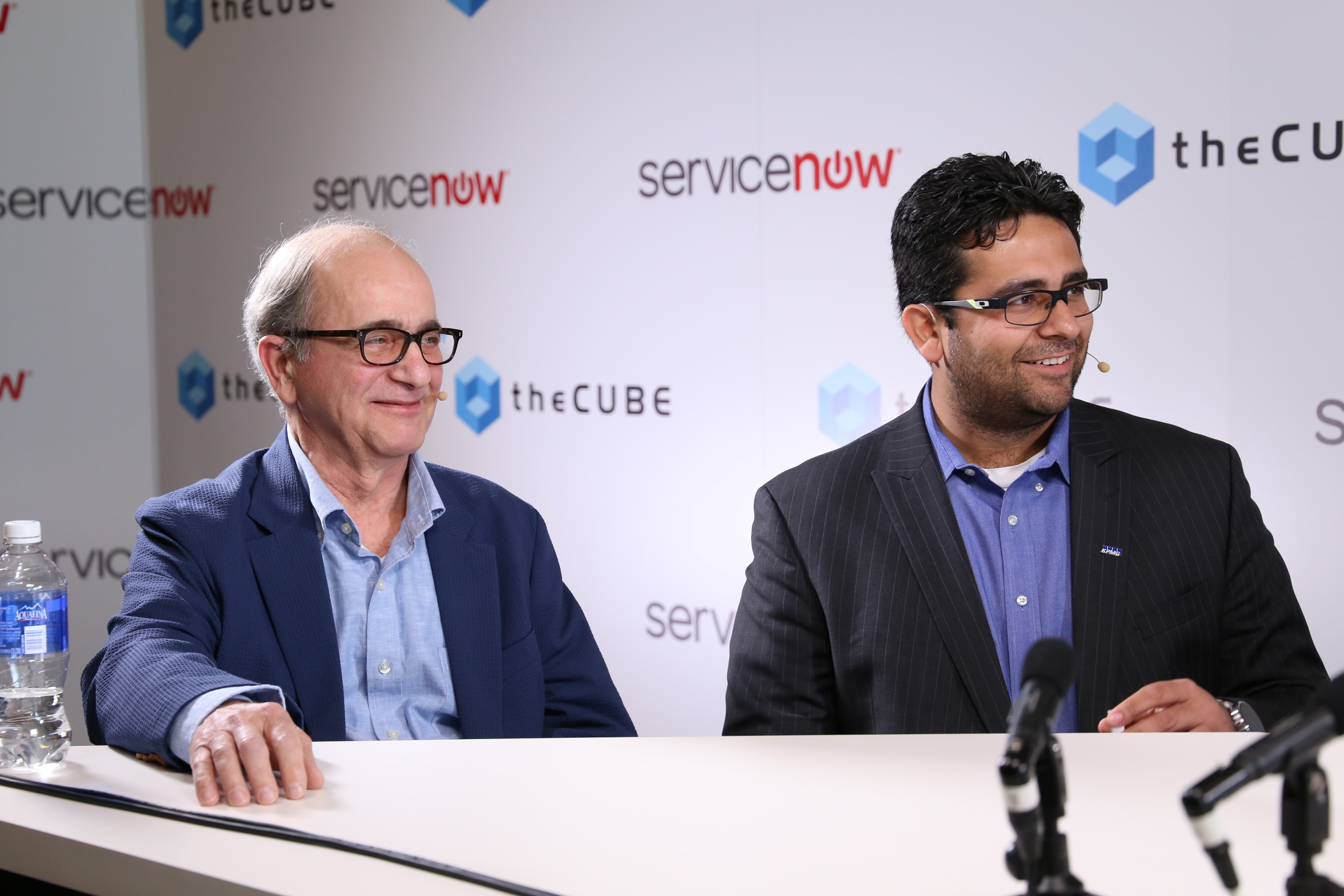
Frank DeSantis, director of service management integration at The Hartford Financial Services Group, Inc., and Saurabh Dubey, director of management consulting at KPMG, LLP, joined Dave Vellante (@dvellante) and Jeff Frick (@JeffFrick), cohosts of theCUBE, from the SiliconANGLE Media team, to talk about their implementation of ServiceNow at The Hartford, how it altered its operations and what they feel ServiceNow can do to expand its appeal.
The Hartford, described by DeSantis as an insurance company that was “very conservative” when it came to IT adjustments, was initially drawn to ServiceNow by interest in its improved functionality. Though it had attempted to draw upon ServiceNow in the days before it became a publicly traded company, it wasn’t until after that change was made that the adoption of its services could be approved by The Hartford’s higher-ups.
“They talked about customer experience,” DeSantis said of ServiceNow, “[which] was very low with the product we were replacing. So it was easy to bring in ServiceNow, because all of the users were very frustrated with the old technology. So we did a lot of demos and got people excited about the new tools, and so that’s how we made the decision and implemented it.”
In comparing the service to its predecessor, DeSantis had only words of praise. “We were very mature in our process structure, which gave us the ability to move faster. But we were stuck with the old technology because we could only go so far,” he described. “So even though we knew what our ideal process was, we couldn’t implement it in the old technology. And that was one of the dramatic improvements moving to ServiceNow.”
“We found considerably more savings than we expected from a soft perspective,” DeSantis noted, “but it’s very hard to tie that to dollars.” Apart from that big benefit, there were obstacles in the wholesale adoption, with one standing out above all the rest: “We literally had to train, at different levels, all 30,000 employees [to use the new system].”
But this change was one that became easier with time, as Dubey described: “Once the first big bang happens, then the approach becomes more of a hybrid/agile, because at that point, you’re starting to request your incremental updates. The new enhancements coming in start falling in that cycle. The first big bang, because of the scenario that we had, had to be done in an integrated fashion.”
Once the major hurdles were cleared, DeSantis said, the rewards were fantastic. “We [now] have a nightly feed into ServiceNow, where we take those applications and we create different environments and relay them to the infrastructure. And then we connect it on the back-end and it goes directly into finance for monthly charge-backs. So we’ve integrated the front-end and the back-end, but by doing that within ServiceNow, we also can track incidents against applications, incidents against service, and not just infrastructure.”
This end-to-end functionality, DeSantis feels, is something that ServiceNow could be doing a better job of advertising to draw in a new client base, while Dubey felt that the changes in that base were already taking place: “I think we’re seeing that evolution … it’s almost like the ownership off the platform, ownership of ServiceNow inside organizations, moves from the ITSM group to the platform group. … We’re starting to see that turn happen.”
Watch the full interview below, and be sure to check out more of SiliconANGLE and theCUBE’s coverage of ServiceNow Knowledge16.
Support our mission to keep content open and free by engaging with theCUBE community. Join theCUBE’s Alumni Trust Network, where technology leaders connect, share intelligence and create opportunities.
Founded by tech visionaries John Furrier and Dave Vellante, SiliconANGLE Media has built a dynamic ecosystem of industry-leading digital media brands that reach 15+ million elite tech professionals. Our new proprietary theCUBE AI Video Cloud is breaking ground in audience interaction, leveraging theCUBEai.com neural network to help technology companies make data-driven decisions and stay at the forefront of industry conversations.