 EMERGING TECH
EMERGING TECH
EMERGING TECH


EMERGING TECH

With great power comes great responsibility: That was the gist of a set of principles for artificial intelligence development laid forth by IBM Corp. Chief Executive Ginni Rometty on Tuesday.
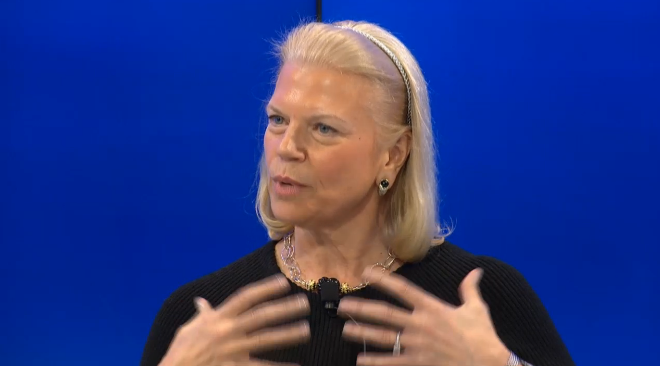
Rometty (pictured) has made AI, or what IBM calls cognitive computing, the centerpiece of the tech giant’s attempt to recharge its growth. In a panel discussion at the World Economic Forum in Davos, Switzerland, she made the mostly optimistic case that AI, intelligently used, will be the foundation of the fourth industrial revolution.
On the panel with Rometty were Ron Gutman, an entrepreneur whose relation to AI is based mostly on how it will transform healthcare, along with Joi Ito, head of MIT’s media lab and leading spokesperson on AI ethics, and Microsoft CEO Satya Nadella. But Rometty made perhaps the biggest splash, issuing a set of three principles that she called “Principles for the Cognitive Era.”
One is “purpose,” a need to define AI’s role in society given that many people are worried about how many jobs are being replaced by computers and whether there will be any jobs left for people ultimately. In what has become a familiar refrain among many tech companies working on AI, Rometty explicitly said AI is intended to augment human intelligence, not replace it.
“It will be a symbiotic relationship,” she said, “Our purpose is to augment, and really, be in service of what humans do.”
Rometty also offered some relief to consumers of future doom theories, saying that AI was not about to become super-intelligent and so won’t — in the words of technology philosopher Nick Bostrom — wipe extraneous human plebes from the planet.
“The human needs to remain in control of the system,” Rometty said. People should always know when they are interacting with AI and how it got trained and understand that we can always “pull the plug.”
She later pointed out that new jobs throughout history have arrived when there has been a “dislocation of technology.” There will be a new workforce, not blue collar, or white collar, she said, but “new collar.”
The second principle is “transparency,” a promise to disclose the purpose of AI-driven technologies, how the data that power them will be used and who will own that data.
And third is skills. IBM pledged to “work to help students, workers and citizens acquire the skills and knowledge to engage safely, securely and effectively in a relationship with cognitive systems, and to perform the new kinds of work and jobs that will emerge in a cognitive economy.” Rometty said industries and education must immediately prepare for people’s new collaboration with machines.
IBM is far from alone among tech companies, various of which have joined together in the past year to come up with ethical frameworks for AI. In September, IBM, Facebook Inc., Microsoft Corp., Amazon.com Inc. and Google Inc. announced a Partnership on AI, to devise best practices for development of AI technologies. And this month, the MIT Media Lab and the Berkman Klein Center for Internet and Society at Harvard University announced a $27 million Ethics and Governance of Artificial Intelligence Fund to fund ethical AI work.
Support our mission to keep content open and free by engaging with theCUBE community. Join theCUBE’s Alumni Trust Network, where technology leaders connect, share intelligence and create opportunities.
Founded by tech visionaries John Furrier and Dave Vellante, SiliconANGLE Media has built a dynamic ecosystem of industry-leading digital media brands that reach 15+ million elite tech professionals. Our new proprietary theCUBE AI Video Cloud is breaking ground in audience interaction, leveraging theCUBEai.com neural network to help technology companies make data-driven decisions and stay at the forefront of industry conversations.