
 CLOUD
CLOUD
CLOUD
CLOUD
CLOUD

Like other web giants, Google LLC is investing a lot of resources into recruiting artificial intelligence researchers. Improving its developer services is one of the ways in which the company has been putting that talent to use.
Today, the Alphabet Inc. subsidiary released two new features for the Google Cloud Natural Language application programming interface to help customers extract more value from their text-based content. The first is a classification mechanism that can be used to automatically organize content by category. More than 700 labels are supported on launch.
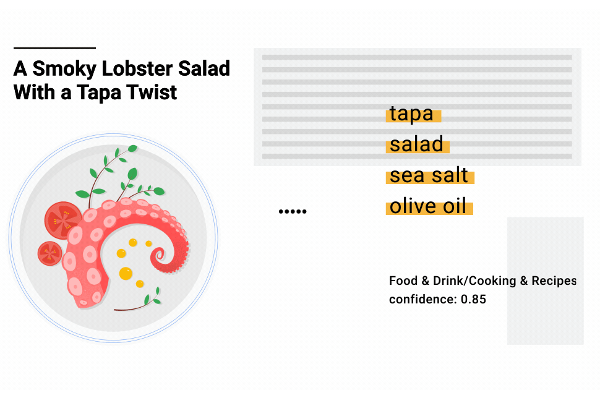
In a blog post, Google product manager Apoorv Saxena detailed that his team used the feature on a recent cooking column on the New York Times as part of an internal test. The service not only filed the article under “Cooking & Recipes,” but also correctly deduced that it belongs to the “Meat & Seafood” subcategory.
A publisher might employ the classification mechanism to organize articles in a way that can make it easier for staff to find relevant content. Brands could use it to sort their social media communications and check what type of post resonates the most with consumers.
Companies interested in the latter kind of use case also stand to benefit from the other enhancement that Google rolled out today. It applies to the Natural Language API’s sentiment analysis capabilities. According to Saxena’s blog post, the service can now identify not only the overall tone of a sentence or block of text but also the attitude expressed toward a specific object.
The feature can be used to identify how consumers feel about a product or company. One of the first brands to have put it to use is Motorola Mobility, which was at one point a part of Google. The search giant sold the smartphone maker to Lenovo Group Ltd. for $2.9 billion in 2014.
Besides its cloud platform, Google has also been working to improve the natural language processing capabilities of other products. In July, for instance, the company released a natural language query feature for Google Analytics to make traffic reports more easily accessible.
John Giannandrea, senior vice president of engineering at Google and head of its AI work, said today that language understanding is the most important thing he’s working on. “Today computers can’t read,” he said today at the TechCrunch Disrupt conference in San Francisco. “So progress in that area is something I’m really excited about.”
With reporting from Robert Hof
Support our mission to keep content open and free by engaging with theCUBE community. Join theCUBE’s Alumni Trust Network, where technology leaders connect, share intelligence and create opportunities.
Founded by tech visionaries John Furrier and Dave Vellante, SiliconANGLE Media has built a dynamic ecosystem of industry-leading digital media brands that reach 15+ million elite tech professionals. Our new proprietary theCUBE AI Video Cloud is breaking ground in audience interaction, leveraging theCUBEai.com neural network to help technology companies make data-driven decisions and stay at the forefront of industry conversations.