

 WOMEN IN TECH
WOMEN IN TECH
WOMEN IN TECH

WOMEN IN TECH

What is it about women who not only nab jobs but achieve excellence in technology? Silicon Valley’s sexist company cultures are practically a meme thanks to the stream of corroborating headlines. For women techies to advance despite this, they must be one-in-a-million mega STEM wonders, right? One winner at the CloudNOW 6th Annual Top 10 Women in Cloud Innovation Awards begs to differ.
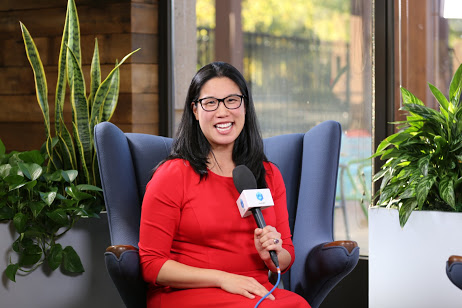
“I don’t think there’s anything so special about any of the women that won awards tonight,” said Caroline Wong (pictured), vice president of security strategy at Cobalt Labs Inc. In fact, most of the award winners are not extraordinary in anyway, nor did they overcome any extreme barriers to success, she added.
Wong spoke with Lisa Martin (@LuccaZara), host of theCUBE, SiliconANGLE Media’s mobile livestreaming studio, during the award ceremony in Mountain View, California.
This week, theCUBE spotlights Caroline Wong, along with five other CloudNOW Women in Cloud Innovation Award winners, in our Women in Tech feature.
Watch the complete video interview with Wong below:
Wong did not come into the world with any special yearning to engineer things. “When I was 16 years old, my dad asked me what I wanted to study in college, and I told him dance or psychology,” she said.
Wong’s father had other ideas; he insisted that his daughter study engineering at the very best institution that would admit her. And so it went — Wong studied electrical engineering at the University of California at Berkeley. Though she struggled with the curriculum, she’s glad for her background in technology and the opportunities it affords her.
Wong also found herself in “information security” through a series of circumstances that had little to do with passionate pursuit. “At the time, I didn’t even know what that meant. The night before my interview, I looked up ‘information security’ on Wikipedia, and I memorized the definition.”
Her winding route into tech shows that the field is accessible to others who may doubt so, Wong stated. There are probably lots of women who could be working in high-earning tech jobs today, she believes. So why aren’t they?
In 2015, 66 percent of tech startups had no female board members; the number climbed to 70 percent in 2017, according to a Silicon Valley Bank report. The overall information technology workforce is 24 percent female today and will dip to 22 percent by 2025, according to a report from Girls Who Code and Accenture PLC.
The picture of women evaporating from tech causes a squint given the rise of diversity and inclusion initiatives at tech companies. Those diversity reports from the likes of Google LLC and Twitter Inc. do not stack up to equal gender representation. “Transparency is good, but ‘diversity as performance art’ is not — and diversity reports are part of it,” saif engineer Cate Huston on Wired.com.
There have been more earnest efforts to recruit women into tech, some government-backed, such as the recently launched TechWomen, from the U.S. Department of State’s Bureau of Educational and Cultural Affairs. Yet despite these efforts, female representation is backsliding.
Explanations for disparity are, of course, all over the map. CloudNOW awardee Erica Windisch, co-founder and chief technology officer at IOpipe Inc., spoke to theCUBE about her own startup’s unusually diverse makeup. “Part of that is that we started very diverse,” Windisch said.
Roughly half of IOpipes’ nine-person staff are underrepresented in some aspect. Lots of company heads say that the natural process of hiring within the company’s network perpetuates homogeneity, Windisch explained. By the same token, since IOpipe started out diverse, hiring within network keeps it diverse.
“That organic hiring growth can be problematic if you don’t start in a very diverse place,” she said.
Watch the complete video interview with Windisch below:
Windisch, who began teaching herself about technology in grade school, is transgender. “The fact that I was recognized as a woman — top 10 women in cloud computing — was extra important and special for me,” she said.
An organic approach (or non-approach) to gender representation is the one ingredient in Netflix Inc.’s lauded workplace culture. The company overall is 41 percent female, 59 percent male. Its technology department is 27 percent women and 73 percent men, while the creative and corporate wing is 57 percent women and 43 percent men.
Tracy Wright, director of global content operations at Netflix, recently spoke to Forbes about female employees’ relative happiness within the company. Perhaps surprisingly, the company does not satisfy female staff with a laundry list of gender-specific programs.
“We don’t have formal programs,” she said. Instead, the environment naturally gives everyone clearance to rise and get ahead. The company urges all employees to speak up with ideas and opinions for improving the company.
Hiring at the company is built to give all applicants — not just the “cookie-cutter” ones — a fair shake, Wright said. “Often a lot of what we’re doing here at Netflix is new. So you’re not always going to find somebody who could just come in and do, because it hasn’t been done before. And so, we really do say, who are the people, internally or externally, who we think have that potential to come in and do a great job?” she said.
Several CloudNOW awardees noted that they often fold seemingly unrelated, past experience into their work in technology.
“What I spend most of my time doing is connecting the dots and saying, ‘Oh this technology can be applied here or these two technologies can work together. Have you ever thought of that?'” said Beth Cohen, cloud technology strategist at Verizon Communications Inc.
Cohen’s C.V. spans studying architecture at Rhode Island School of Design to cooking at a French restaurant in Philadelphia. She learned different aspects of creativity and critical thinking from all of it, she told theCUBE. “There’s no such thing as wasted time,” she said.
Neha Jain, senior software engineer at LinkedIn Corp., initially wanted to become a doctor, until hemophobia halted that plan. Then her knack for math led her to engineering, but her humanitarian instinct remained. Jain found herself at LinkedIn where she empowers people around the globe to network and build their careers. Unlike some previous roles, Jain’s job at LinkedIn allows her to measure impact, she explained.
“I’m sort of a person who is driven more by results, by metrics,” she said.
Bridget Kromhout, principal cloud developer advocate at Microsoft Corp., had no yen for STEM until a single class changed her career course. “I didn’t know I would major in computer science until I took a programming class and realized I loved it and dropped all my other classes and completely switched my major,” she told theCUBE.
It is surprising how often her tech career calls for skills she did not learn in computer science, however. “I majored in computer science, because I didn’t want to talk to people, and, oops, turns out software’s made of people,” she said. Getting companies to adopt new cloud computing methods may require lots of employees to talk out their aversion to change, she explained.
A single encounter with coding changes minds and molds careers all the time, according to Alice Steinglass, president of Code.org. Hour of Code — which is one aspect of Code.org’s approach to computer science education — is a little like speed dating for prospective programmers; students can give it a chance without commitment. The one-hour tutorial is geared for all ages and taught in 45 languages.
“Most students who do the hour of code go beyond the hour of code,” Steinglass said, noting that high school girls show the sharpest increase in interest.
Watch the complete video interview with Steinglass below:
Was Wong being modest when she said tech innovators like herself are nothing special? Perhaps, but basic tech training should be standard, Steinglass believes, whether it creates a future CloudNOW winner or not.
“Knowing how computer science works, I think, is a critical set of skills for all people everywhere in this day and age,” Steinglass concluded.
Be sure to check out more of SiliconANGLE’s and theCUBE’s coverage of the CloudNOW 6th Annual Top 10 Women in Cloud Innovation Awards.
Support our mission to keep content open and free by engaging with theCUBE community. Join theCUBE’s Alumni Trust Network, where technology leaders connect, share intelligence and create opportunities.
Founded by tech visionaries John Furrier and Dave Vellante, SiliconANGLE Media has built a dynamic ecosystem of industry-leading digital media brands that reach 15+ million elite tech professionals. Our new proprietary theCUBE AI Video Cloud is breaking ground in audience interaction, leveraging theCUBEai.com neural network to help technology companies make data-driven decisions and stay at the forefront of industry conversations.