




 POLICY
POLICY
POLICY
POLICY

Readers of some U.S. news media in Europe found that after the General Data Protection Regulation came into effect some sites denied them access.
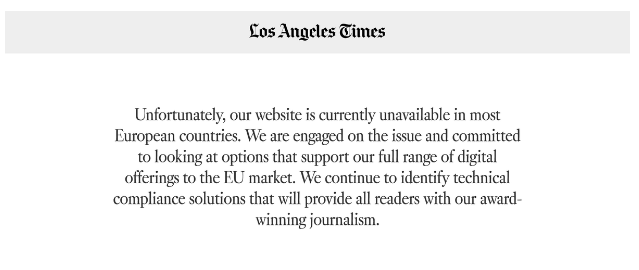
Some big names were affected, including the Los Angeles Times, the Chicago Tribune, the Orlando Sentinel, the New York Daily News and the Baltimore Sun. Instead of news, readers were faced with a “currently unavailable” page.
“We are engaged on the issue and committed to looking at options that support our full range of digital offerings to the EU market,” was the notice on some websites. “We continue to identify technical compliance solutions that will provide all readers with award-winning journalism.”
Tronc and Lee Enterprises publishing houses own most of the news media that was unavailable. Tronc is the U.S.’s third-largest newspaper publisher and owns all of the media mentioned and many more smaller news outlets. Lee Enterprises owns 46 local news media across 21 states in the U.S.
Some of the most widely read U.S. media in Europe such as the New York Times and CNN were not affected, while big hitters such as Time and the Washington Post had to set new terms that European readers had to agree to if they wanted access. NPR took it a step further, offering readers a plain-text version of the site.
Other media seems to have impressed readers with the changes made, even if it’s not clear the changes are sustainable. “The GDPR-compliant version of the USA Today website is so much better than the normal version it’s unreal,” tweeted tech writer at The Guardian, Alex Hern. “Ad free, no auto-playing video, crisp clean design.”
Under the GDPR guidelines, all companies must be transparent about what data they collect on users and how that data is used. A violation could lead to a fine of up to 4 percent of the company’s global annual turnover or a straight 20 million euro ($23.4 million) fine.
Facebook Inc. and Google Inc. have already been hit with lawsuits over alleged GDPR violations. Noyb, a European non-profit that is leading this charge, accused Facebook of “forced consent,” which in a nutshell means users are given a “like it or leave it” scenario when signing terms of services agreements.
However, other impacts of GDPR may only end up cementing Google’s and Facebook’s dominance in online advertising. According to a report in Digiday, so-called programmatic or automated advertising, the way most online ads are delivered today, plummeted over the weekend in Europe because it was uncertain that the automated systems complied with GDPR.
Support our mission to keep content open and free by engaging with theCUBE community. Join theCUBE’s Alumni Trust Network, where technology leaders connect, share intelligence and create opportunities.
Founded by tech visionaries John Furrier and Dave Vellante, SiliconANGLE Media has built a dynamic ecosystem of industry-leading digital media brands that reach 15+ million elite tech professionals. Our new proprietary theCUBE AI Video Cloud is breaking ground in audience interaction, leveraging theCUBEai.com neural network to help technology companies make data-driven decisions and stay at the forefront of industry conversations.