
 INFRA
INFRA
INFRA
INFRA

INFRA

Nowhere does digital transformation earn its name better than in healthcare, a field where better patient care and employee efficiency can literally make the difference between life and death. But transitioning convoluted computing systems is a huge undertaking, especially for large networks spread over many locations.
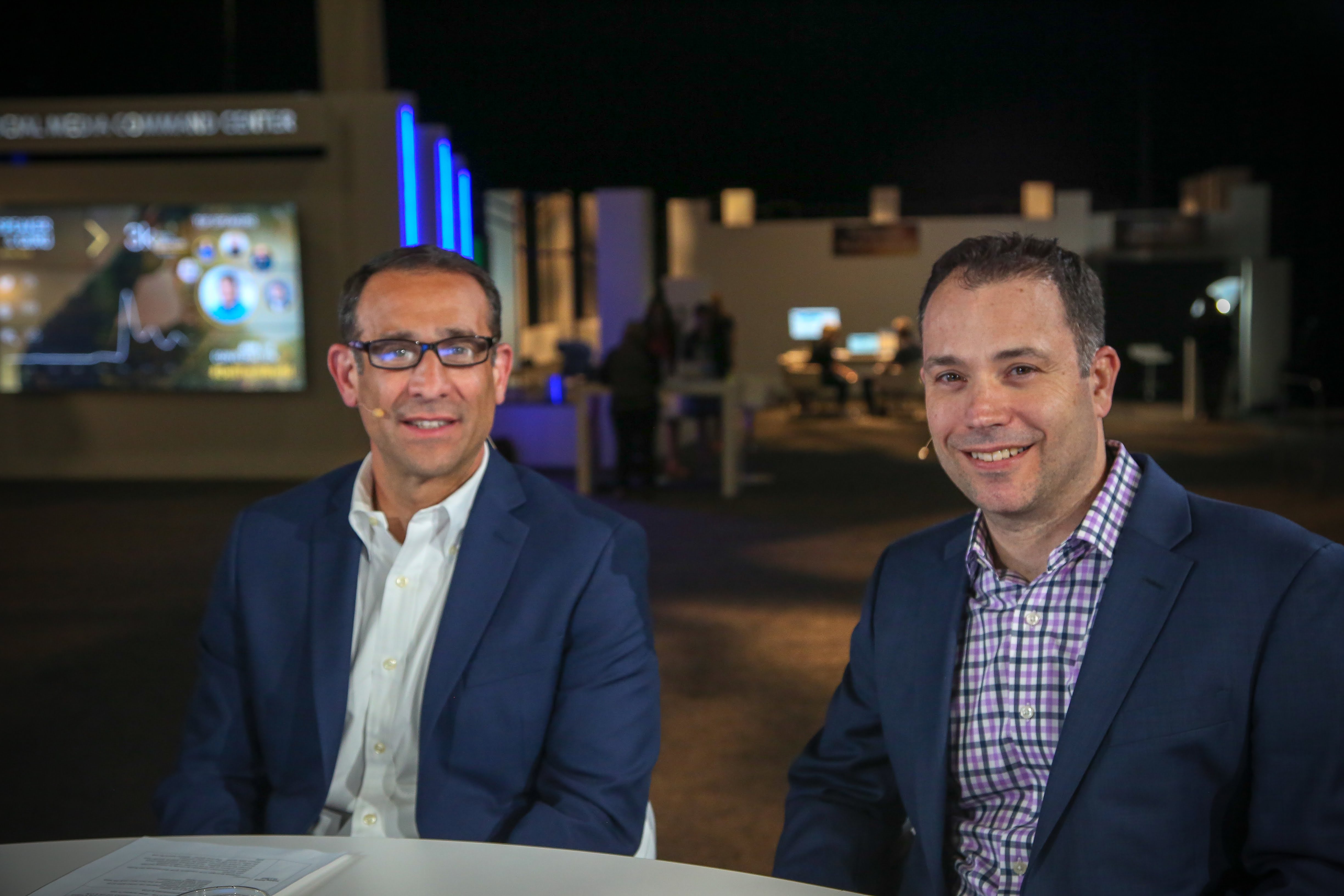
“We are a seven-hospital system with seven data centers managed by seven different [information technology] organizations,” John Grieco (pictured, left), vice president and chief technology officer of the University of Vermont Health Network. “What we’re trying to do is really simplify and standardize everything we do; consolidate and centralize our data centers.”
Grieco was joined by Jon Siegal (pictured, right), vice president of product marketing at Dell Technologies Inc., for an interview with Stu Miniman (@stu) and John Walls (@JohnWalls21), co-hosts of theCUBE, SiliconANGLE Media’s mobile livestreaming studio, at the Dell Technologies World event in Las Vegas. They discussed the UVM health network’s digital transformation. (* Disclosure below.)
The focus of Dell EMC’s infrastructure solutions portfolio has always been on simplifying workflow for the customer. “Seven or eight years ago when we came out with VxBlock … it was about, how do we help customers get out of the infrastructure business day to day, the mundane business,” Siegal said.
Continuing that commitment, Dell EMC are working with the UVM health network to standardize and automate the organization’s workflow. “It’s not just a plug and play,” Siegal said. “Cloud is an operating model, not a place … it’s a combination of technology, how you modernize the infrastructure, but also, what are you doing to actually transform that organization to deliver IT as a service.”
The current system at the UVM health network involves repeating actions, such diagnostic tests, each time the patient is transferred between hospitals. This is costly and inefficient, a problem Grieco wants to address: “We want to make sure that they have the data and are reading that data before the patient’s there, so [we need] the ability to take the image once and read the image while our patient is in transit … so when they arrive at that hospital, we are ready to take on that patient and immediately provide them the care they’re there for,” he said.
UVM is partnering with Dell to make its digital transition smooth and efficient. “[We are] standardizing on a ruthless infrastructure like [Vx]Block, [Vx]Rack and [Vx]Rail, and on top of that, automating everything we do within IT from a workflow perspective,” Grieco explained. “We want to leverage our partners, like Dell Technologies, and their technology, to really run the business for us while our IT is more in the transfer, informative, innovative and growth of that business,” he explained.
The stability and strength of Dell EMC VxBlock protects UVM’s mission-critical workloads, while less critical non-clinical apps leverage the increased flexibility of hyperconvergence. “We’re seeing a lot of those medium to low-end workloads on [Vx]Rack or [Vx]Rail, where we have the ability to really scale out quick, and dynamically with those smaller type applications that are mini in size, where we’re trying to standardize with our clinical ones more on our Block. So really the application requirement drives where that application sits in our environment,” Grieco said.
Grieco’s aim for the UVM health network is to be “one shared service model … working in unison.”
“In essence, we become a dynamic IT shop that I can leverage wherever there’s a need. … Just like the experience we want to give our users, the same look and feel as they travel, we want to do the same for IT. One logical shared service vision of a department that offers services to our hospitals that they consume, all like for like,” Grieco said.
Watch the complete video interview below, and be sure to check out more of SiliconANGLE and theCUBE’s coverage of the Dell Technologies World 2018 event. (* Disclosure: Dell Technologies Inc. sponsored this segment of theCUBE. Neither Dell EMC nor other sponsors have editorial control over content on theCUBE or SiliconANGLE.)
Support our mission to keep content open and free by engaging with theCUBE community. Join theCUBE’s Alumni Trust Network, where technology leaders connect, share intelligence and create opportunities.
Founded by tech visionaries John Furrier and Dave Vellante, SiliconANGLE Media has built a dynamic ecosystem of industry-leading digital media brands that reach 15+ million elite tech professionals. Our new proprietary theCUBE AI Video Cloud is breaking ground in audience interaction, leveraging theCUBEai.com neural network to help technology companies make data-driven decisions and stay at the forefront of industry conversations.