


 CLOUD
CLOUD
CLOUD
CLOUD

CLOUD

Cisco Systems Inc. was king in networking infrastructure. But things changed when the cloud took over and organizations increasingly began moving applications to the cloud. Yet, over time, many businesses took their workloads back to their on-premises environment and implemented a hybrid multicloud ecosystem.
Cisco quickly realized it needed to transform along with the industry, and the company responded by creating an ecosystem of partners to serve this new demand. Through Cisco DevNet, the company is bringing together developers and IT professionals to consult and create applications and integrations for Cisco products and APIs. Cisco and its DevNet partner Presidio Inc., an IT solutions provider, are creating network automation aimed at unlocking new capabilities on the network.
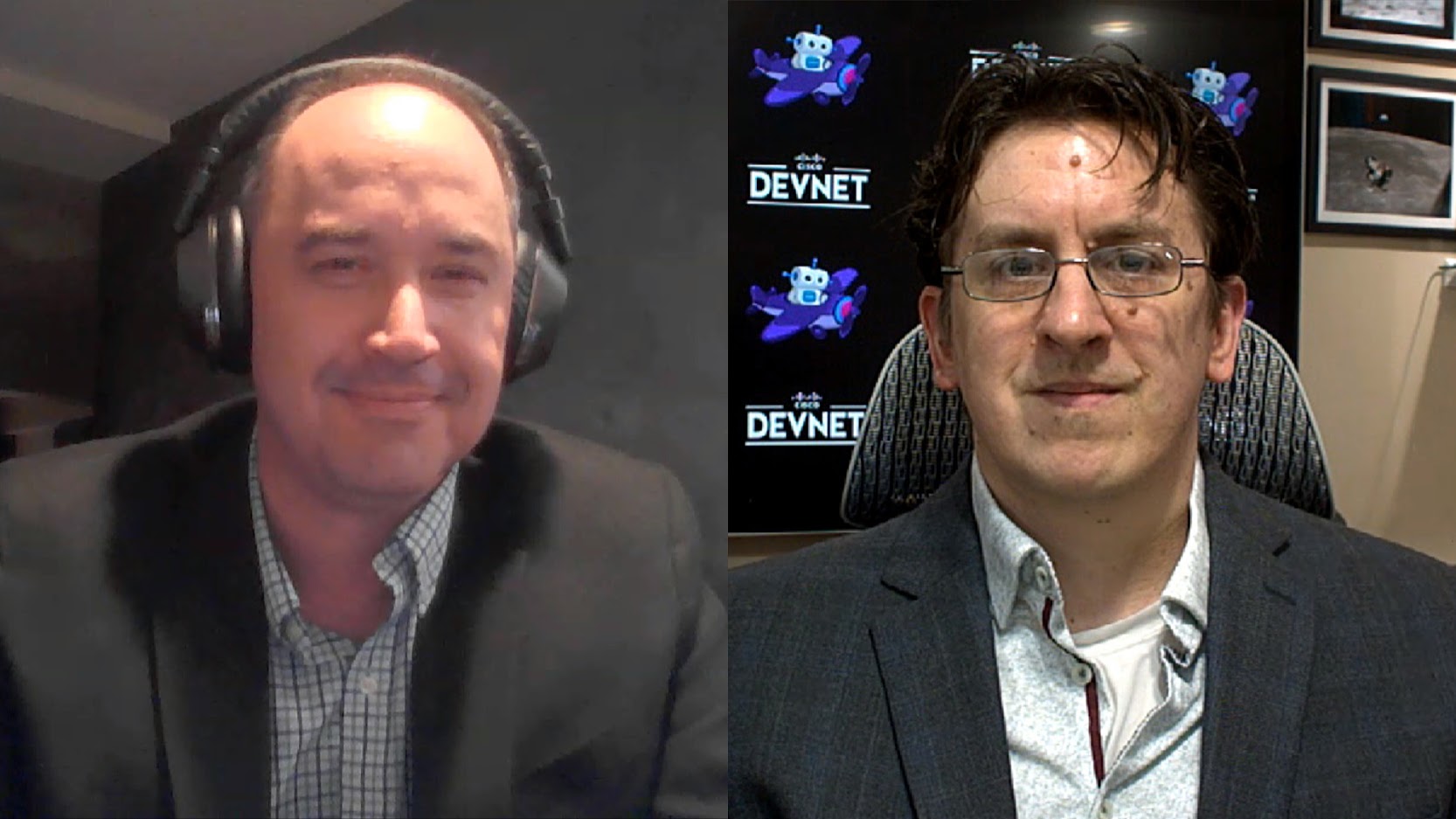
Brad Haas (pictured, left), director of cloud, automation and development at Presidio, and Chuck Stickney (pictured, right), business development architect of Cisco DevNet partner transformation at Cisco Systems, spoke with Jeff Frick, host of theCUBE, SiliconANGLE Media’s livestreaming studio, during the Cisco Accelerating Automation With DevNet event. They discussed DevNet, how businesses are transitioning during COVID-19, cloud migration, software-defined networking, and network automation. (* Disclosure below.)
[Editor’s note: The following has been condensed for clarity.]
Let’s talk about the programs that you guys are putting together and how important it is to have partners to move this whole [software-defined networking] thing forward versus just worrying about people that have Cisco badges.
Stickney: So, along this whole journey of DevNet where we’re trying to leverage that customization and innovation built on top of our Cisco platforms, most of Cisco’s business is transacted through partners. We have some of our partners that have been building these practices going along this step in that journey with us for the last six years. They really want to say, “Hey, how can I differentiate myself against my competitors and give an edge to my customers to show them that, yes, I have these capabilities, I’ve built a business practice, I have technologists that really understand this capability and they have the DevNet certifications to prove it.’
I wonder if, from your perspective, the importance of the network, the importance of security, and the ability now to move into this new normal very quickly … you guys were pretty much in as good as space as you could be given this new [COVID-19] challenge thrown at you.
Stickney: I think the transition that we’ve seen in the industry as far as moving to that application type of economy, as we go to microservices, as we go to a higher dependency upon the cloud, those things have really enabled the world to be able to better respond to this COVID situation. And I think it’s helped to justify the investments that our customers have made, as well as what our partners have been able to do to deliver on that multicloud capability, to take those applications, get them closer to the end user — instead of sitting in a common data center — and then making it more applicable to users wherever they may be.
Even though you guys are both in the business of networking and infrastructure, there’s still this recognition that apps first is the way to go because that gives people a competitive advantage. It gives them the ability to react in the marketplace and to innovate and move faster. So, it’s a really interesting twist to be able to support an application first by having a software-defined in a more programmable infrastructure stack.
Haas: What defines an application right now, especially with the whole move to cloud native and microservices, and the automation that helps make that all happen? With infrastructure as code, you’re now able to bundle the infrastructure with those applications together as a single unit. So when you define that application as the infrastructure’s code, the application in the definition of what those software assets for the infrastructure are, all are wrapped together. And you’ve got change control, version control, and it’s all automated. It’s a beautiful thing.
Could speak about automation, because there’s just too much stuff going on for individual people to keep track of, and they shouldn’t be keeping track of it because they need to be focusing on the important stuff, not this increasing amount of bandwidth and traffic going through the network.
Stickney: So, the bandwidth is necessary in order to support everybody working from home, to support this video conference. We used to do this sitting face to face; now we’re doing this over the internet. The number of people necessary to be able to facilitate that type of traffic if we were doing it the way we did 10 years ago, we would not scale. It’s automation that makes that possible, that allows us to look higher up, the ability to do that automatic provisioning. Now that we’re in microservices, now that everything is cloud native, we have the ability to better adjust to and adapt to changes that happen with the infrastructure below hand.
There are a lot of opinions about what is multicloud, what is hybrid cloud? How are you helping people navigate through that? And what does having programmable infrastructure enable you to do for helping customers.
Haas: Those applications are becoming much more complex than they used to be because we’re breaking them apart into different services. Those services could live all over the place. So with automation, we’re really gaining the power of being able to combine those things as I mentioned earlier. Those resources, wherever they are, can be defined in that infrastructure’s code and automation.
But, you know, aside from provisioning … when we talk about automation, we also have these amazing capabilities on the side of operations too. Like we’ve got streaming telemetry and the ability to gain insights into what’s going on in ways that we didn’t have before, or at least in the early days of monitoring software. So, the observability factor is a huge thing that I think everybody should be paying attention to moving forward with regards to when you’re moving things to the cloud or even to other data centers or in your premise. Breaking that into microservices you really need to understand what’s going on in the programmability and APIs.
Chuck … there was something that you said in another interview, about DevNet really opening up a whole different class of partners for Cisco as really more of a software lead versus kind of the traditional networking lead. I wonder if you can put a little more color on that.
Stickney: What we’re doing with the DevNet specialization gives us the ability to bring those partners into the ecosystem and share them with our extremely large DevNet community so they can get access to those potential customers. But also it allows us to do a partner-to-partner type of integration.
So Brad and Presidio, they built a fantastic network. They always have a fantastic networking business, but they’ve built this fantastic automation business that’s there. But they may come into a scenario where it’s working with a vertical or working with the technology piece that they may not have an automation practice for. We can leverage some of these software-specific partners to come in there and do a joint go-to-market, so they can go where that traditional channel partner can leverage their deep Cisco knowledge and those customer relationships.
Watch the complete video interview below, and be sure to check out more of SiliconANGLE’s and theCUBE’s coverage of the Cisco Accelerating Automation With DevNet event. (* Disclosure: TheCUBE is a paid media partner for the Accelerating Automation With DevNet event. Neither Cisco Systems Inc., the sponsor for theCUBE’s event coverage, nor other sponsors have editorial control over content on theCUBE or SiliconANGLE.)
Support our mission to keep content open and free by engaging with theCUBE community. Join theCUBE’s Alumni Trust Network, where technology leaders connect, share intelligence and create opportunities.
Founded by tech visionaries John Furrier and Dave Vellante, SiliconANGLE Media has built a dynamic ecosystem of industry-leading digital media brands that reach 15+ million elite tech professionals. Our new proprietary theCUBE AI Video Cloud is breaking ground in audience interaction, leveraging theCUBEai.com neural network to help technology companies make data-driven decisions and stay at the forefront of industry conversations.