 AI
AI
AI
AI

AI

App modernization in the age of AI is no longer an option; it has become a competitive requirement.
This is driving a transition away from monolithic systems and legacy databases toward open cloud-native architectures. The result is to place key platforms such as Postgres at the center of the modern data strategy, supporting enterprises looking for extensibility, cost-effectiveness and open-ecosystem innovation.

Experts from AMD, EnterpriseDB, Supermicro and Lightbits Labs talk with theCUBE about app modernization.
AI is creating a need for open standards and major enterprise vendors are positioning their offerings around open platforms such as Postgres and Kubernetes to facilitate the rapid change that AI has brought to the party.
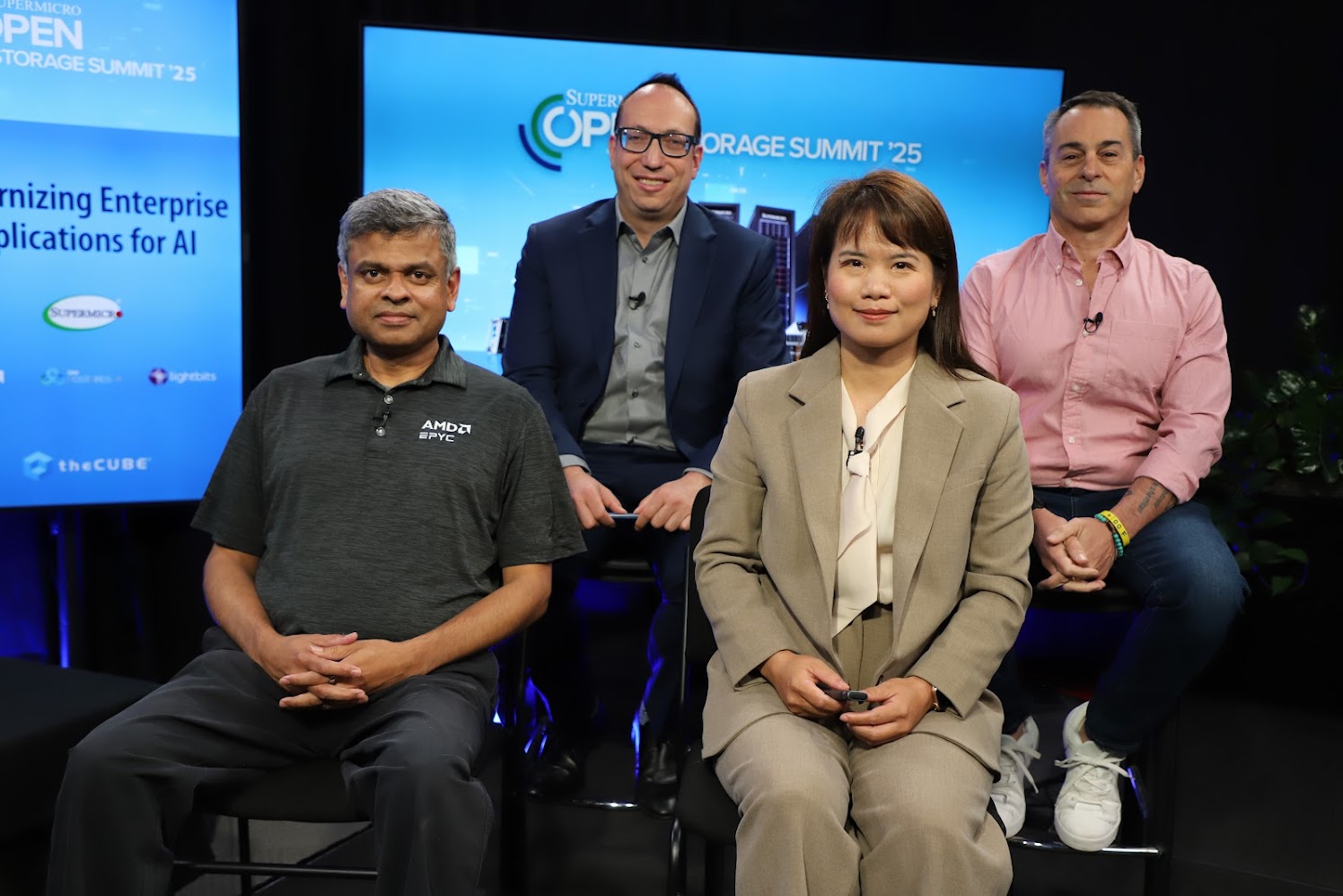
“As a customer, you should be building everything on open standards, and I think that’s one thing that all the vendors here embrace. That’s very important because the technology is going to change and evolve,” said Simon Lightstone (pictured, back row, left) director, technology product manager, at EnterpriseDB Corp. “You have to think how this system is going to go into production quickly. It’s not just about having a toolbox with a bunch of tools in it. How do you actually envision taking these tools and going into production across three nodes in your data center in a way that will finally deliver that ultimate business result?”
Lightstone spoke with theCUBE’s Rob Strechay at the Supermicro Open Storage Summit, during an exclusive broadcast on theCUBE, SiliconANGLE Media’s livestreaming studio. He was joined by Shiva Gurumurthy (front row, left), global partner marketing manager of database and analytics at Advanced Micro Devices Inc.; Junxia Zhou (front row, right), product manager at Supermicro Computer Inc.; and Sagy Volkov (back row, right), distinguished performance architect at Lightbits Labs Inc., and they discussed how support from platforms such as Postgres and Kubernetes are delivering the next generation of enterprise applications. (* Disclosure below.)
To harness the potential of AI-driven applications, organizations are reevaluating how to deliver performance at every layer of the stack. This has elevated the role of high-performance block storage, which can enable low latency and high throughput access for transaction dense Postgres workloads.
An example of this can be found in Lightbits Labs, which has positioned itself in block storage-as-a-service using a software-defined approach with ultra-low latency and high throughput storage for databases and analytics. Using cloud-native EDB Postgres and AMD CPUs on Supermicro’s X-14 platform, Lightbits was able to demonstrate significant throughput across three work nodes.
“We’re looking at close to a million transactions per second of read-only; we’re looking at about 700,000 transactions per second from 12 clusters of EDB for a 90% read, 10% write,” Volkov said. “These are massive numbers. That means, basically, that you can use this platform to consume all these IOs, play with how many Postgres databases you want to actually have, and also even use it in an environment where there’s multiple customers using the same environment.”
This level of efficiency can have a meaningful effect on the customer side. An integrated stack of hardware and software to run Postgres and AI workloads can help users realize savings in energy costs and the ever-increasing expense of building out data center capacity.
“What does it really mean to a customer?” Gurumurthy asked. “It means better performance, faster throughput, yes, correct. But really what it means is that customers can now achieve more with less footprint, both in terms of energy and also in terms of data center space. That tremendously improves or makes them compliant with a lot of those energy budgets or regulations that would be affecting their bottom line.”
Beyond Postgres to enable high-throughput workload access, IT vendors are also working to support AI inference and transaction processing for real-world use cases. This is where container orchestration tools such as Kubernetes can play an increasingly important role as enterprises re-platform applications to be more portable and scalable.
“We spend a lot of time making sure that all the components work together,” Lightstone noted. “We provide full lifecycle support for security updates, for major version updates, not just to the Postgres software, but to every component inside the stack, including Open Shift Kubernetes … which, of course, means that customers don’t need to have 24-hour staffing of Kubernetes specialists around the clock.”
The end result is that key enterprise IT vendors are adapting to a new world where AI has fundamentally transformed the way that businesses approach compute infrastructure. For Supermicro, this means staying on top of key trends that are driving the process of app modernization.
“The AI evolution is driving the high demand for optimized hardware, especially for inference and real-time applications, which requires high-performance for compute, networking, storage,” Zhou said. “Enterprises want an end-to-end AI infrastructure. A solution can simplify the deployment, no matter if it is on-premises, in hybrid environments or the cloud.”
Here’s the complete video interview, part of SiliconANGLE’s and theCUBE’s coverage of the Supermicro Open Storage Summit:
(* Disclosure: TheCUBE is a paid media partner for the Supermicro Open Storage Summit. Neither Super Micro Computer Inc., the sponsor of theCUBE’s event coverage, nor other sponsors have editorial control over content on theCUBE or SiliconANGLE.)
Support our mission to keep content open and free by engaging with theCUBE community. Join theCUBE’s Alumni Trust Network, where technology leaders connect, share intelligence and create opportunities.
Founded by tech visionaries John Furrier and Dave Vellante, SiliconANGLE Media has built a dynamic ecosystem of industry-leading digital media brands that reach 15+ million elite tech professionals. Our new proprietary theCUBE AI Video Cloud is breaking ground in audience interaction, leveraging theCUBEai.com neural network to help technology companies make data-driven decisions and stay at the forefront of industry conversations.