
 AI
AI
AI
AI

AI

The next wave of artificial intelligence is driving a major transformation in how organizations operate and create value. Across industries, businesses are embracing agentic AI enterprise automation and prioritizing cultural adaptation to successfully navigate the evolving AI landscape.
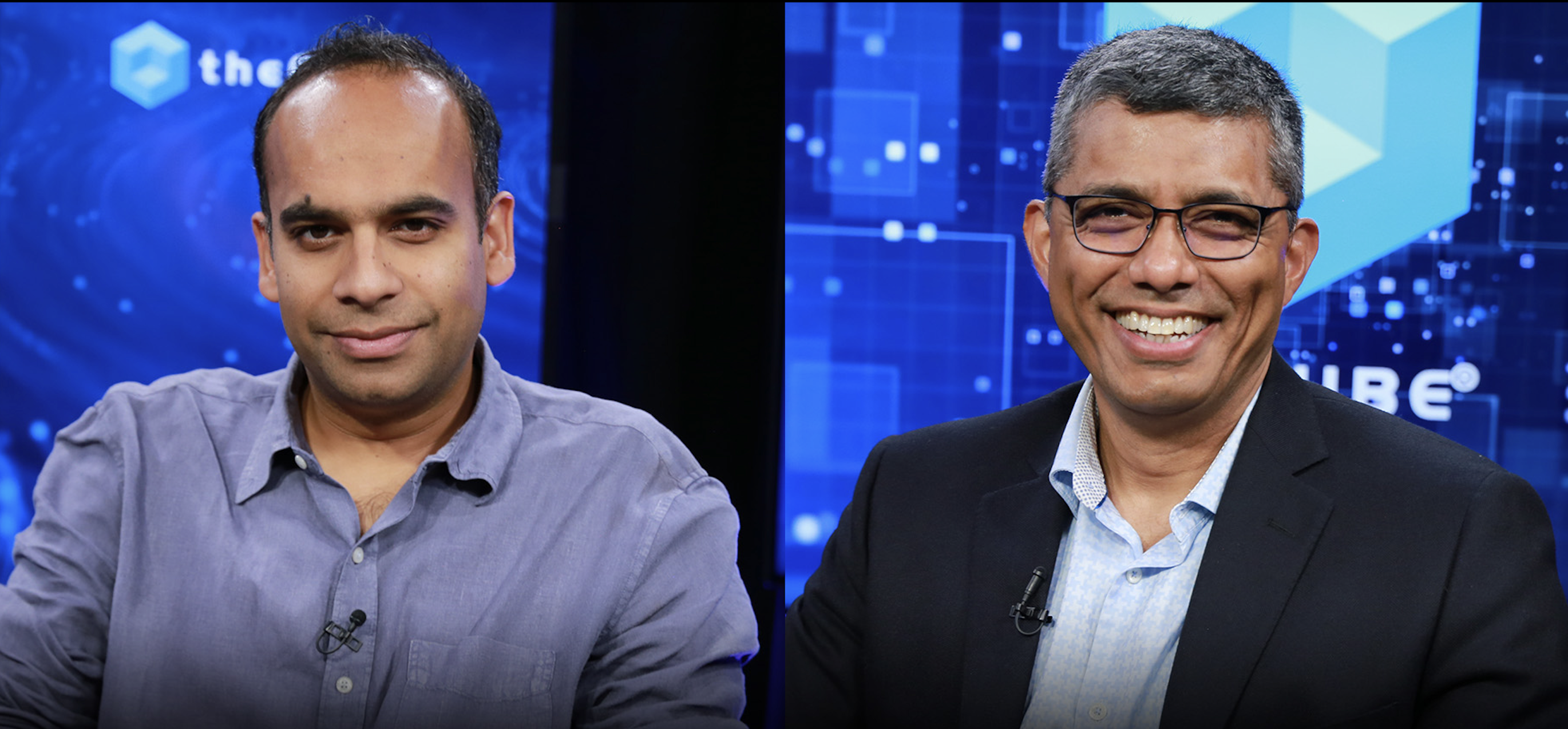
The past year has seen AI agents evolve from concept to reality, fueled by rapid advances in processing power and adoption. These systems are now delivering tangible returns and driving productivity, according to Clive D’Souza (pictured, right), director and head of partner engineering at Google Cloud.
PwC’s Vikas Agarwal and Google Cloud’s Clive D’Souza talk with theCUBE about agentic AI enterprise automation and partner ecosystems.
“Unlike [looking for] the fastest [large language model] or the fastest compute, we are seeing customers fundamentally shift their choice of a cloud services partner,” he said. “They’re going for a platform which is giving them complete integration from top to bottom, which is very domain-specific, as opposed to just giving me an LLM-specific, task-specific commodity compute. That’s where we are seeing the shift happen, and it’s happening very, very fast.”
D’Souza and Vikas Agarwal (left), chief technology and innovation officer of PwC Advisory at PwC U.S., spoke with theCUBE’s Rebecca Knight for the Google Cloud Partner AI Series event, during an exclusive broadcast on theCUBE, SiliconANGLE Media’s livestreaming studio. They discussed agentic AI enterprise automation and the growing role of partnerships in driving real-world business outcomes. (* Disclosure below.)
When enterprises move from experimentation to scale, isolated pilots tend to break at the integration points — siloed data, disconnected workflows and unclear platform ownership. Programs that succeed treat AI as a team sport instead, D’Souza explained.
“It’s all about orchestration and not about isolation,” he said. “[As with] all things AI, it’s a data story, and we always go and say that if your data within your entire enterprise data corpus is not integrated, you don’t have a data strategy – you’re going to fail.”
With that integrated backbone in place, the payoff shows up at the workflow layer: Agents can move from merely surfacing insights to taking the next best action across systems. In practice, that means less manual stitching and more end-to-end execution with light human oversight, according to Agarwal.
“[AI agents] can actually go end to end and use thinking and judgment in the steps along the way – with the LLM models in context – to start to automate all those tasks in a very intelligent way,” he said.
In August, PwC announced the launch of more than 120 enterprise AI agents developed with Google Cloud. In an example of how AI agents have delivered real business impact, a call center client significantly reduced its 2,000-person operation by using AI to streamline workflows and boost efficiency, according to Agarwal.
Another compelling example involved a client with 200 paralegals translating state laws into plain English. By deploying AI agents to automate the task, the team was reduced to just 20 while maintaining accuracy and efficiency, according to Agarwal.
“It was an even greater gain,” he said. “But all they were doing was something that with the right context, we were able to back-test. We were able to prove it’s safe.”
Building trust between humans and agents began with transparency — demonstrating that these models aren’t black boxes, but systems with understandable reasoning and logic. That confidence was strengthened by extensive backtesting and simulations that compared machine outputs to human results side by side, according to Agarwal.
“I think it’s an interesting phenomena that we always expect humans to be imperfect and machines to be perfect, and we have to remind people that both are imperfect,” he said. “They’re imperfect in different ways, but I think oftentimes, our testing finds that the machine is less imperfect, even though it can be imperfect at times.”
Here’s the complete video interview, part of SiliconANGLE’s and theCUBE’s coverage of the Google Cloud Partner AI Series event:
(* Disclosure: Google LLC sponsored this segment of theCUBE. Neither Google nor other sponsors have editorial control over content on theCUBE or SiliconANGLE.)
Support our mission to keep content open and free by engaging with theCUBE community. Join theCUBE’s Alumni Trust Network, where technology leaders connect, share intelligence and create opportunities.
Founded by tech visionaries John Furrier and Dave Vellante, SiliconANGLE Media has built a dynamic ecosystem of industry-leading digital media brands that reach 15+ million elite tech professionals. Our new proprietary theCUBE AI Video Cloud is breaking ground in audience interaction, leveraging theCUBEai.com neural network to help technology companies make data-driven decisions and stay at the forefront of industry conversations.