







 POLICY
POLICY
POLICY
POLICY

Anthropic PBC Chief Executive Dario Amodei today lambasted the U.S. government over its recent U-turn on advanced artificial intelligence chip sales to China, slamming the move as a “major mistake” that will result in “incredible national security implications.”
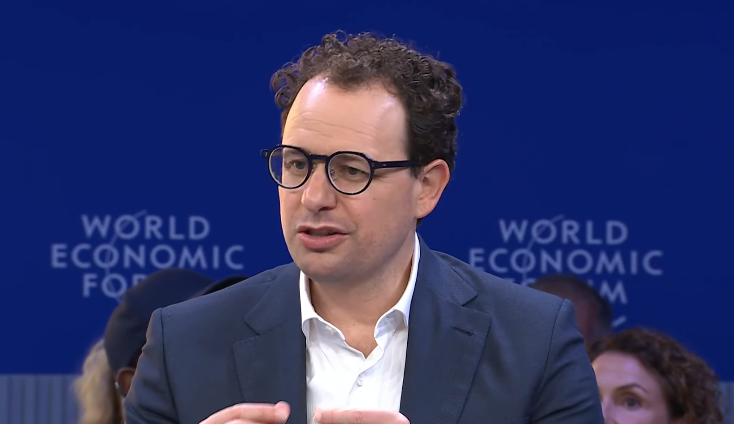
Amodei (pictured), who has a history of making dire warnings about AI’s potential for misuse, was speaking at the World Economic Forum in Davos, Switzerland. His comments come just weeks after President Donald Trump gave Nvidia Corp. the green light to start selling its powerful H200 graphics processing units to Chinese customers. In return, the U.S. government will receive a 25% cut of all revenue generated by the sales.
“We are many years ahead of China in our ability to make chips, so I think it would be a big mistake to ship these chips,” the executive said in front of an audience that included some of the world’s most prominent leaders, CEOs and policymakers. “I think this is crazy. It’s a bit like selling nuclear weapons to North Korea.”
Trump decided to ease the ban on U.S. chipmakers selling more advanced AI processors to China as part of his ongoing trade talks with that country. However, the move represents a significant departure from previous administrations, which implemented the export ban in order to prevent Beijing from developing advanced military technologies and applications. The decision was widely viewed as a significant win for Nvidia, which points to the rapid evolution of China’s domestic chipmaking industry and argues that it will simply build its own alternatives if the ban isn’t revoked.
However, critics argue that giving China access to the chips will cause problems.
Launched more than two years ago, the Nvidia H200 GPU is the most advanced kind of processor that can legally be exported to China under current rules. Nvidia also sells a more advanced GPU in the shape of its Blackwell generation chips, but this is offered only to customers based in the U.S. and allied nations. The chipmaker is also developing an even faster processor known as Vera Rubin, and that will almost certainly be unavailable to China when it launches.
Nvidia’s rival Advanced Micro Devices Inc. is also pushing to be allowed to sell its MI325X chips to China. The MI325X is an alternative to the H200, and offers a similar amount of computing power.
Trump’s decision to lift the export ban on more advanced processors comes at a time when the U.S. and Chinese technology industries are locked in what many perceive to be a “winner-takes-all” battle to develop more powerful AI models. The two countries are racing to achieve “artificial general intelligence,” which is loosely defined as the point where AI exceeds the cognitive capabilities of humans.
Concerns about China’s rapid advances in AI became widespread last year with the emergence of DeepSeek Ltd., whose DeepSeek R-1 model burst onto the scene showing benchmark scores that surpassed those of the leading U.S.-made models at the time, despite being built at just a fraction of the cost.
Amodei is one of a number of critics who say that the Trump administration is shooting itself in the foot by giving China access to superior chips, as semiconductors are one of the few remaining advantages possessed by U.S. AI companies. “The CEOs of these [Chinese] companies say ‘It’s the embargo on chips that’s holding us back.’ They explicitly say this,” he said.
“I hope they change their mind,” he added, calling on the Trump administration to rethink its decision.
Despite his hawkish stance towards China, Amodei has also downplayed the country’s progress in AI. With regard to DeepSeek, he insisted that the R1 model had been “very optimized” to achieve high scores on a “finite list of benchmarks,” and insisted that U.S. models were far superior.
Amodei made similar comments last year, during his first visit to Davos. That’s when he urged the U.S. government to maintain its ban on exports to China, saying he was worried about “1984 scenarios, or worse,” referring to George Orwell’s dystopian novel about totalitarian government.
Support our mission to keep content open and free by engaging with theCUBE community. Join theCUBE’s Alumni Trust Network, where technology leaders connect, share intelligence and create opportunities.
Founded by tech visionaries John Furrier and Dave Vellante, SiliconANGLE Media has built a dynamic ecosystem of industry-leading digital media brands that reach 15+ million elite tech professionals. Our new proprietary theCUBE AI Video Cloud is breaking ground in audience interaction, leveraging theCUBEai.com neural network to help technology companies make data-driven decisions and stay at the forefront of industry conversations.