



 INFRA
INFRA
INFRA
INFRA
INFRA

Advanced Micro Devices Inc. easily beat Wall Street’s expectations in its latest financial results, but although it offered a bullish forecast for the current quarter, it still disappointed some analysts who were expecting the chipmaker to show even stronger momentum.
The company reported fourth-quarter earnings before certain costs such as stock compensation of $1.53 per share, while revenue for the period rose 34% from a year earlier to $10.27 billion. They were solid numbers, with analysts modeling earnings of just $1.32 per share on lower sales of $9.67 billion, and they meant AMD was able to boost its bottom line significantly. Its net income climbed to $1.51 billion at the end of the quarter, up from just $482 million in the year-ago quarter.
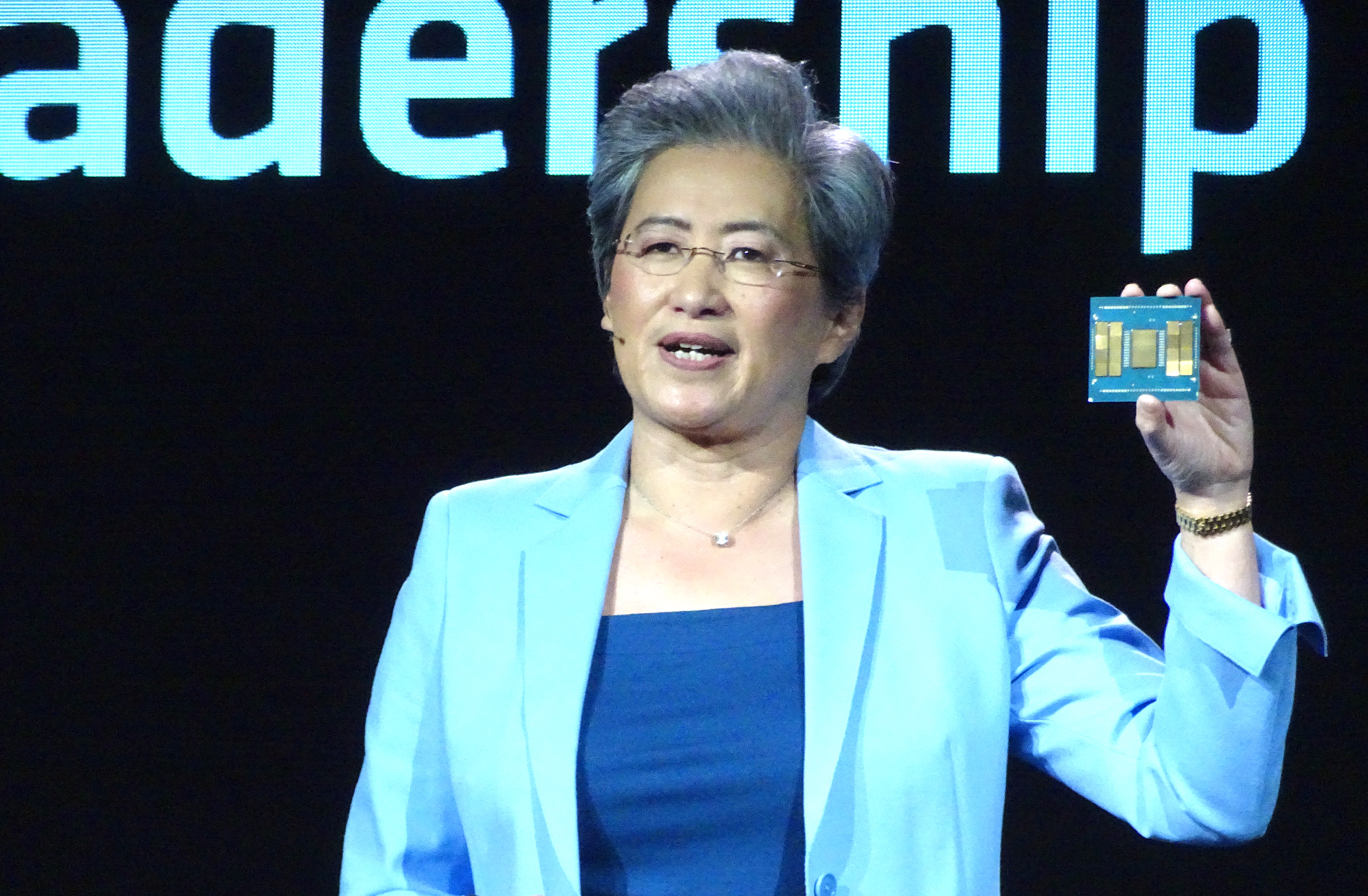
AMD Chair and Chief Executive Lisa Su (pictured) told analysts that fiscal 2025 was a defining year for the company, during which it achieved record revenue and earnings thanks to broad-based demand for its AI platforms. She was referring to AMD’s Instinct MI455X graphics processing units, which are a popular alternative to Nvidia Corp.’s GPUs for running artificial intelligence workloads.
“We are entering 2026 with strong momentum across our business, led by accelerating adoption of our high-performance EPYC and Ryzen CPUs and the rapid scaling of our data center AI franchise,” Su said.
That momentum is expected to drive the company towards $9.8 billion in first-quarter revenue, plus or minus $300 million, ahead of the Street’s consensus estimate of $9.38 billion. However, AMD’s stock fell more than 8% after-hours in a sign that some analysts and investors were hoping for even stronger guidance than what the company provided. The company is dealing with inflated expectations at a time when its customers continue to expand spending on AI infrastructure.
AMD is the world’s second-biggest manufacturer of GPUs and is widely considered to be Nvidia’s most significant rival, yet its share of the AI chip market remains dwarfed by that of its competitor. Its stock price more than doubled in 2025 and is up 13% in the year to date, even after today’s decline.
The chipmaker has signed deals with a number of major customers recently, including the ChatGPT maker OpenAI Group PBC and the cloud infrastructure giant Oracle Corp. It’s planning to ship a new integrated server-scale system called Helios, featuring dozens of MI455X chips, to customers later this year. On a conference call with analysts, Su said the company is holding “active discussions” with customers over yet more Helios sales.
AMD’s GPU sales are reported in its data center business unit, which generated $5.4 billion in revenue during the quarter, up 39% from a year earlier. Su said the sales increase was due to demand for both GPUs and the company’s central processing units, which are also used in AI servers.
“Hyperscalers are expanding their infrastructure to meet growing demand for cloud services in AI, while enterprises are modernizing their data centers to ensure they have the right compute required to enable new AI workflows,” Su told analysts.
AMD is also seeing big demand in its client and gaming segment, which sells chips for personal computers, video games consoles and other devices. Su said the unit delivered $3.9 billion in sales during the quarter, up 37% from a year ago, thanks to rising demand for the company’s Ryzen processors for laptops and PCs. She added that the company continues to gain market share in PCs at the expense of Intel Corp.
AMD’s client and gaming revenue growth was quite remarkable considering the misfiring fortunes of its main rivals in the segment, said Holger Mueller of Constellation Research. “It shows that Intel’s struggles are likely something it brought onto itself, because AMD’s high-end strategy shows there is a path to both growth and profit,” he explained.
Emarketer analyst Gadjo Sevilla told SiliconANGLE that AMD’s latest announcements at CES 2026 last month show it’s more than ready to capitalize on this demand. At the event, it previewed not only the Helios rack-scale platform, but also a new MI440X GPU and new Ryzen AI 400 chips. “Product diversification in high-demand markets such as AI hardware, gaming and PCs will continue to create opportunities for AMD’s growth,” he said. “Unlike Nvidia, which remains GPU-centric, AMD blends x86 CPUs, GPUs, adaptive SoCs and semi-custom silicon. Unlike Intel, it operates fabless, maintaining margin flexibility and capital discipline.”
The company also has a smaller embedded business, which sells chips for sensors and industrial devices such as medical imaging systems, robots, cars and aircraft systems. It generated $950 million in sales in the quarter, up 3% from a year earlier.
Mueller said that while the segment is much smaller than the others, its poor performance does not bode so well for AMD’s future, and should serve as a warning sign for its management. “It demonstrates that AMD may struggle to compete in segments showing signs of commoditization, and that’s a concern because all chip revenue curves eventually come under growth and profit pressure as a result of this,” the analyst said.
Like Nvidia, AMD has faced headaches in China, with export controls restricting its ability to ship some of its higher-end chips to that country. However, U.S. President Donald Trump recently eased export controls on some older types of chips, and AMD was able to record $390 million in China sales during the quarter. Su added that the company hopes to sell another $100 million worth of chips to Chinese customers in the current quarter.
Support our mission to keep content open and free by engaging with theCUBE community. Join theCUBE’s Alumni Trust Network, where technology leaders connect, share intelligence and create opportunities.
Founded by tech visionaries John Furrier and Dave Vellante, SiliconANGLE Media has built a dynamic ecosystem of industry-leading digital media brands that reach 15+ million elite tech professionals. Our new proprietary theCUBE AI Video Cloud is breaking ground in audience interaction, leveraging theCUBEai.com neural network to help technology companies make data-driven decisions and stay at the forefront of industry conversations.