

 AI
AI
AI
AI
AI

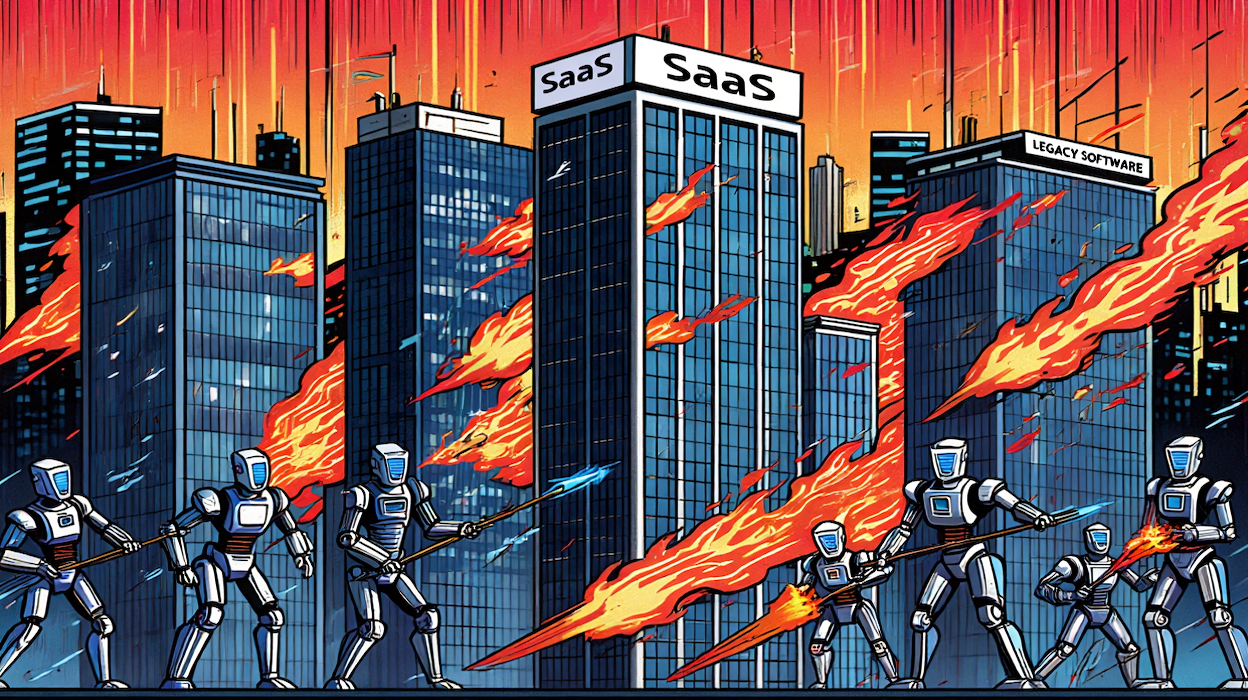
Everyone’s suddenly talking about a “SaaSpocalypse,” but that framing of artificial intelligence disrupting software-as-a-service misses the point.
What’s playing out isn’t collapse, it’s a reshuffle — AI is changing how work gets done, and investors are struggling to separate real disruption from headline noise.
Last week’s $285 billion software selloff was a fundamental miscalculation about where power resides in the emerging agentic era. TheCUBE Research partner Raphaëlle d’Ornano at Decoding Discontinuity just published a deep-dive analysis that cuts through the hysteria, and what she has uncovered should matter to anyone trying to navigate this transition.
As Dave Vellante and I were discussing on theCUBE Pod this week, Anthropic PBC dropped a legal plugin for Claude Cowork, basically an open-source tool built in weeks. Thomson Reuters Corp. tanked 16%. RELX fell 13%. LegalZoom Inc. dropped 20%. Goldman’s software basket posted its worst day since the April tariff selloff. Jefferies called it the “SaaSpocalypse.”
Then Anthropic released Claude Opus 4.6 with PowerPoint integration, and OpenAI Group PBC launched its Codex desktop app. Within five days, markets finally woke up to what we’ve been tracking: AI labs aren’t content selling application programming interfaces. They’re moving up the stack and coming for software companies’ lunch.
Here’s where it gets interesting. The market treated this like an extinction event and lumped everyone together. Thomson Reuters, Salesforce Inc., ServiceNow Inc. and LegalZoom all got hammered as if they face identical threats.
As Raphaëlle argues: That’s analytically lazy, and it has created massive mispricing — a must-read if you’re following this AI software transformation.
Raphaëlle frames her analysis around two critical questions that I think every software company needs to answer:
First: Are you a system of record or a workflow wrapper?
Second: If you’re a system of record, can you become the system of action and not just the database they query? In this case, the system of action, or the orchestration layer, tells AI agents what to do.
If you’re just a workflow wrapper, then yes, you’re probably toast. If your product is “model + wrapper + workflow” and the model creator can cut you out with a plugin, your moat was always temporary.
But if you’re a system of record with decades of operational data, thousands of trained users, and integrations woven throughout the enterprise nervous system, then it’s a different story.
This is the first nuance markets are missing, according to Raphaëlle: Systems of record aren’t dying, but they face a critical transition. In the pre-agentic world, when a sales rep updated a deal, they opened Salesforce. The application was where intent met execution.
In the agentic world, intent starts in a conversation. You tell an AI agent “update the Q2 pipeline forecast,” and it calls Salesforce’s API, analyzes the data and reports back without your ever opening Salesforce. The platform is still essential, but it risks getting relegated from system of action to system of storage.
And databases get priced very differently than platforms. Think 5x revenue versus 25x revenue multiples. That’s hundreds of billions in market cap difference.
Right now, agents interact through structured endpoints such as Agentforce, ServiceNow’s workflow APIs and MCP integrations. That means the system of record still controls what data agents access and which actions they can take. But this phase is transitional.
What’s coming next are user interface agents that operate software through the interface itself, clicking and navigating like humans. When agents can bypass APIs and just use the interface directly, that API gateway leverage evaporates.
But here’s the twist: A UI agent needs to know what to do, not just how to click. It needs to know which approval path applies to this specific deal, which escalation logic matters, which exceptions are routine versus requiring human review. That orchestration logic is the accumulated context of how an enterprise operates is what a system of action provides.
Meanwhile, AI labs are moving up the stack not from strength but from necessity. The model layer is commoditizing faster than anyone expected. Menlo Ventures data shows only 11% of enterprises switched AI providers last year despite models being technically interchangeable. Why? Organizational lock-in around prompts and workflows.
But here’s the paradox: An enterprise can retune prompts in weeks. It can’t rebuild 15 years of customer data and institutional context in weeks. Large language model lock-in is behavioral and fragile. Customer relationship management lock-in is structural and deep.
This means Anthropic and OpenAI face their own imperative. They need to move upstream to build durable moats beyond the model layer. They’re racing to become the very thing they threaten: enterprise platforms with deep organizational lock-in and context.
The market is pricing systems of record as if their demotion to passive storage is inevitable, discounting to zero the possibility they can transition to systems of action. That’s not justified by the evidence. These companies have context, data gravity and years of accumulated operational intelligence. Capabilities improve on curves measured in months. Context accumulates on curves measured in years.
Both sides, AI labs and incumbents, are racing toward the same prize from opposite ends of the stack. And neither has won yet.
Support our mission to keep content open and free by engaging with theCUBE community. Join theCUBE’s Alumni Trust Network, where technology leaders connect, share intelligence and create opportunities.
Founded by tech visionaries John Furrier and Dave Vellante, SiliconANGLE Media has built a dynamic ecosystem of industry-leading digital media brands that reach 15+ million elite tech professionals. Our new proprietary theCUBE AI Video Cloud is breaking ground in audience interaction, leveraging theCUBEai.com neural network to help technology companies make data-driven decisions and stay at the forefront of industry conversations.