

 AI
AI
AI
AI
AI

Silicon-based artificial intelligence has come a very long way in a very short space of time, driving massive advances in the large language models that sit at the heart of today’s generative AI chatbots, image creation tools and autonomous agents.
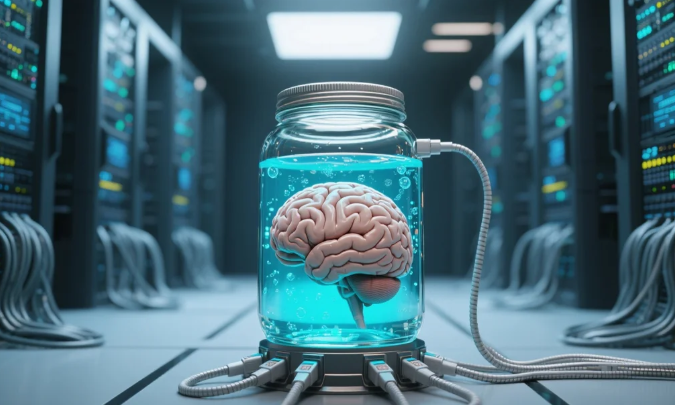
Now a startup called The Biological Computing Co. believes that the future of AI lies in biological computing systems that use real, living neurons to power a new generation of models that will be much faster, cheaper and more adaptive than anything seen so far.
TBC, as the startup likes to refer to itself, said today it has raised $25 million in seed funding from Primary Ventures to coincide with the commercial launch of the world’s first biological computing platform for computer vision and generative AI.
Formerly known as Biological Black Box, TBC does things very differently from the likes of OpenAI Group PBC, Google LLC and Anthropic PBC, connecting living neurons with modern AI infrastructure to create frontier models that are more stable, scalable and efficient than traditional LLMs. Its neural-based platform integrates directly with foundational models to enhance their performance while simultaneously reducing compute costs, reflecting its founder’s belief that AI has more potential when it’s incorporated with biological intelligence.
TBC co-founder and Chief Executive Alex Ksendsovsky said his company sits at the intersection of three emerging forces, including rapid advancements in neuroscience, the growing constraints of today’s AI systems and an emerging climate and energy crisis that threatens to cause massive disruption to the world if not addressed. One of the problems he has with today’s LLMs is their reliance on brute-force scaling and repeated optimization cycles to drive improvements. Such approaches become exponentially more expensive with each new leap in performance, he said, making them unsustainable over the long term.
The solution, according to Ksendsovsky, is to build an entirely new class of computing systems, where lab-grown neurons complement silicon to unlock superior performance and efficiency gains. “Using the real brain for computing is paradoxically the most elusive yet the most obvious idea in the field of computer science,” he said.
TBC’s neuroscience and engineering team encodes real-world data, such as text, images and video, directly into these living neurons, before decoding their neural activity into rich representations that can be mapped onto frontier models using modular adapters. In parallel, TBC’s Inspired Compute platform applies biologically derived principles to inform new AI system designs, creating a new layer of compute that strengthens existing AI architectures.
TBC’s other co-founder, Chief Operating Officer Jon Pomeraniec, said the company is sitting at the ground level of a paradigm shift toward what comes after silicon. “We’re building infrastructure to understand and interact with the world in a fundamentally new way,” he added.
Ksendsovsky said TBC’s biological AI infrastructure provides some solid benefits over traditional silicon-based AI. By harnessing the natural dynamics of neurons, it can dramatically reduce the amount of compute required by AI models to generate outputs. Neurons also support continuous learning and improved memory, with minimal training required, overcoming the “stateless” nature of rigid, silicon-based models. They also mimic the human brain’s ability to extract high-dimensional patterns, which means biological-powered AI models can learn and generalize with fewer examples, he said. Finally, neurons require only a fraction of the power used by traditional silicon chips.
The quest to run AI in more cost effective ways is sparking new ideas left and right, because enterprises are spending billions of dollars on infrastructure, said Holger Mueller of Constellation Research. Any idea that can save some of those billions is sure to get a lot of attention, he believes.
“The Biological Computing’s idea is compelling, using the human brain and its proven footprint as the basis of a better and more energy-efficient AI architecture,” he said. “But it’s a radically different approach compared to what we’re doing now, and the startup will have to prove that this approach not only delivers, but is able to scale to support the kinds of AI applications we’re using today. If it can do this, it will definitely find a lot of takers.”
TBC has already applied its technology to enhance the capabilities of AI models in various ways. For instance, its VAE efficiency adapters are helping developers to improve the reconstruction quality and representation efficiency of frontier models, and it has also shown an ability to enhance long-horizon coherence in generative AI video and world models.
The startup’s plan is to disrupt the traditional AI infrastructure market, which is currently dominated by enormous clusters of graphics processing units hosted in cloud data centers and is forecast to be worth $1.7 trillion by 2030. To do this, it’s planning to launch hybrid neuro-silicon clusters for cloud environments, and has set a 2027 launch date.
Brian Schechter of Primary Ventures said silicon has carried the torch for AI so far, but it’s quickly reaching its limits. “AI’s next breakthrough will come from alternative architectures like biological computing,” he said. “We believe TBC can deliver step-change gains for demanding workloads such as computer vision and world models, and its early progress points to a new class of AI infrastructure.”
Support our mission to keep content open and free by engaging with theCUBE community. Join theCUBE’s Alumni Trust Network, where technology leaders connect, share intelligence and create opportunities.
Founded by tech visionaries John Furrier and Dave Vellante, SiliconANGLE Media has built a dynamic ecosystem of industry-leading digital media brands that reach 15+ million elite tech professionals. Our new proprietary theCUBE AI Video Cloud is breaking ground in audience interaction, leveraging theCUBEai.com neural network to help technology companies make data-driven decisions and stay at the forefront of industry conversations.