

 CLOUD
CLOUD
CLOUD
CLOUD
CLOUD

Salesforce Inc. clocked up its highest-ever quarterly revenue as it delivered its latest financial results, beating expectations, but its revenue guidance for the new fiscal year trailed Wall Street’s projections.
The customer relationship management software giant crushed Wall Street’s expectations, delivering fourth-quarter earnings before certain costs such as stock compensation of $3.81 per share, well ahead of the $3.04 analyst consensus estimate. Revenue grew 12% from a year earlier, to $11.2 billion, surpassing the Street’s $11.18 billion estimate, though revenue from Salesforce’s acquisition of Informatica contributed to that higher growth.
Investors would have been encouraged to note that Salesforce’s revenue grew at the fastest rate in over two years, and that growth helped to boost its bottom line too. The company reported net income of $1.94 billion in the quarter, rising from the $1.71 billion profit it posted one year earlier.
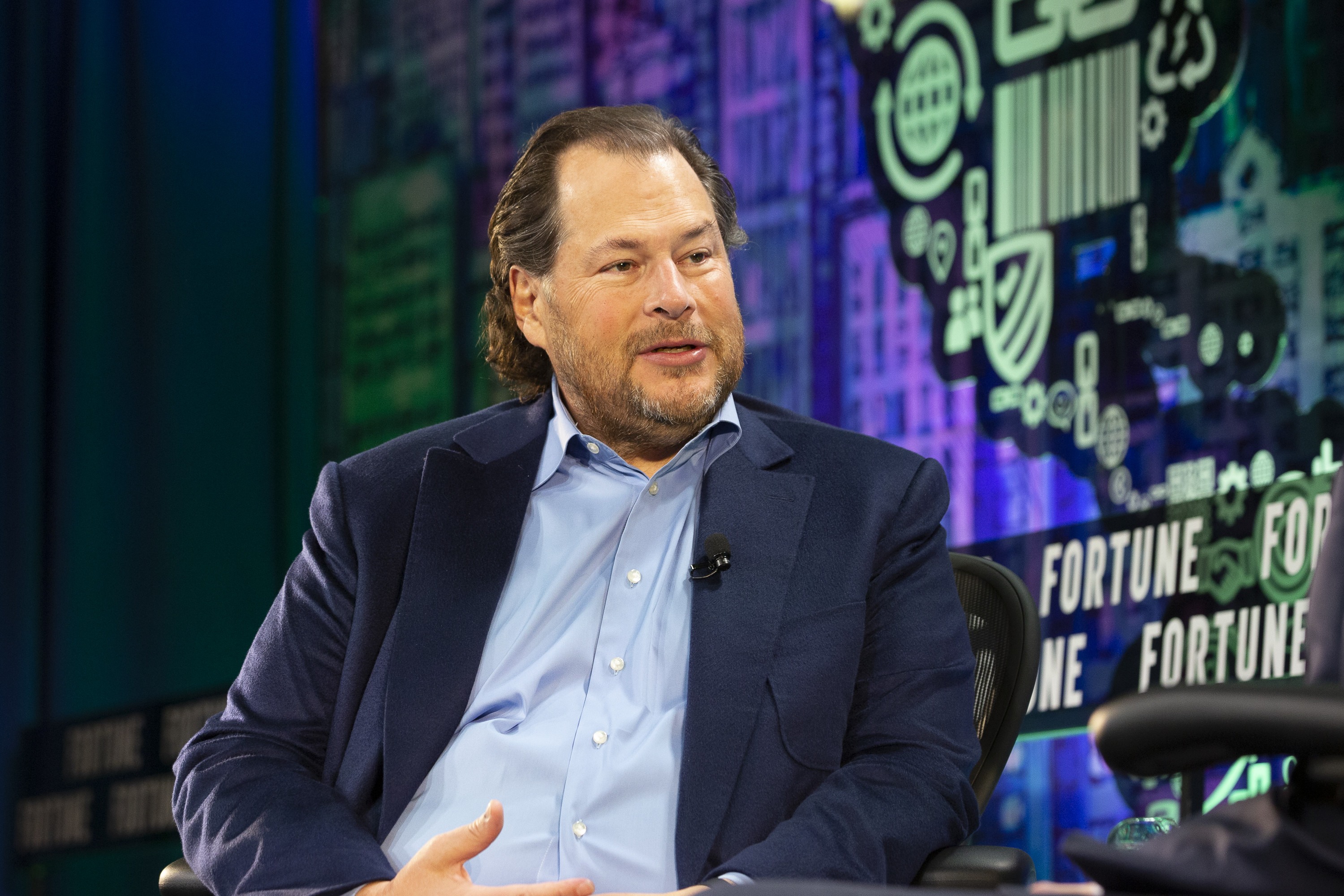
Salesforce Chair and Chief Executive Officer Marc Benioff (pictured) hailed the company’s performance, explaining that artificial intelligence is the driving force behind its renewed growth. “We’ve rebuilt Salesforce to become the operating system for the agentic enterprise, bringing humans and agents together on one trusted platform,” he said. “And the more intelligence moves to where work happens, the more valuable Salesforce becomes. Agentforce ARR reached $800 million, up 169% year-over-year, and we’ve closed 29,000 deals, up 50% quarter-over-quarter.”
There were more impressive numbers, with the company reporting remaining performance obligations of $35.1 billion, above the Street’s $34.53 billion consensus. RPO refers to the sum of contracted but so far unrecognized revenue that the company expects to receive over the next year.
For the current quarter, Salesforce said it’s looking at earnings of between $3.11 and $3.13 per share on sales of $11.03 billion to $11.08 billion. Wall Street is seeking a profit of exactly $3 per share on sales of $10.99 billion.
So far, so good, but the company’s fiscal 2027 revenue forecast wasn’t as encouraging. The company said it’s looking for annual sales of $46 billion at the midpoint of its guidance range, trailing the Street’s forecast of $46.06 billion. Unfortunately for Salesforce, that lone blot on its copybook was all it took to send investors running to the hills. Its stock nosedived after-hours, declining more than 5%, erasing a gain of 3% made during the regular trading session.
So far this year, Salesforce’s stock has declined more than 27%, partly as a result of broader economic trends, but mostly because investors have become extremely worried about what the future holds for software companies amid the rise of autonomous AI agents. The fear is that agentic tools such as Anthropic PBC’s Claude Cowork and OpenAI Group PBC’s Frontier might make software-as-a-service platforms “invisible” and consequently less valuable.
Basically every publicly traded software-as-a-service company has seen its stock decline in the last few weeks. There are even fears that enterprises might one day just use AI coding tools to build their own software platforms entirely. That’s partly why IBM Corp.’s stock fell more than 13% on Monday, when Anthropic updated Claude Code, giving it the ability to modernize mainframe applications written in the Cobol programming language.
However, Benioff rejected these fears as unrealistic. On a conference call with analysts, he said he’s taking advantage of Salesforce’s reduced value to allocate another $50 billion for stock buybacks “because these are some low prices.”
Meanwhile, Salesforce continues to confront the agentic AI threat head on, doubling down on the development of its own agentic automation tools. During the quarter, the company debuted a new Slackbot assistant in the Slack team communication app for paying customers. The company completed its $8 billion acquisition of Informatica LLC, and also announced its intention to buy the agentic marketing startup Qualified.
Benioff offered a bullish long-term forecast too, saying he believes the company can hit $63 billion in annual sales by the end of fiscal 2030, up from a target of $60 billion it first revealed in October.
Valoir analyst Rebecca Wettemann told SiliconANGLE that she’s also optimistic about Salesforce’s long-term prospects, citing the $800 million in annual recurring revenue generated by its Agentforce platform. She pointed to the company’s focus on building specific industry cloud verticals as a key differentiator.
“Industry adoption is going to be an important driver for Agentforce,” she said. “The Life Sciences Cloud growth is important because it’s a customer retention story against Veeva and other competitors, and because adopting industry clouds reduces the cost and friction of AI adoption and accelerates time to value for Agentforce.”
However, Wettemann also said Salesforce still has much more work to do on the agentic front. She believes investors want to see it doing more than just talking about new customer wins and contract sizes, and start showing real customer success stories. “To make AI a reality for customers and the market, and cement Salesforce’s position in it, it needs to be able to show how customers are moving AI agents into production at scale with governance, observability and trust needed, as well as ROI,” the analyst said.
Meanwhile, Salesforce scored some significant victories in its battle against other SaaS vendors, if Benioff is to be believed. He said five customers of ServiceNow Inc. dropped that vendor in favor of Salesforce’s alternative information technology service management platform during the quarter. All told, the platform gained 180 new customers, he said.
Wettemann said this is a significant and welcome development for the company’s broader strategy. “The ITSM story is a key part of Salesforce’s ‘apps plus agents’ message and it’s a way for the company to own more of the service automation pie beyond CRM,” she explained.
The good news for Salesforce is that not everyone is buying into the AI-is-eating-software story. Analysts from Morgan Stanley, who have a buy rating on the company’s stock, said in a note to clients this week that its conversations with partners suggest “we are in the early innings” of the agentic push.
It’s notable that Salesforce is seeing a significant benefit from its investment in Anthropic, too. The company generated an $811 million gain on that investment in the quarter, up from just $96 million in the same quarter one year earlier.
“I think we just put another $100 million into the new round,” Benioff told analysts. “We’re at about $330 million into Anthropic invested. It’s almost 1% of Anthropic, and believe me, I wish we have invested a lot more.”
Support our mission to keep content open and free by engaging with theCUBE community. Join theCUBE’s Alumni Trust Network, where technology leaders connect, share intelligence and create opportunities.
Founded by tech visionaries John Furrier and Dave Vellante, SiliconANGLE Media has built a dynamic ecosystem of industry-leading digital media brands that reach 15+ million elite tech professionals. Our new proprietary theCUBE AI Video Cloud is breaking ground in audience interaction, leveraging theCUBEai.com neural network to help technology companies make data-driven decisions and stay at the forefront of industry conversations.