 AI
AI
AI
AI











AI

Cursor today introduced an artificial intelligence model called Composer 2 that it says can outperform Claude Opus 4.6 across many programming tasks.
The model is accessible through the company’s popular AI code editor. Cursor, which is incorporated as Anysphere Inc,. says that the software has more than 1 million daily active users. That large installed base helped the company secure a $29.3 billion valuation last November.
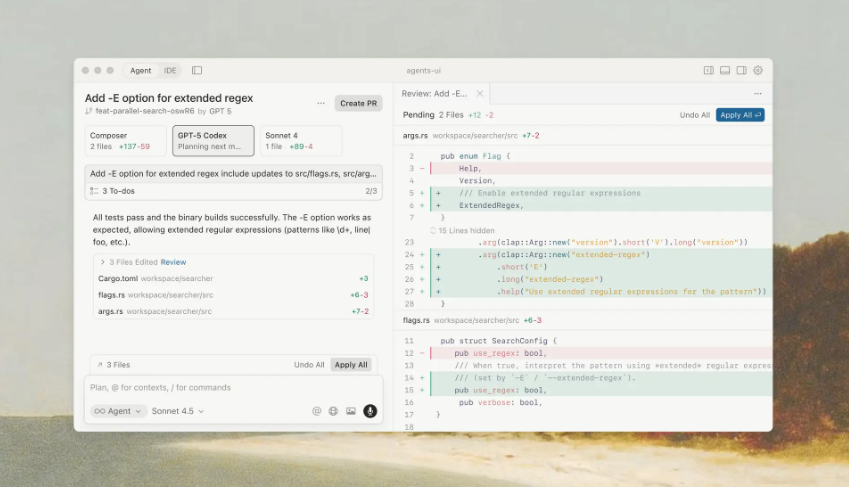
Composer 2 supports prompts with up to 200,000 tokens. It can generate code, fix bugs in existing software and interact with a computer’s command line interface. Developers can optionally extend the model’s capabilities by providing it with access to a browser, an image generator and other tools.
Cursor evaluated Composer 2 using an internal benchmark called CursorBench. The programming challenges that it contains are based on tasks completed by the company’s engineering team. The average CursorBench challenge includes 352 lines of code spread across eight files.
Composer 2 achieved a score of more than 60%, which put it in third place behind GPT-5.4’s high and medium configurations. Those are modes in which OpenAI Group PBC’s flagship model uses more hardware to increase output quality. According to Cursor, Composer 2 outperformed GPT 5.4’s low configuration and Claude Opus 4.6.
The new model also bested Anthropic PBC’s model on the Terminal-Bench 2.0 benchmark. The evaluation measures AI models’ ability to perform tasks in a command line interface.
Cursor says Composer 2 is more cost-efficient than many competing frontier models. The standard edition of the algorithm is priced at 50 cents per million input tokens and $2.50 per million output tokens. There’s also a second, more expensive version that offers the same output quality but responds to developers’ prompts considerably faster. It’s available for $1.50 per million input tokens and $7.50 per million output tokens.
According to Bloomberg, the model’s cost-efficiency partly stems from the fact that it was trained solely on coding datasets. Frontier models are usually trained to automate a wider range of tasks, which increases their hardware footprint.
Cursor used a machine learning method called self-summarization to streamline the development process. The coding tasks that an AI model receives during training require it to process a significant amount of data. In some cases, the data volume exceeds the model’s context window. Self-summarization compresses information into a form that doesn’t exceed context window limits.
The launch of Composer 2 may help boost investor interest in the funding round that Cursor is reportedly raising. The investment is expected to boost the company’s valuation to about $50 billion.
Support our mission to keep content open and free by engaging with theCUBE community. Join theCUBE’s Alumni Trust Network, where technology leaders connect, share intelligence and create opportunities.
Founded by tech visionaries John Furrier and Dave Vellante, SiliconANGLE Media has built a dynamic ecosystem of industry-leading digital media brands that reach 15+ million elite tech professionals. Our new proprietary theCUBE AI Video Cloud is breaking ground in audience interaction, leveraging theCUBEai.com neural network to help technology companies make data-driven decisions and stay at the forefront of industry conversations.