



 INFRA
INFRA
INFRA
INFRA

INFRA

With Kubernetes becoming the bedrock of modern enterprise infrastructure, Kubernetes virtualization seems to be the next logical step forward.
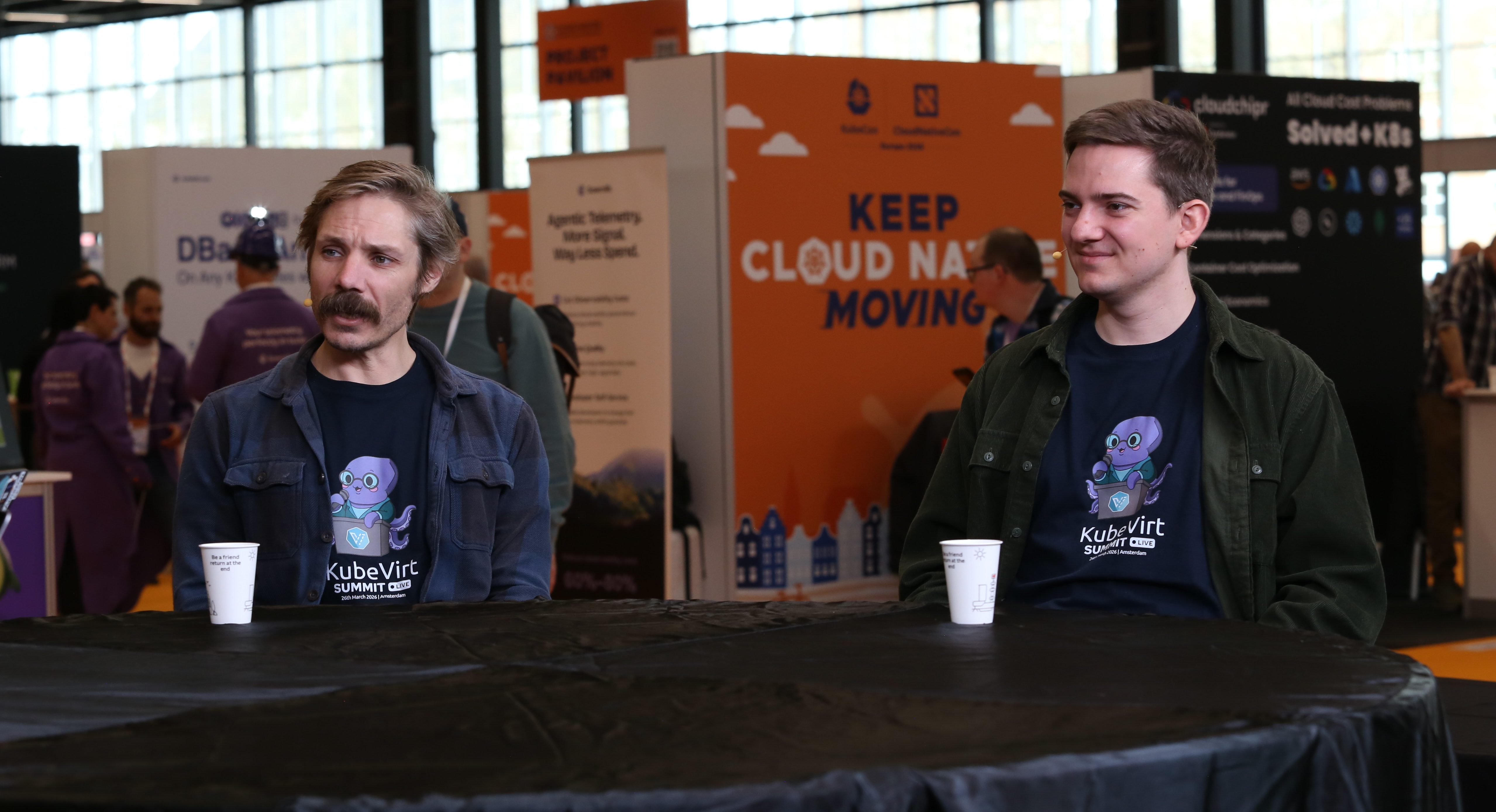
In fact, KubeVirt — an open-source project that brings container-native virtualization to Kubernetes — is enabling teams to run and manage virtual machines alongside containers from a single control plane. With the release of version 1.8 and the project’s first live summit, a cross-industry contributor base is pushing KubeVirt toward Cloud Native Computing Foundation graduation — a signal of production-grade maturity, according to Andrew Burden (pictured, left), community facilitator and KubeVirt maintainer at Red Hat Inc.
“Graduating for us makes it more obvious for people that [KubeVirt] is deeply embedded in the Kubernetes ecosystem [and] the CNCF ecosystem,” Burden told theCUBE. “They can see us graduate and be like, ‘That’s obviously a mature product. Let’s investigate that.'”
Burden and Ľuboslav Pivarč (right), principal software engineer and KubeVirt maintainer at Red Hat, spoke with theCUBE’s Rebecca Knight and Rob Strechay at KubeCon + CloudNativeCon EU, during an exclusive broadcast on theCUBE, SiliconANGLE Media’s livestreaming studio. They discussed Kubernetes virtualization, community governance and the path to CNCF graduation. (* Disclosure below.)
The momentum behind KubeVirt has sharply accelerated since its early days as a Red Hat-heavy project. KubeVirt was accepted to the CNCF in 2019, and moved to the incubating maturity level in 2022. Contributors now span chip manufacturers and hyperscalers alike, including Nvidia Corp., Intel Corp., Advanced Micro Devices Inc. and IBM Corp., Pivarč noted.
“We see a lot of collaboration with a lot of companies. We see ideas and features that we need to develop together. We see AI driving a lot of this, for example, from the hardware perspective where we need to enable it, and Nvidia is coming to us, helping us with it,” Pivarč said. “We also have confidential computing, which we are trying to bring to KubeVirt, and there you need all the vendors from the chip manufacturers — Intel, AMD, IBM — and they are all coming to us.”
Microsoft Corp. has also stepped in to lead a major multi-hypervisor feature — a move attributed to the project’s transparent enhancement proposal process, according to Burden. That process mirrors the Kubernetes enhancement process but is lighter, giving outside contributors a clear path to propose and negotiate features with the community, he explained.
“We didn’t know Microsoft was an end user until they came with this really exciting, complicated idea,” Burden said. “But through negotiation, through conversation and engagement, they were able to finally bring this thing where we came together [and] came up with something that made sense for all the parties.”
Here’s the complete video interview, part of SiliconANGLE’s and theCUBE’s coverage of KubeCon + CloudNativeCon EU:
(* Disclosure: Red Hat sponsored this segment of theCUBE. Neither Red Hat nor other sponsors have editorial control over content on theCUBE or SiliconANGLE.)
Support our mission to keep content open and free by engaging with theCUBE community. Join theCUBE’s Alumni Trust Network, where technology leaders connect, share intelligence and create opportunities.
Founded by tech visionaries John Furrier and Dave Vellante, SiliconANGLE Media has built a dynamic ecosystem of industry-leading digital media brands that reach 15+ million elite tech professionals. Our new proprietary theCUBE AI Video Cloud is breaking ground in audience interaction, leveraging theCUBEai.com neural network to help technology companies make data-driven decisions and stay at the forefront of industry conversations.