

 AI
AI
AI
AI
AI

Microsoft Corp. is moving closer to delivering on its vision of autonomous artificial intelligence agents that can do more than just chat.
Today it has announced the launch of Copilot Cowork, a new capability within the Microsoft 365 platform that can handle “long-running, multistep tasks” that could previously be done only with constant human oversight.
Copilot Cowork was announced in a blog post by Jared Spataro, Microsoft’s chief marketing officer for AI at Work. He said the new capability is being made available through the company’s Frontier program, which lets enterprises test cutting-edge AI features before they’re released more broadly.
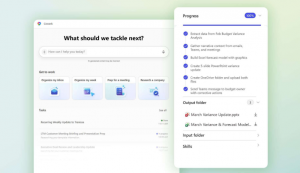
Microsoft’s Copilot tool has been around for a couple of years already, but until now it has mostly been focused on generative tasks, such as summarizing emails or drafting the text of an email or blog post. Copilot Cowork, on the other hand, is built for delegation, so instead of having humans perform every step in a complex workflow, someone can now describe their desired outcome and let AI complete all of those tasks autonomously.
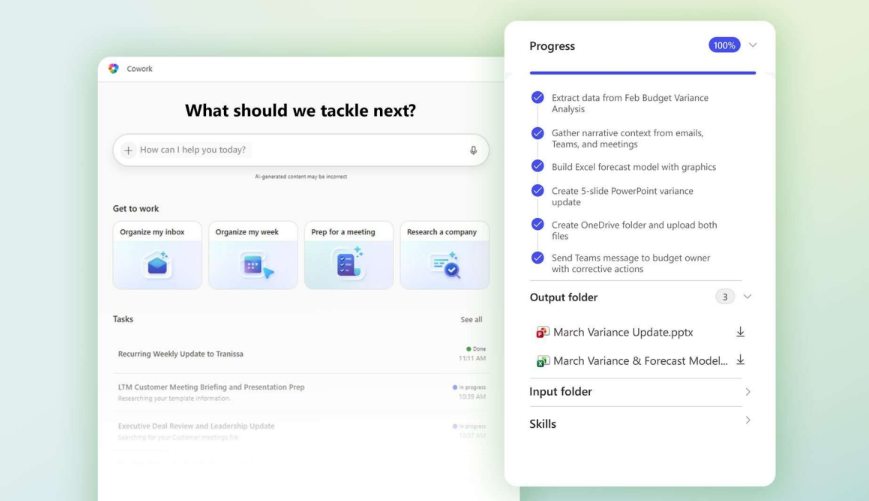
Spataro said users simply tell Copilot Cowork what they’re trying to accomplish, and it will then go ahead and create a plan before immediately carrying out the necessary tasks to achieve that goal, reasoning across various Microsoft 365 applications and files. Human oversight is still present, though. As it’s working, humans will be able to monitor the agent’s progress, and step in to “steer” it in the right direction should it go off track, Spataro said.
The system is grounded in the Work IQ framework that’s designed to teach Copilot about the specific context of an organization’s data while ensuring its security and governance protocols are followed. Spataro said Copilot Cowork is all about making work more efficient, eliminating the need for humans to keep jumping from one application to another.
Even a relatively simple task such as completing a monthly budget review will require a human to constantly switch between platforms such as Excel, Outlook, Teams and SharePoint. It’s necessary to gather the required data and coordinate with colleagues, before compiling everything into a report.
Copilot Cowork eliminates all of this hassle. It acts as an “orchestrator,” performing tasks such as daily briefings and calendar management without needing to be prompted to complete each individual step.
Barton Warner, senior vice president of enterprise technology at Capital Group Companies Inc., an early adopter, said Copilot Cowork is about taking real action, rather than generating content and answers. “It’s connecting steps, coordinating tasks and following through across everyday workflows,” he explained.
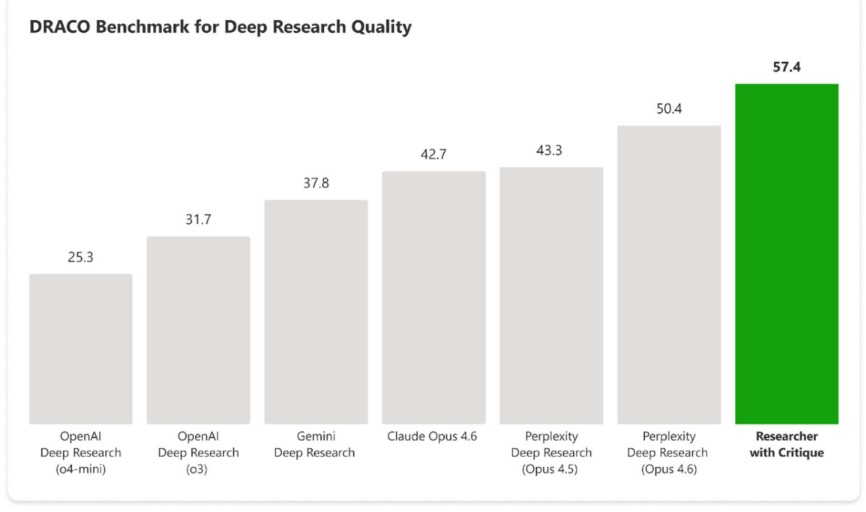
One of Copilot Cowork’s biggest strengths is its multi-model approach, integrating with both OpenAI Group PBC’s GPT models and Anthropic PBC’s Claude. This can be seen in the company’s newly enhanced “Researcher” agent, which now taps into both AI models via a new “critique” layer.
The way it works is that OpenAI’s GPT model will draft a response, which is then reviewed by Claude for accuracy and to ensure its citations are correct. Spataro said this combination has improved the Researcher agent’s score on the DRACO benchmark by 13.8%.
In addition, it’s possible to reverse the roles, so that Claude drafts the response and GPT does the fact checking. Then, with the new “model council” feature, users can compare the results of each model to see where they agree, where they diverge and where they come up with unique outputs. It’s much like having multiple researchers working on the same project.
By allowing different models to perform distinct roles, with one for drafting a response and one for critiquing, Microsoft is trying to build a more resilient system that reduces the “hallucinations” that have plagued early AI systems. By allowing humans to cross-reference the work of different AIs, enterprises can potentially scale up AI automation with greater trust.
Support our mission to keep content open and free by engaging with theCUBE community. Join theCUBE’s Alumni Trust Network, where technology leaders connect, share intelligence and create opportunities.
Founded by tech visionaries John Furrier and Dave Vellante, SiliconANGLE Media has built a dynamic ecosystem of industry-leading digital media brands that reach 15+ million elite tech professionals. Our new proprietary theCUBE AI Video Cloud is breaking ground in audience interaction, leveraging theCUBEai.com neural network to help technology companies make data-driven decisions and stay at the forefront of industry conversations.