 AI
AI
AI
AI







AI

AI in financial services has stopped being just another technology tool and started becoming a measure of operational readiness.
In 2025, 45% of IT decision-makers ranked generative AI tools as their top budget priority. By 2026, nearly 100% of financial services respondents said their AI budgets would increase or hold steady, with 41% focusing investment on optimizing AI workflows already in production. Now the bill is coming due: Financial firms have to turn AI experiments into production systems that can spot risk, accelerate decisions and move faster than legacy processes allow.
Of course, the strategic question is becoming less about whether AI can improve the present and more about whether it can help them prepare for futures their historical models were never built to see, according to Ioana Boier, global head of capital markets at Nvidia Corp.
“It used to be that quantitative research was about making certain assumptions or looking at the historical information and try to think of what the future would look like based on the past,” she said. “That’s never repeating itself. The past is not repeating itself.”
Boier talked with Rebecca Knight at the AWS Financial Services Symposium in New York City during an exclusive interview on theCUBE, SiliconANGLE Media’s livestreaming studio. Knight also spoke with leaders from AWS Partners across banking, insurance, capital markets, compliance, operations and cloud infrastructure about the current state of AI in financial services, from AI-powered observability and autonomous agent payments to digital market twins, safer production AI and why firms are moving beyond pilots toward platforms. (* Disclosure below.)
Here are 18 signals from the future of AI in financial services:
Quantitative research that once took six months to move from idea to production-ready strategy can now be compressed dramatically with accelerated compute, shifting the economics of algorithmic trading toward firms that invest in continuous research pipelines, Nvidia’s Ioana Boier explained. Nasdaq Inc. is already applying that logic at the market structure level, using generative AI to build digital replicas of limit order books — effectively market twins that trading firms can use to stress-test strategies against more faithful simulations of how markets actually behave.
Explore the full conversation on theCUBE.
Until now, an AI agent that hit a paid endpoint simply stopped, forcing developers to spend months building bespoke billing integrations and managing separate application programming interface keys across every service their agent needed to access. AWS launched Amazon Bedrock AgentCore payments in a preview at the symposium, built in partnership with Coinbase and Stripe, enabling agents to transact autonomously with just a few lines of code, explained Preethi CN, director of AgentCore at Amazon Web Services Inc. The roadmap goes well beyond micropayments, with commercial transactions like flight and hotel bookings in sight as the next frontier for autonomous agent commerce.
Check out theCUBE’s complete interview.
Banks and insurers were already modernizing their technology stacks, but the pressure to show real value deploying AI in financial services quickly has made fragmented tooling an urgent liability. Consolidating onto a single observability platform, such as Datadog, is increasingly a prerequisite for getting useful output from AI capabilities like agentic site reliability engineering, noted John Trapani, field chief technology officer of financial services at Datadog Inc. Banco Itaú Unibanco S.A. — Brazil’s largest private-sector bank — proved the model, cutting incident volume by nearly half and slashing resolution time by more than 30% after retiring more than a dozen siloed monitoring tools.
See the full interview from theCUBE.
For years, IT teams in banking measured success by uptime and response time, but AI in financial services is forcing a more fundamental question about why these systems exist in the first place. When something degrades in a wire transfer flow, Dynatrace Inc.’s AI-powered platform aims to detect and remediate the issue automatically before customers feel it, according to Bill Zajac, senior director of digital experience monitoring at Dynatrace. Dynatrace recently launched as a native partner with the AWS DevOps agent, giving a clearer path for AI in financial services from anomaly detection to autonomous resolution.
Catch theCUBE’s exclusive sit-down.
Transferring account ownership during an inheritance or divorce used to be an entirely manual process at Vanguard Group Inc., with cycle times stretching from one to two weeks at one of the most stressful moments in a client’s life. Working with EPAM Systems Inc., Vanguard rebuilt the entire workflow on AWS, using Amazon Bedrock to automate document scanning and classification that previously required manual review, explained Andy Li, senior manager and head of IT at Vanguard. The result was a fully automated, end-to-end process that compressed a week or more of waiting into a single day, added Vikram Singh, director of delivery management at EPAM.
Hear the complete conversation on theCUBE.
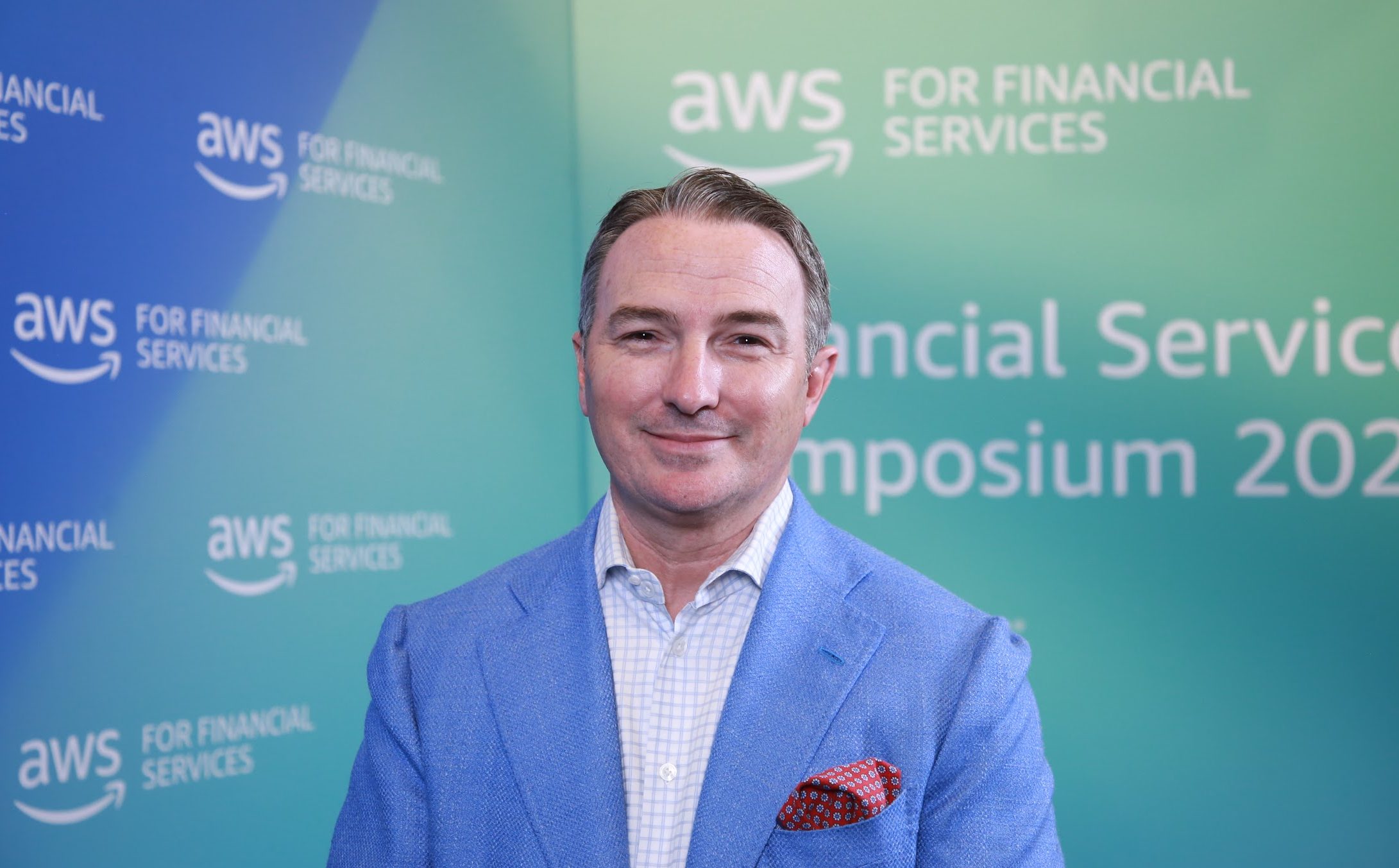
AWS services such as Kiro and Amazon Q are enabling knowledge workers to automate workflows across systems such as Outlook, Slack and Salesforce without writing a single line of code. But the real unlock requires CEO-level commitment to changing how work actually works, said Scott Mullins (pictured), general manager of worldwide financial services at AWS. In other words, the firms with the most to gain will not be the ones that simply give employees AI tools, but the ones that redesign the work around them.
Check out theCUBE’s full exclusive.
Customer loyalty, fraud and compliance pressure are all rising at once, and disconnected data and rigid workflows are making it harder for banks to respond at the speed customers now expect. FICO’s platform unifies data, decisions and analytics into an “always-on” customer profile with AI-powered decisioning in milliseconds, letting business users test and deploy strategies without waiting on IT, according to Aninda Bhattacharyya, senior director of platform architecture at FICO.
Dive into the full conversation on theCUBE.
AI coding assistants are lowering the barrier to writing code dramatically, but they also pull in open-source libraries that can carry vulnerabilities and trigger supply chain attacks, making automated governance and quality gates more critical than ever. Harness Inc. helped Citibank shrink a 150-page cloud onboarding document into a 10-minute automated workflow and consolidated Morningstar’s 36,000 Jenkins pipelines down to 50 reusable templates, noted Alex Valentine, vice president of solutions engineering at Harness.
Check out theCUBE’s complete interview.
With over 95% of its applications already on the cloud and a centralized data hub in place, New York Life Insurance Co. entered its AI-first transformation from a position of strength, focused on growth and broker experience rather than cost-cutting alone. The goal is to remove manual work so employees can shift from reactive to consultative, with agentic AI handling the operational load, explained Kristina Welke, VP and head of strategy, solutions and marketing at New York Life. Treating AI in financial services as a technology project rather than an operating model change is the mistake most insurers are making right now, added Abhi Bakre, lead client partner for strategy and transformation at IBM Corp.
Explore the full conversation on theCUBE.
Financial institutions that experimented with agentic AI and then stalled did so because they treated it as a standalone project, a pattern Infosys Ltd. has seen repeat itself, noted Rajaram R.K., VP and head of sales for financial services at Infosys. Working with one large bank, Infosys broke the entire institution into 24-plus domains, rewiring each from human-led processes into agentic-AI-first workflows using its Topaz platform.
Here’s the full sit-down on theCUBE.
For teams running mission-critical workloads, if the promise of AI in financial services means re-architecting familiar storage infrastructure, it is a risk most institutions don’t take lightly. Amazon FSx for NetApp ONTAP brings enterprise-grade capabilities — instant cloning, space-efficient snapshots, cross-region replication and a built-in ransomware detection engine — to AWS without requiring teams to learn a new storage stack, according to Jacob Lim, cloud solutions architect at NetApp Inc. S&P Global Inc. used the solution to migrate mission-critical SQL Server workloads to AWS across multiple availability zones, exiting its data center while preserving high availability and continuously optimizing costs.
TheCUBE has the exclusive conversation.
A PagerDuty Inc. survey of 100 banks found that 78% reported operational efficiency gains of more than 15% in the past six months, with 88% planning to increase their digital operations budgets in 2026 and 2027, according to Todd McNabb, chief revenue officer at PagerDuty. The company’s Operations Cloud chains together an Insight Agent, a Scribe Agent and an SRE Agent that ingest telemetry, summarize incidents in real time and either remediate automatically or pull a human into the loop before customers feel the impact.
Hear the complete conversation on theCUBE.
Unum Group faced over 7,000 hours of annual manual processing work locked inside 1.5 million lines of largely undocumented mainframe code, a problem Pegasystems Inc., AWS and Accenture PLC resolved in three months using agentic workflows — a process that previously took seven years to implement, explained Steve Morgan, global banking industry lead at Pega. A major U.K. mortgage lender rebuilt its 14-year-old origination system in eight months and saw digital throughput jump between 20% and 40% as a result.
Watch the full interview from theCUBE.
Smarsh Inc. captures data across more than 100 channels into a single integrated platform, using its Intelligent Agent capability to cut through false positives and surface genuine risks — including cases where bad actors switch languages to avoid detection, said Vincent David, VP of AI engineering at Smarsh. A strategic collaboration agreement with AWS lets the company focus engineering resources on agentic AI in financial services rather than infrastructure, pushing compliance intelligence further up the value stack.
Hear the complete conversation on theCUBE.
Banks are under constant attack from sophisticated threat actors, and Splunk’s data platform gives security and observability teams a common operating picture — pulling in data from almost any source to move from asking what is happening to deciding what to do about it, noted Peter Sprenger, field chief technology officer of Splunk, a Cisco Systems Inc. company. Agents are now layering on top of that foundation, helping teams sift through the haystack faster and orchestrate responses without heavy coding skills.
Here’s the full interview, only on theCUBE.
TEKsystems Global Services LLC built an intelligence layer on top of a commercial bank’s data that let relationship managers query information through natural language prompts, accelerating their productivity by 50%, while a separate data compliance engagement anonymized 1.3 petabytes across 13.5 billion objects with 97.5% accuracy and 100% compliance, according to Armando Franco, senior director for cloud and platform modernization at TEKsystems. Doing AI safely in a regulated environment requires trusting the data, governing the model and validating the results, added Tony DiBitetto, AWS sales and solutions director at TEKsystems.
Check out theCUBE’s complete interview.
Responding to a complex financial product request used to take traders and salespeople hours or even a full day of manual checks, but Numerix LLC.’s Request for Quote agent wraps deterministic risk models in an intelligence layer that personalizes quotes to a client’s specific liability and risk constraints in real time, explained Satyam Kancharla, chief product officer at Numerix. The multi-agent platform built with Vertical Relevance on AWS is designed to be repeatable across business use cases, giving trading desks a way to offer institutional-grade personalization at scale, noted Brian Jakovich, managing director at Vertical Relevance Inc.
Here’s theCUBE’s entire interview.
Banks that modernize their loan origination workflows are not automating the same old processes — they are reimagining them entirely, with an agentic AI coordinator handling every step from onboarding through approval while experienced bankers focus only on final review, according to Richard Winston, managing director and global financial services lead at Slalom Consulting LLC. Tasks that previously took eight to 16 hours are now being handled by agents, powered by AWS infrastructure, compressing commercial loan turnaround times from days to hours.
TheCUBE has the exclusive conversation.
Here’s the complete video playlist, part of SiliconANGLE’s and theCUBE’s coverage of the AWS Financial Services Symposium:
(* Disclosure: TheCUBE is a paid media partner for the AWS Financial Services Symposium. Neither AWS, the sponsor of theCUBE’s event coverage, nor other sponsors have editorial control over content on theCUBE or SiliconANGLE.)
Support our mission to keep content open and free by engaging with theCUBE community. Join theCUBE’s Alumni Trust Network, where technology leaders connect, share intelligence and create opportunities.
Founded by tech visionaries John Furrier and Dave Vellante, SiliconANGLE Media has built a dynamic ecosystem of industry-leading digital media brands that reach 15+ million elite tech professionals. Our new proprietary theCUBE AI Video Cloud is breaking ground in audience interaction, leveraging theCUBEai.com neural network to help technology companies make data-driven decisions and stay at the forefront of industry conversations.