 AI
AI
AI
AI








AI

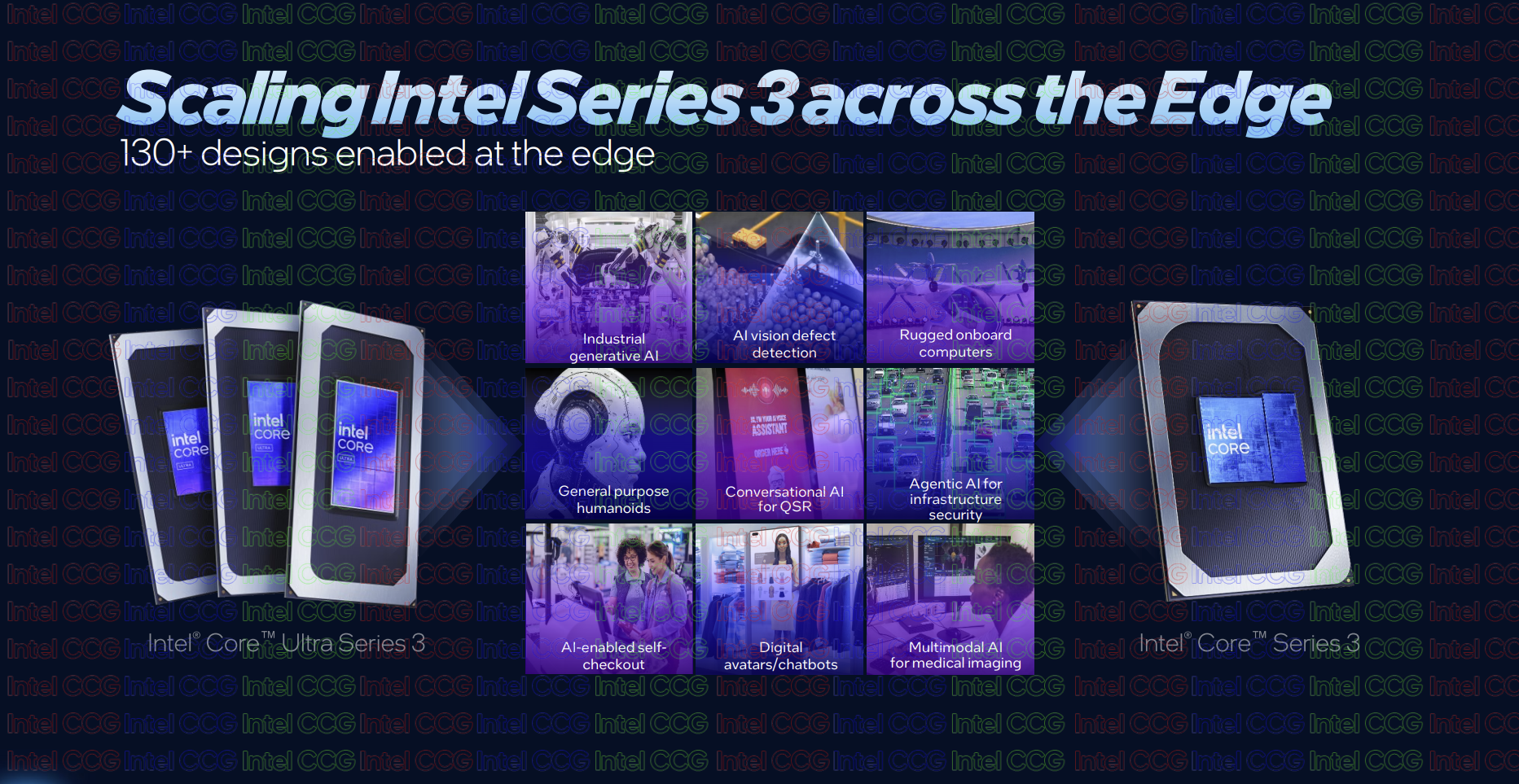
Intel Corp. today announced that more than 130 design engagements for its Series 3 processor family for edge artificial intelligence and edge computing designs and also unveiled a new open-source framework called OpenVINO Physical AI to address what it calls a deployment gap between robotics models built in the lab and fleets running on factory floors.
The announcements, made ahead of Computex in Taipei, position Intel’s edge silicon and robotics software stack as a unified alternative to the fragmented mix of central processing units and discrete accelerators that has dominated robot design to date. The Series 3 family, which includes Intel Core Ultra Series 3 and Intel Core Series 3 processors, was launched at CES in January as the debut product on Intel’s 18A manufacturing process.
Anchoring the design momentum is SensoryAI Inc., which has migrated its multi-agent retail robot Ella to Intel architecture. Ella, which Intel describes as the first multi-agent physical AI store running in public commercial service, previously relied on a separate CPU paired with a discrete accelerator. SensoryAI has replaced that arrangement with a single Intel Core Ultra Series 3 platform that handles both real-time control and AI inference.
Three specialized AI agents now run concurrently on the same system-on-chip, an Avatar agent handling customer conversation, a Guardian agent overseeing system operations, and an Ella agent providing store-level business intelligence. A deterministic orchestrator issues commands to the robot itself. Intel said the consolidation eliminates a class of components, reduces software complexity and offers a cleaner path to scale future robot designs.
Other design wins span industrial generative AI, AI vision defect detection, rugged onboard computers, general-purpose humanoids, conversational AI for quick-service restaurants, agentic AI for infrastructure security, AI-enabled self-checkout, digital avatars and multimodal AI for medical imaging.
The second part of the announcement is OpenVINO Physical AI, an extension of Intel’s OpenVINO toolkit, which the company launched back in 2018 for computer vision at the edge. Intel is positioning the new framework as the first open-source robotics library with a silicon-optimized inference runtime.
The framework is designed to give developers a consistent way to take robot policies and multimodal models from experimentation into working robot systems while maximizing inference performance. It integrates with open-source robotics model development environments, including Intel’s own Physical AI Studio and the open-source LeRobot project.
Intel argues the framework solves a specific industry problem. Deploying physical AI models at scale has required customized pipelines for each robot to handle sensors, codecs, inferencing loops and actuation, often locking customers into dual-compute solutions that are expensive to deploy and maintain. Pairing Intel Core Ultra Series 3 with OpenVINO Physical AI, the company said, allows customers to lower total cost of ownership, reuse more code across robot types and scale fleets across factories, warehouses and retail environments.
“Physical AI models are transforming robotics, but deployment has been slowed by fragmented software stacks and one-off integrations for every robot,” said Dan Rodriguez, corporate vice president of the Edge Computing Group at Intel. “With Intel Core Ultra Series 3 and OpenVINO Physical AI, we provide a unified, open and scalable path from AI experimentation to production-grade robots delivering hardware-accelerated, high-performance inference.”
Intel is also pitching the Series 3 family on cost. In benchmark figures shared with media, the company put its Core Ultra X7 358H against Nvidia Corp.’s Jetson AGX Orin and Jetson Thor T5000 modules, claiming competitive performance with Thor on medium-sized vision-language-action models at roughly half the system cost and lower latency than AGX Orin on a three-camera Pi0.5 Droid workload. Intel pegs Thor’s relative system cost at twice that of its own platform.
Physical AI Studio is available now. OpenVINO Physical AI is available in preview on GitHub, with general availability targeted for the second half of 2026.
Support our mission to keep content open and free by engaging with theCUBE community. Join theCUBE’s Alumni Trust Network, where technology leaders connect, share intelligence and create opportunities.
Founded by tech visionaries John Furrier and Dave Vellante, SiliconANGLE Media has built a dynamic ecosystem of industry-leading digital media brands that reach 15+ million elite tech professionals. Our new proprietary theCUBE AI Video Cloud is breaking ground in audience interaction, leveraging theCUBEai.com neural network to help technology companies make data-driven decisions and stay at the forefront of industry conversations.