 AI
AI
AI
AI


AI

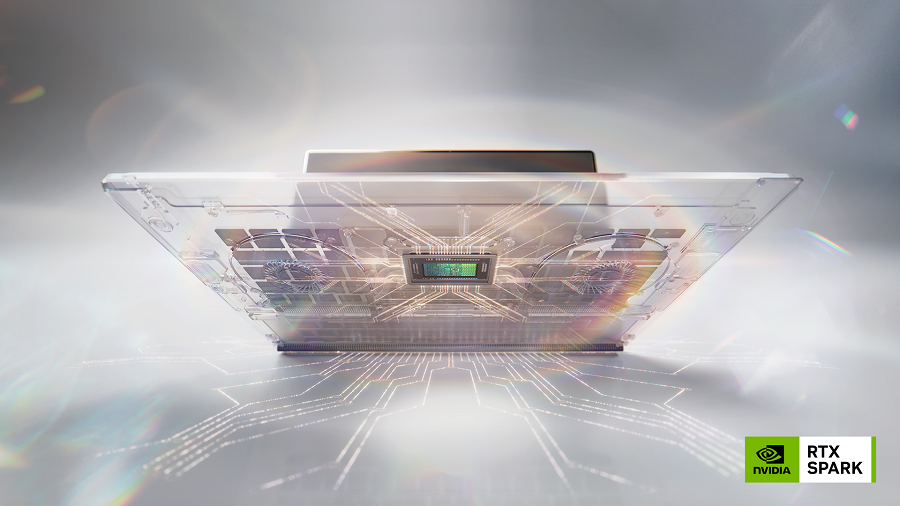
Nvidia Corp. today introduced a system-on-chip designed to power Windows laptops and compact desktops.
RTX Spark, as the processor is called, will roll out alongside Windows upgrades that will make the operating system better at running artificial intelligence agents. Separately, Nvidia will launch an AI-optimized desktop for technical professionals.
The processor is powered by a graphics processing unit based on Nvidia’s Blackwell architecture. It features 6,144 CUDA cores, which can perform a wide range of tasks, with an unspecified number of specialized Tensor Cores. The latter circuits are optimized for a narrower set of use cases such as running large language models.
Nvidia originally developed Blackwell for data centers. The most advanced server chip that uses the architecture, the Blackwell Ultra, features about four times as many CUDA cores as the RTX Spark. The former chip includes specialized circuits optimized to speed up workloads such as database queries and LLM attention calculations.
The system combines its Blackwell accelerator with a 20-core central processing unit. The CPU is based on Nvidia’s Grace architecture, which was designed for data centers similarly to Blackwell. Nvidia adapted it to Windows computers through a partnership with MediaTek Inc., a major supplier of consumer device chips.
RTX Spark’s GPU and CPU exchange data via a custom interconnect called the NVLink-C2C. They’re supported by 128 gigabytes of unified memory. Together, the chip’s two computing modules provide up to 1 petaflop of performance when processing data in the FP4 format, which is widely used by AI models.
An RTX Spark computer can run on-device LLMs with up to 120 billion parameters and a 1 million-token context window. Such models can be used to power, among other programs, AI agents such as OpenClaw. Nvidia says that the OpenClaw Windows app’s developers will integrate the software with a set of new AI agent controls built into RTX Spark computers.
Microsoft will extend Windows with “identity, containment, policy and end-to-end security” features for AI agents. Nvidia, in turn, will provide access to its recently launched OpenShell tool. The software runs agents in isolated sandboxes to reduce the impact of cybersecurity incidents. According to Nvidia, the controls will enable users to block agents’ access to personal information and limit the range of actions they can perform.
“Microsoft and Nvidia are going to reinvent the PC,” Nvidia Chief Executive Officer Jensen Huang said at the company’s GTC Taipei event today, where it announced the RTX Spark alongside several other product updates. “This is the first completely reengineered, reinvented line of PCs that has happened in 40 years.”
Running AI agents is not the only use case that Nvidia is targeting with the RTX Spark. The company says that laptops equipped with the chip also lend themselves to running creative applications and video games.
Many video games generate visuals using ray tracing, a rendering technique that simulates light beams. The RTX Spark enhances ray tracing programs with a feature called DLSS 4.5 Ray Reconstruction. According to Nvidia, the feature uses a custom transformer model to fix noise in video games frames generated with ray tracing. The company expects DLSS 4.5 Ray Reconstruction to improve lighting and motion efforts.
Over in the creative software market, several major players including Adobe Inc. are updating their applications to run on the RTX Spark. Photoshop is receiving enhancements that will enable users to complete some tasks up to twice as fast as before. The image editing application includes several AI-powered features that enable designers to add, remove and change elements with prompts.
Nvidia has partnered with more than a half-dozen computer manufacturers to bring the RTX Spark to market. Microsoft will also join the fray with the Surface Laptop Ultra, an upcoming high-end laptop. The device combines an RTX Spark with a 15-inch display, five port types and a battery that supports up to 24 hours of use between charges.
Support our mission to keep content open and free by engaging with theCUBE community. Join theCUBE’s Alumni Trust Network, where technology leaders connect, share intelligence and create opportunities.
Founded by tech visionaries John Furrier and Dave Vellante, SiliconANGLE Media has built a dynamic ecosystem of industry-leading digital media brands that reach 15+ million elite tech professionals. Our new proprietary theCUBE AI Video Cloud is breaking ground in audience interaction, leveraging theCUBEai.com neural network to help technology companies make data-driven decisions and stay at the forefront of industry conversations.