 EMERGING TECH
EMERGING TECH
EMERGING TECH








EMERGING TECH

Fusion power startup Helion Energy Inc. has closed a $465 million funding round led by Thrive Capital.
The Series G deal also included contributions from SoftBank Vision Fund 2, Lightspeed and more than a half-dozen others. Helion stated in its Thursday funding announcement that it’s now valued at $15.5 billion. That’s nearly three times what the company was worth after its last raise in January 2025.
Helion is developing a fusion reactor, a system that generates electricity by fusing atomic nuclei. Merging two atomic nuclei produces a single nucleus that is slightly lighter than the combined mass of the particles from which it was formed. The mass differential turns into energy.
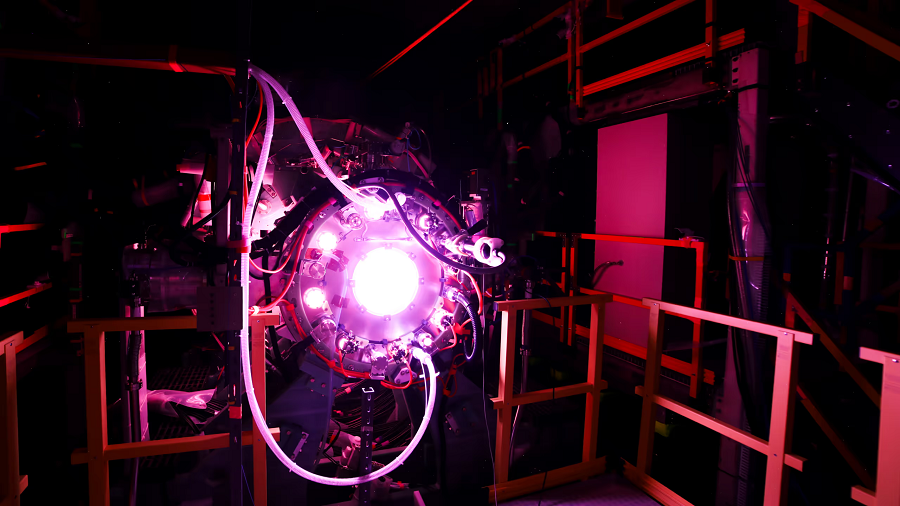
Scientists have long sought to harness fusion for commercial energy generation, but technical challenges still remain. Helion believes its fusion reactor design, which it calls Polaris, will provide the necessary breakthrough.
Polaris is a cylindrical structure that uses a fuel called D-He-3. It produces energy through a process that starts with the insertion of D-He-3 fuel into the two ends of the cylinder. The reactor turns the fuel into plasma, a mixture of electrons and atoms with a positive electric charge. It then uses magnetic fields to compress the plasma into a donut-like shape.
Once the plasma donuts at the two ends of the cylinder are ready, Polaris accelerates them toward each other at a speed of 100 million miles per hour. The resulting collision compresses the fuel. A magnetic field further increases the pressure and heat inside Polaris, creating the conditions necessary for atomic nuclei to fuse.
Fusion reactions cause changes in the magnetic field that Polaris generates. Those changes, in turn, produce an electric current.
Helion’s D-He-3 fuel comprises two materials called deuterium and helium-3. Deuterium is an isotope, or variant, of hydrogen with an extra neutron that makes it about twice as heavy as the standard version. It’s commonly found in seawater. Helium-3, in turn, is a rare helium isotope that costs millions of dollars per liter.
The company plans to manufacture helium-3 in-house by merging deuterium nuclei with one another in its reactors. Deuterium-deuterium reactions produce helium-3 and tritium, a radioactive hydrogen isotope that turns into helium-3 over time.
Helion’s approach to fusion comes with certain tradeoffs. Producing helium-3 is technically challenging and Polaris must heat its D-He-3 fuel to much higher temperatures than other reactors. However, Helion says, the tradeoffs are offset by the benefits.
The radiation that Polaris gives off comprises protons, which are significantly easier to contain than the neutrons generated by other reactors. As a result, the system requires less shielding equipment. Helion says its design also reduces the need for other costly modules such as cooling towers and turbines.
Several of the components that the company didn’t include in Polaris are needed by other reactors because of a phenomenon called fusion ignition. It’s a set of conditions under which a reactor’s fuel can continuously heat itself. According to Helios, Polaris doesn’t require continuous heating because it generates energy through a series of discrete fusion events. The reactor shapes plasma into donuts, merges them and repeats the process.
The company will use its latest round to expand its manufacturing capacity and accelerate commercialization initiatives. Helios started building its first commercial fusion power plant in Malaga, Washington last year. The facility is expected to generate 50 megawatts of electricity when it comes online in 2028.
Support our mission to keep content open and free by engaging with theCUBE community. Join theCUBE’s Alumni Trust Network, where technology leaders connect, share intelligence and create opportunities.
Founded by tech visionaries John Furrier and Dave Vellante, SiliconANGLE Media has built a dynamic ecosystem of industry-leading digital media brands that reach 15+ million elite tech professionals. Our new proprietary theCUBE AI Video Cloud is breaking ground in audience interaction, leveraging theCUBEai.com neural network to help technology companies make data-driven decisions and stay at the forefront of industry conversations.