 EMERGING TECH
EMERGING TECH
EMERGING TECH












EMERGING TECH

Gravis Robotics AG said today it has bagged $200 million in funding from SoftBank Group Corp. in what is the largest-ever Series A round for a construction robotics startup.
The startup was founded in 2022 after being spun out of the Swiss Federal Institute of Technology Zurich, having developed intelligent, software-defined systems for heavy excavators. Its software transforms them into self-operating machinery that’s able to navigate busy construction sites and perform work autonomously, without human drivers.
Gravis says the construction industry is crying out for greater automation. While the artificial intelligence infrastructure buildout hogs all of the headlines, physical infrastructure is currently in the midst of a similar expansion, with an urgent need for new homes, roads, transit networks, bridges and power grids. But unlike the AI industry, the construction sector is struggling to keep up with the demand for this new infrastructure. Because of an aging workforce and severe labor shortages, construction firms often struggle to meet their project timelines.
At present, the construction industry is one of the world’s least automated, being highly reliant on humans to drive its heavy machinery, and that’s what Gravis wants to change.
But bringing automation to the construction sector is far from simple. In fact, it requires overcoming technical challenges that simply don’t exist in other industries, Gravis says. Existing physical AI systems such as autonomous vehicles and robotic arms operate in what the company calls “static environments,” where the main objective is to move without disturbing their surroundings.
In contrast, heavy machines like excavators do the opposite. Their job is to interfere with the terrain around them, digging through soil and subterranean rock and reshape the landscape they operate in.
To overcome this challenge, Gravis’ AI models have been trained in simulated environments that attempt to replicate all of the subtle feedback that human excavator operators experience when driving these machines. As co-founder and Chief Technology Officer Dominic Jud explained, humans can listen to the sound of the engine, sense the machine’s vibrations and react to hydraulic resistance to “read the earth” they’re digging through.
“Our AI takes that same physical input and grounds it in machine telemetry, responding to varying subterranean forces and soil mechanics at microsecond speeds,” Jud explained. “We didn’t try to simplify the world for our software; we gave it the physical intuition to handle real job sites with precision that goes beyond what any human can feel from inside the cab.”
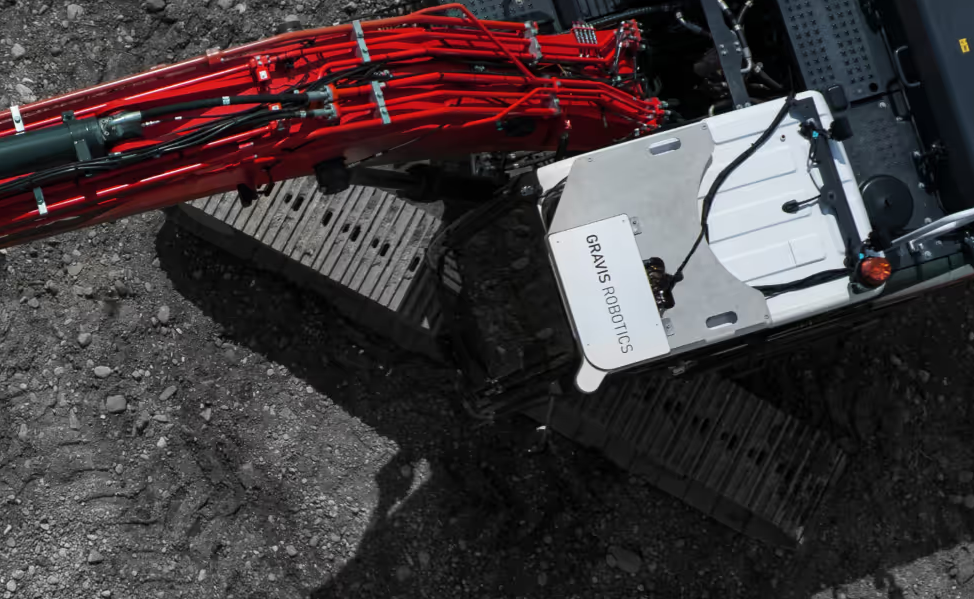
Gravis’s AI models power the Gravis Rack, which is an autonomous control system that can be retrofitted onto existing machines from companies such as Caterpillar Inc., John Deere & Co., JCB International Co. Ltd. and Hitachi Ltd. According to the startup, Gravis Rack enables a 30% boost in productivity compared to driving these machines manually, though the system also acts as a copilot for human operators, in addition to operating machines fully autonomously.
The Gravis Rack is a flat, rectangular computing appliance that sits on the roof of the host excavator. It contains not only the chip that runs the system’s AI software but also cameras and a lidar sensor. Additional cameras and lidar modules are attached to a pair of rear vehicle masts that come included in the package.
According to Gravis, the rear masts host not only sensors but also a GPS module. The location data that GPS satellites beam down to Earth can be imprecise at times. The Gravis Rack uses a technology called GNSS RTS to increase the accuracy of the data.
This collects not only GPS measurements, but also technical information about the radio signals that carry those measurements. It analyzes that information to find and fix errors in location data. In some cases, GNSS RTS can boost the accuracy of GPS signals to under an inch.
The startup says each excavator is also fitted with a Wi-Fi transmitter. It’s responsible for syncing data to and from the Gravis Rack’s companion Slate tablet. The tablet enables construction professionals to remotely operate earthmoving vehicles. It displays real-time footage from a vehicle’s sensors, overlaying visual cues on the video stream to highlight water pipes and other infrastructure that an excavator should avoid. Additionally, the tablet’s interface displays geographic information such as elevation data.
The startup says Gravis Rack has been deployed across dozens of job sites globally, but the goal now is to expand the adoption of its platform much more rapidly. One of its main targets is the U.K., where it was recently awarded an $8 million contract to retrofit existing excavator fleets.
Co-founder and Chief Executive Ryan Luke Johns stressed the importance of automating excavation work, noting that it’s the starting point of every new construction project. “Whether we are building housing, scaling data centers or modernizing energy grids, every project starts with moving earth,” he said. “That foundational work has been the bottleneck slowing down the entire built environment.”
Support our mission to keep content open and free by engaging with theCUBE community. Join theCUBE’s Alumni Trust Network, where technology leaders connect, share intelligence and create opportunities.
Founded by tech visionaries John Furrier and Dave Vellante, SiliconANGLE Media has built a dynamic ecosystem of industry-leading digital media brands that reach 15+ million elite tech professionals. Our new proprietary theCUBE AI Video Cloud is breaking ground in audience interaction, leveraging theCUBEai.com neural network to help technology companies make data-driven decisions and stay at the forefront of industry conversations.