 AI
AI



AI

At Block Builderlab Launch Event 2026, AI agents moved out of single-player chat windows and into shared workspaces. There they work beside people as named, auditable members of the team. Block Inc. built these tools to run itself as an intelligence company, and it is now offering them to other businesses, building on Buzz, its open-source workspace for humans and AI agents.
The next phase will depend less on how capable a single agent becomes than on how well agents collaborate, share an organization’s context and stay inside firm security boundaries. Block plans to spread that model with open-source code, model-agnostic design and hosted infrastructure. The company is making that push while its core business delivers a third straight guidance raise.
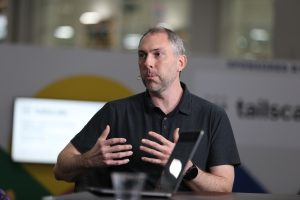
“If you’re talking about making the whole organization more productive, you need to break down these distinctions between what the software does and what the people do,” said Paul Gillin, enterprise editor of SiliconANGLE Media Inc.
Alison Kosik and co-host Gillin spoke with industry experts during Block Builderlab Launch Event 2026 in San Francisco. The interviews covered Block’s open-source business model, agents with their own identities, the shift from prompting to overnight delegation and the security controls that let enterprises trust autonomous systems. (* Disclosure below.)
Here are four standout insights from the event:
Builderlab gives developers endlessly customizable agents on an open-source plug-in architecture, and the launch audience of application builders cheered the idea, according to Gillin. Agents in Buzz have names, avatars and personalities. That shifts the focus from switching among software-as-a-service applications to the work itself, and it could threaten SaaS companies. The revenue model follows the classic open-source pattern of giving the software away and charging for the convenience of a hosted cloud service, he explained. Block said little about commercialization or about Cash App, which brings in 60% of its revenue. Gillin described that as a savvy move, since developers will build the integrations and find new uses themselves.
Check out theCUBE’s complete interview.
Most AI tools are built for one person at a time, so each user becomes the bottleneck when results have to be shared with a team, noted Lucas Isaza, product lead of Buzz at Block. In Buzz, agents have their own identities, can be tagged like colleagues and leave an audit trail of every action. Plug-ins, added after the first version launched in July, let anyone reshape the interface. Nontechnical staff, such as account managers building personal dashboards, have been the heaviest users of the companion apps platform. Companies can self-host the open-source code, use a free tier or add funds for remote agents, models and extra storage, Isaza highlighted.
Watch the full interview from theCUBE.
Builderlab sits as an interface layer above the models, so Buzz can use agents from any AI lab and switch to the newest frontier model as it arrives, emphasized Brad Axen, head of AI capabilities at Block. Remote agents run in central cloud environments that are easier to secure than laptops. People can hand them large assignments overnight and act as reviewers. Instead of soft guardrails, agents run on secure building blocks that never grant them permission for certain actions. Some teams have shipped software releases 50% to 75% faster. Axen expects agents to need much less human steering within the next year because they already sit inside the conversation.
See theCUBE’s full coverage.
Securing agents that act on their own does not mean starting over, because principles such as least privilege, isolated environments and egress controls still apply, shared James Nettesheim, chief information security officer and head of enterprise technology at Block. Builderlab gives every agent a full identity owned by a human, runs it in hardened cloud virtual machines and records its actions in a cryptographically signed ledger that cannot be altered. Block is also building information flow control, which tags data from sensitive sources so the security policy travels with that data and blocks leaks. AI already reviews Block’s code and sorts its security alerts. Nettesheim added that agents let defenders keep pace with attackers’ machine speed.
Don’t miss the full interview on theCUBE.
Here’s more of SiliconANGLE’s and theCUBE’s coverage of Block Builderlab Launch Event 2026:
[Add the YouTube playlist for this event in WordPress before publishing]
(* Disclosure: TheCUBE is a paid media partner for the Block Builderlab Launch Event 2026 event. Neither Block, the sponsor of theCUBE’s event coverage, nor other sponsors have editorial control over content on theCUBE or SiliconANGLE.)
Support our mission to keep content open and free by engaging with theCUBE community. Join theCUBE’s Alumni Trust Network, where technology leaders connect, share intelligence and create opportunities.
Founded by tech visionaries John Furrier and Dave Vellante, SiliconANGLE Media has built a dynamic ecosystem of industry-leading digital media brands that reach 15+ million elite tech professionals. Our new proprietary theCUBE AI Video Cloud is breaking ground in audience interaction, leveraging theCUBEai.com neural network to help technology companies make data-driven decisions and stay at the forefront of industry conversations.