 WIKIBON
WIKIBON
WIKIBON











WIKIBON

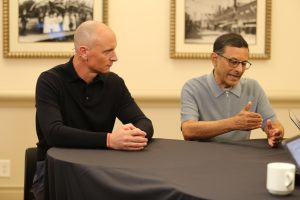
 Barack Obama might be a bit of a lame duck President these days, but he does at least get to decide who’s in charge of the government’s IT operations. And to hammer that point home, he’s just gone and appointed VMware CIO Tony Scott as the new U.S. CIO.
Scott assumes the role that was originally created for Vivek Kundra, who became the government’s first CIO in 2009. Kundra’s legacy was assured when he kicked off the ongoing Federal Data Center Consolidation Initiative (FDCCI), as part of a wider effort to overhaul the federal government’s IT spend and consumption. As for Scott, he joined VMware in 2013, serving as its CIO and senior vice president, following a five-year stint as Microsoft’s CIO. Before that, he served as CIO at Walt Disney and as CTO of General Motors.
VMware was quick to wish Scott every success in his new role, while stating it was now actively hunting for his replacement. “Tony Scott will bring to his new role strong leadership skills and a passion for success,” said Jonathan Chadwicj, VMware’s CFO, COO and executive vice president. “We’re excited for him and the country and we thank Tony for his pioneering work at VMware.”
The White House has been pushing federal agencies hard to modernize and consolidate their IT infrastructure ever since Kundra became the U.S. government’s first CIO. As well as introducing the FDCCI, he also encouraged the use of commerical cloud services via a mandate that all agencies should evaluate these first, before deciding to build applications on-premise.
“Over the past six years, this administration has embarked on a comprehensive approach to fundamentally improve the way government delivers results and technology services to the public,” said Shaun Donovan, director of the Office of Management and Budget, and Beth Cobert, deputy director for management at the White House, in a joint statement.” Under Tony’s leadership, we will continue to build on the remarkable work done by the Nation’s first CIOs Vivek Kundra and Steve VanRoekel in changing the way the Federal government manages IT.”
The FDCCI has proven difficult to implement in many agencies, hence progress with shutting down unnecessary data center capacity has been slow. The original plan was for agencies to consolidate data center assets, but the approach has since changed to one where applications must be “rationalized”, which means finding the most economical way to host core apps and getting rid of those considered non-essential.
Kundra quit the White House role in 2011 to take up a fellowship at Harvard. Later, he joined Salesforce.com as its executive vice president of emerging markets. He was succeded by ex-Microsoft man Steve VanRoekel, who held the role for three years before his abrupt resignation in September 2014, when he joined the U.S. Agency for International Development’s Ebola response team as its chief innovation officer.
Image credit: VMware.com
Support our mission to keep content open and free by engaging with theCUBE community. Join theCUBE’s Alumni Trust Network, where technology leaders connect, share intelligence and create opportunities.
Founded by tech visionaries John Furrier and Dave Vellante, SiliconANGLE Media has built a dynamic ecosystem of industry-leading digital media brands that reach 15+ million elite tech professionals. Our new proprietary theCUBE AI Video Cloud is breaking ground in audience interaction, leveraging theCUBEai.com neural network to help technology companies make data-driven decisions and stay at the forefront of industry conversations.