












Samsung Electronics Co., Ltd. might be struggling to grow its smartphone business anymore, but could soon make up for it with a new series of chips it hopes will power the Internet of Things.
Announced yesterday at the Internet of Things World conference in San Francisco, Samsung’s Artik IoT chips are said to be as powerful as full-fledged computers, and designed to power a range of connected ‘things’ including smart appliances, smart sensors and even smart clothing. The Artik hardware platform is a system-on-a-chip series that integrates the most popular radio frequency standards into a single component, which makes it easier for developers to build gadgets that can communicate with other devices.
Young Sohn, Chief Strategy Officer at Samsung Electronics, said the Artik line of processors combines hardware and software to help companies quickly and easily build Internet-connected devices.
Samsung’s system-on-a-chip (SoC) design integrates all of the key components of a mobile computer onto a single chip, including memory, sensors, accelerometer, and most crucially, radio frequency functions. The company’s original SoC chip was the Exynos, a powerful ARM-based chip that’s used to power Samsung’s Galaxy smartphones. Samsung also built an earlier SoC model that was used to power the first Apple iPhone back in 2007.
But the Artik SoC is considerably different, not least because it’s aimed at hardware developers large and small, rather than just the big guns like Samsung and Apple. During the 2015 Consumer Electronics Show in January, Samsung, led by co-CEO Boo-Keun Yoon, vowed that all of the company’s products would be built on platforms that are open and compatible with other products. Yoon said that 90 percent of its devices — which range from smartphones to refrigerators — would be able to connect to the Web by 2017. In five years, every product in the company’s entire catalog is expected to be Internet-connected, and the Artik SoC’s look likely to play a big part in making that happen.
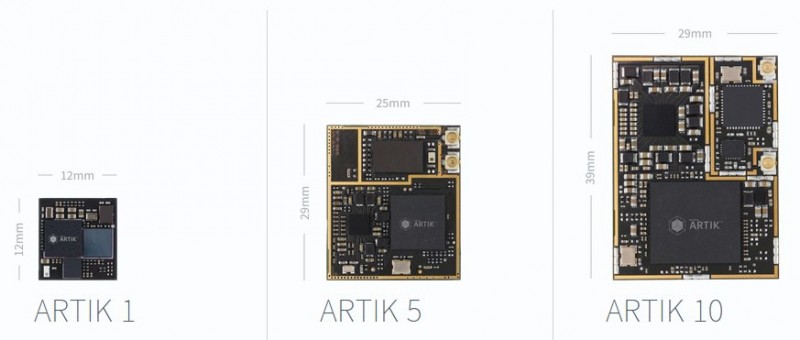
Samsung’s Artik SoC’s come in three variations – Artik 1, Artik 5 and Artik 10, with each model subsequently packing in faster processing power and more capabilities than its predecessor. The price of the chips will start at just $10 for the smaller version, up to $100 for the most powerful, Sohn said, and will be aimed at everything from simple tracking sensors to smart home hubs, drones and more. Both the chips and Samsung’s new SmartThings Open Cloud, a platform designed to facilitate communication between different devices, are available to hardware manufacturers from today.
“What’s important is these are smart machines that are going to make our lives better,” Sohn said during his appearance at San Francisco’s Moscone Center.
That’s if people choose to use them. Unfortunately for Samsung, it’s likely to face some stiff competition, with companies like Broadcom Corp., Intel corp., and Qualcomm Inc. all pushing their own systems to power the Internet of Things. For example, last January, Intel unveiled a new processor platform aimed at wearable devices called Curie – a button-sized device that packs in a processor, Bluetooth low-energy radio, sensors and a dedicated engine to tell apart different sporting activities. Intel said Curie could be used power wearables of different designs, from rings to pendants to clothes, but the chip, which is based on 32-nanometer technology, won’t be available until later this year, giving Samsung’s Artik a slight edge.
Samsung is clearly betting big on the Internet of Things, and with good reason. Analyst firm Gartner Inc. predicts the number of connected devices will surge to 26 billion units by 2020, from about 900 million in 2009, turning formerly “dumb” objects into smart ones that can communicate with each other. Another analyst firm, International Data Corp., reckons the IoT market will be worth $3.04 trillion by 2020.
Samsung’s push into the IoT comes at a time when its fortunes are flagging somewhat in the smartphone market its led for years. The company’s market share in China fell by an astonishing 50 percent in the first quarter, while Apple’s own share rose by more than half. Overall, Samsung’s profits dropped by 20 percent in the first quarter, weighed down by its mobile division, while its semiconductor unit saw earnings jump by 50 percent.
Support our mission to keep content open and free by engaging with theCUBE community. Join theCUBE’s Alumni Trust Network, where technology leaders connect, share intelligence and create opportunities.
Founded by tech visionaries John Furrier and Dave Vellante, SiliconANGLE Media has built a dynamic ecosystem of industry-leading digital media brands that reach 15+ million elite tech professionals. Our new proprietary theCUBE AI Video Cloud is breaking ground in audience interaction, leveraging theCUBEai.com neural network to help technology companies make data-driven decisions and stay at the forefront of industry conversations.