




 AI
AI
AI
AI
AI

French artificial intelligence startup Mistral AI is jumping into the vibe coding market with the launch of Devstral 2, a new model that’s built specifically to handle advanced coding tasks.
Announced today, Devstral 2 is a 123 billion-parameter model that comes with autonomous software engineering capabilities that the company says can rival those of the best proprietary vibe coding systems, while undercutting costs by almost 85%.
Devstral 2 is being released alongside Mistral Vibe, a new command-line interface that allows developers to access the model and execute complex tasks using natural language prompts. There’s also a smaller model called Devstral Small 2, which has just 24 billion parameters and is optimized for local deployment.
Mistral AI is trying to provide an alternative to proprietary coding bots from companies such as Google LLC and OpenAI, which try to lock users into their ecosystems, positioning itself as a true open-source vibe coding platform.
The Mistral Vibe CLI is the key interface here, leveraging the underlying Devstral models to transform user’s natural language prompts into real-world code changes. The system is comprehensive, and rather than just generating snippets of code, it’s meant to explore, modify and create changes across an entire codebase. It can operate within any third-party integrated development environment or as a standalone terminal utility, with a suite of tools that enables the model to edit files, search codebases, manage version control and execute shell commands with full autonomy.
Mistral AI said Devstral 2’s ability to scan file structures and Git statuses means it has the “project-aware context” to update dependencies or make changes to the codebase across an entire project without losing track of what it’s doing.
Mistral AI says its primary focus with Devstral 2 is operational efficiency. It combines its 123 billion-parameter dense transformer architecture with a 256,000 token context window to achieve an impressive 72.2% score on the SWE-bench benchmark, ranking it among the top-performing coding models in the business. Among rival open-weight models, only DeepSeek V3.2 has achieved a superior score. Google, OpenAI and Anthropic PBC’s cutting-edge models also rank higher.
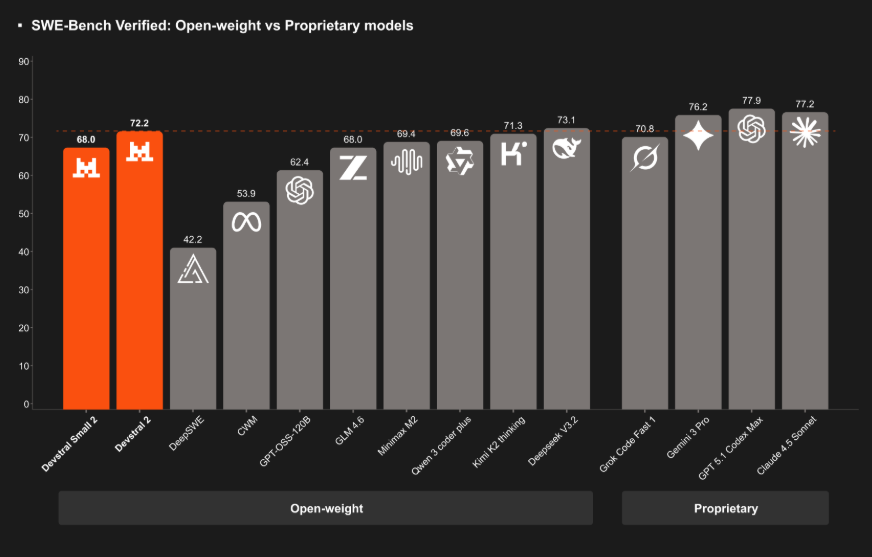
The Devstral Small 2 variant also demonstrates impressive performance considering its much smaller footprint, with its 68% score on the same benchmark meaning it can go toe-to-toe with models that are five-times larger. It’s impressive because the model’s lightweight nature means it’s efficient enough to run on consumer hardware such as a standard laptop, eliminating the latency that comes with AI running in the cloud.
However, Mistral AI says Devstral 2’s biggest advantage is in cost, with the model priced at 40 cents per million input tokens and $2 per million output tokens via its application programming interface. That undercuts models such as Anthropic’s Claude Sonnet 3.5 by about seven times.
The most obvious difference between Devstral 2 and Devstral Small 2 is size, but Mistral AI has opted to issue the models under different licensing terms. Devstral 2 ships with a Modified MIT license that implies some kind of revenue-based restrictions on users, whereas Devstral Small 2 is available under a more permissive Apache 2.0 license, meaning no restrictions on its use. Developers can therefore modify the smaller model and integrate it anyway they desire, without the legal headaches of proprietary systems.
It’s easy to imagine how some enterprises using Devstral 2 opt for a hybrid workflow, using the heavy 123 billion-parameter model for complex architectural planning tasks, and the smaller 24 billion-parameter version for more rapid, private code changes that remain within their network boundaries.
Mistral AI is launching Devstral 2 at a time when competition in the vibe coding segment intensifies, but its open-weights strategy may find some appeal. Competitors have been trying to lock in developers, with Google’s newly announced partnership with Replit Inc. exemplifying this push by bundling a powerful model, IDE and cloud compute into a single stack.
Google’s Gemini 3 Pro is tightly integrated with the company’s new AntiGravity IDE and also seems to want to keep developers locked into its ecosystem, while Anthropic is said to be building a dedicated runtime for its own coding agents following its acquisition of the JavaScript toolkit Bun.
With Devstral 2, Mistral AI provides developers with a welcome alternative, combining open weights with local deployment that sits firmly outside the walled gardens being built by many of its rivals.
Support our mission to keep content open and free by engaging with theCUBE community. Join theCUBE’s Alumni Trust Network, where technology leaders connect, share intelligence and create opportunities.
Founded by tech visionaries John Furrier and Dave Vellante, SiliconANGLE Media has built a dynamic ecosystem of industry-leading digital media brands that reach 15+ million elite tech professionals. Our new proprietary theCUBE AI Video Cloud is breaking ground in audience interaction, leveraging theCUBEai.com neural network to help technology companies make data-driven decisions and stay at the forefront of industry conversations.