 CLOUD
CLOUD
CLOUD
CLOUD






CLOUD

Today, enterprises are walking a fine line — between chasing AI innovation and securing proprietary data.
The complex nature of modern multicloud environments has led to a governance gap: Companies want to put AI into production at scale, but the ability to control it is lagging behind. At the same time, AI innovation is accelerating faster than the frameworks designed to manage it. Moreover, the pressures of digital sovereignty and regulations are forcing enterprises to rethink how they manage their workloads.
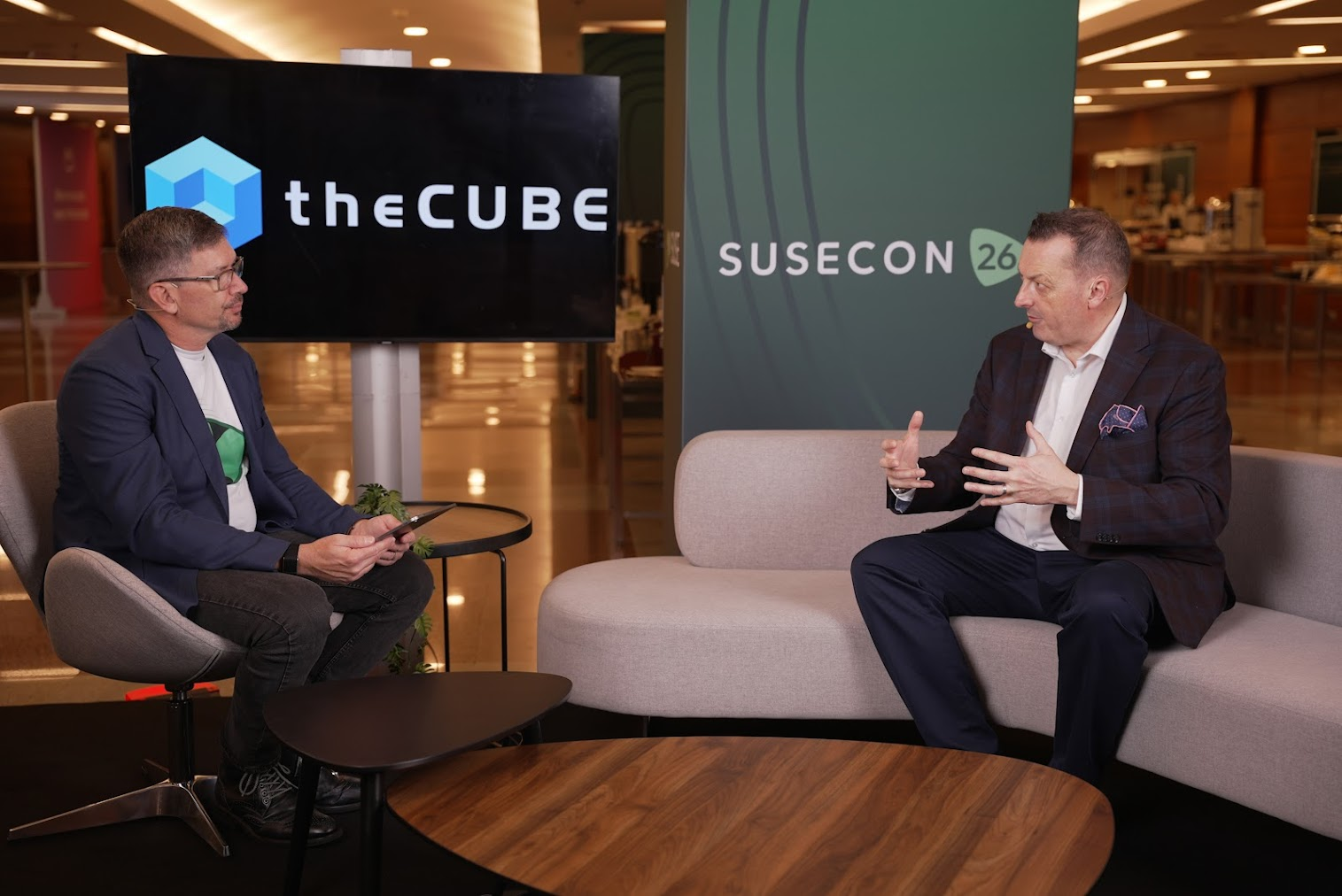
“I think people have gone past, ‘Is it a virtual machine environment? Is it a container environment? Is it a bare metal environment?’” said Steven Dickens (pictured, right), chief executive officer of HyperFRAME Research LLC. “You layer those three different hardware and infrastructure choices over a multicloud strategy — [that’s] too much complexity to manage if you’ve got a different tool or a different environment for each.”
Dickens spoke with theCUBE’s Paul Nashawaty (left) as part of a keynote analysis at SUSECON 2026, during an exclusive broadcast on theCUBE, SiliconANGLE Media’s livestreaming studio. At the event, leaders in open-source platforms gathered to discuss digital sovereignty, multicloud management and the concerns around protecting proprietary data while supporting ongoing AI innovation. (* Disclosure below.)
Here are three key insights you may have missed from SUSECON 2026:
Companies now need to operate complex multicloud environments while navigating digital sovereignty and regulations. With 65% of organizations using four or more clouds, a portable framework has become essential for enterprises hoping to keep up with the fast pace of AI adoption and sustain AI innovation across environments, according to Nashawaty.
“Cloud portability is the number one database strategic priority for enterprises over the next 24 months,” he said. “We also see that … 20% of respondents in [theCUBE’s] 2025 research indicated that it’s critical for their applications to be portable.”
On-premises environments continue to be an important part of the equation, especially in Europe, where enterprises must adhere to the Digital Operations Resilience Act (DORA). This has led many companies to engage in cloud repatriation — moving digital workloads from public clouds back to on-premises data centers or private clouds.
“You’re seeing repatriation of workloads,” Dickens said. “People are looking at, ‘Hey, do I bring the AI to the data or the data to the AI?’ That’s driving infrastructure choices. You factor all that in, you need a provider like SUSE, who’s got all of that optionality and choice.”
Here’s theCUBE’s complete Keynote Analysis with Paul Nashawaty and Steven Dickens:
Enterprises are increasingly concerned about public large language models accessing their proprietary data and threatening not just their security, but their entire business model. More than 75% of enterprises are expected to have a digital sovereignty strategy in place by 2030, according to Gartner Inc., and on-premises data centers will be a significant part of those plans.
“If the information that the models learn from is intellectual property, then you don’t want your intellectual property to leave through the front door because a large language model offers it up to the wider audience,” said Dirk-Peter van Leeuwen, chief executive officer of SUSE, in an interview with theCUBE. “Data sovereignty and data security is really front of mind of every large enterprise before they start adopting AI.”
Nonetheless, van Leeuwen cautions enterprises against “proprietary lock-in” — getting stuck in a single-vendor or single-cloud strategy. Companies do not need to operate within a closed system in order to have more control over their data; in fact, SUSE leaders argue, the more transparency, the better for maintaining long-term AI innovation.
“The need for resiliency is important,” said Peter Smails, general manager of cloud-native at SUSE, who spoke to theCUBE during the event. “A lot of vendors … they’re going more proprietary at the worst possible time, because customers need the exact opposite, which positions SUSE very well.”
SUSE’s five-pathway resilience framework encompasses digital sovereignty, operational efficiency, cloud portability, edge and AI adoption. Its Kubernetes-based portability enables customers to deploy workloads across any cloud or on-prem environment, giving customers greater flexibility and security while enabling continuous AI innovation, according to Van Leeuwen.
“You have to find the solution that allows you to consume the continuous stream of innovation that comes from AI and do it on a platform that is stable enough to handle that innovation,” he said. “You want a stable core — a foundation that you invest [in] with your GPUs and with all the infrastructure you need — and then benefit from all the innovation on top without having to constantly rip and replace.”
Here’s theCUBE’s complete video interview with Dirk-Peter van Leeuwen:
And here’s the complete video interview with Peter Smails:
The gap around AI governance is growing. Shadow AI, in which employees use public AI models without company oversight, has led to security breaches and raised concerns about safe AI adoption as AI innovation spreads across the enterprise, explained Rhys Oxenham, vice president and general manager of AI at SUSE.
“Pilots are relatively straightforward to demonstrate value, but then how do you take that from that initial, ‘We’ve proven it here. How do I then do it at scale in production with critical data, with the need for that safety net and that governance?’” he said. “That is the production gap — or the production chasm — that our customers are having to cross and where we are helping them solve it.”
SUSE aims to address that problem with its AI stack, composed of SUSE Rancher Prime and SUSE Linux Enterprise Server. The package offers comprehensive observability and automation that maximizes the productivity of GPUs while enforcing governance across agentic workflows without slowing AI innovation. The goal is to support infrastructural resiliency so that SUSE’s customers can weather future changes in AI technology or government regulations, according to Abhinav Puri, general manager of portfolio and community at SUSE.
“The infrastructure that most organizations have today — that is based on a legacy foundation — was designed to host applications and host workloads,” he said. “That was designed to be managed. It wasn’t designed to think. SUSE, for the last 30-plus years, we’ve mastered the art of software-defined. We are elevating the infrastructure for IT leaders from simply a platform or a foundation to a digital coworker.”
SUSE is also delivering Model Context Protocol servers, a plug-compatible layer that works across any existing agentic AI platform and enables organizations to maintain proprietary control without locking in to one vendor while continuing to advance AI innovation.
“Digital sovereignty is not a European compliance check mark anymore,” Oxenham said. “Every organization in the world needs to think about their independence, their autonomy [and] their resilience planning for what they do with their infrastructure.”
Here’s theCUBE’s complete video interview with Rhys Oxenham:
And here’s the complete video interview with Abhinav Puri:
To watch more of theCUBE’s coverage of SUSECON 2026, here’s our complete event video playlist:
(* Disclosure: TheCUBE is a paid media partner for SUSECON 2026. Neither SUSE, the sponsor of theCUBE’s event coverage, nor other sponsors have editorial control over content on theCUBE or SiliconANGLE.)
Support our mission to keep content open and free by engaging with theCUBE community. Join theCUBE’s Alumni Trust Network, where technology leaders connect, share intelligence and create opportunities.
Founded by tech visionaries John Furrier and Dave Vellante, SiliconANGLE Media has built a dynamic ecosystem of industry-leading digital media brands that reach 15+ million elite tech professionals. Our new proprietary theCUBE AI Video Cloud is breaking ground in audience interaction, leveraging theCUBEai.com neural network to help technology companies make data-driven decisions and stay at the forefront of industry conversations.