 EMERGING TECH
EMERGING TECH
EMERGING TECH







EMERGING TECH

Space technology startup Cowboy Space Corp. today disclosed that it has raised $275 million in funding at a $2 billion valuation.
Index Ventures led the Series B round. It was joined by NEA, IVP and several other institutional investors along with Cowboy Space founding Chief Executive Baiju Bhatt, who previously co-founded Robinhood Markets Inc. The raise brings the company’s total outside funding to $355 million.
Cowboy Space is one of several startups working to deploy artificial intelligence data centers in space. The primary motivation behind doing so is the abundance of solar power available in orbit.
A solar panel can generate significantly more electricity in space than on the ground because its efficiency is not diminished by atmospheric light absorption. Furthermore, orbital solar panels can be deployed at a perpendicular angle to the sun to maximize power generation. On the ground, solar farms are only perpendicular to the sun for a limited amount of time.
Cowboy Space launched last year under the name Aetherflux. Its original plan was to deploy orbital solar panels and beam down the power they generate in the form of infrared light. Ahead of its funding round, the company pivoted to using those solar panels to power data centers in low-Earth orbit.
According to TechCrunch, each of the company’s data center modules will provide 1 megawatt of computing power. That power is set to be provided by about 800 onboard graphics processing units. Those chips, the data center module’s auxiliary computing equipment and its other components together weigh 20 to 25 tons.
The system is based on the Space-1 Vera Rubin Module that Nvidia Corp. debuted earlier this year. It’s a modified version of the company’s Vera Rubin accelerator, which combines an 88-core central processing unit with two Rubin graphics cards. A single Rubin chip can provide 50 petaflops of performance when processing NVFP4 data.
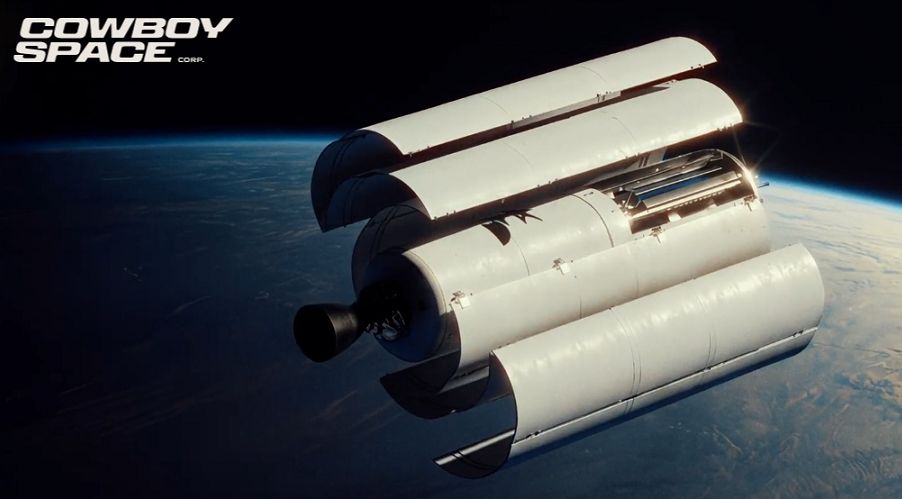
The company plans to make not only data center modules but also the rockets that it will take them to orbit. A space launch vehicle comprises two segments: a first stage responsible for lifting it out of the atmosphere and a second stage that contains cargo. Usually, the second stage is a single-use module that floats off after releasing its cargo.
Cowboy Space plans to take a different approach. The company intends to use its rocket’s second stage as a data center container, which will remove the need to discard it. Cowboy Space expects that arrangement to lower hardware costs.
The 1-megawatt capacity of the company’s data center module represents a fraction of the processing power offered by terrestrial AI environments. As a result, it may have to link together multiple data center modules into a cluster. Cowboy Space didn’t specify how it plans to go about the task.
Rival space startup Starcloud Inc. plans to attach multiple data center modules to a single support structure with a 6.1-square-mile solar array. In theory, such a support structure can be equipped with a network that facilitates packet movement. The alternative is to have the data center center modules exchange data wirelessly using laser transmitters.
Cowboy Space plans to launch its first satellite next year. In the longer term, it hopes to lower its launch costs by building a reusable rocket.
The company may face significant competition from SpaceX Corp.’s upcoming Starlink rocket. The launch vehicle features a reusable second phase with a maximum capacity of 150 tons, or 7.5 times the weight of Cowboy Space’s data center module. SpaceX has indicated that it also plans to deploy AI infrastructure in orbit.
Support our mission to keep content open and free by engaging with theCUBE community. Join theCUBE’s Alumni Trust Network, where technology leaders connect, share intelligence and create opportunities.
Founded by tech visionaries John Furrier and Dave Vellante, SiliconANGLE Media has built a dynamic ecosystem of industry-leading digital media brands that reach 15+ million elite tech professionals. Our new proprietary theCUBE AI Video Cloud is breaking ground in audience interaction, leveraging theCUBEai.com neural network to help technology companies make data-driven decisions and stay at the forefront of industry conversations.