 AI
AI
AI
AI





AI

The enterprise artificial intelligence conversation is moving past models and compute. As companies push projects into production, the harder problem is increasingly what sits underneath them: getting distributed, messy and often sensitive enterprise data ready for systems that need reliable context at speed.
“AI momentum is accelerating, but enterprises are discovering that moving from experimentation to production depends less on model selection and more on data readiness,” said Paul Nashawaty, practice lead and principal analyst — application development, modernization, cloud-native at theCUBE Research. “Our AppDev data shows that 86% of enterprises prioritize data unification over compute, while 64% of enterprise AI teams identify insufficient storage throughput as a leading training bottleneck.”
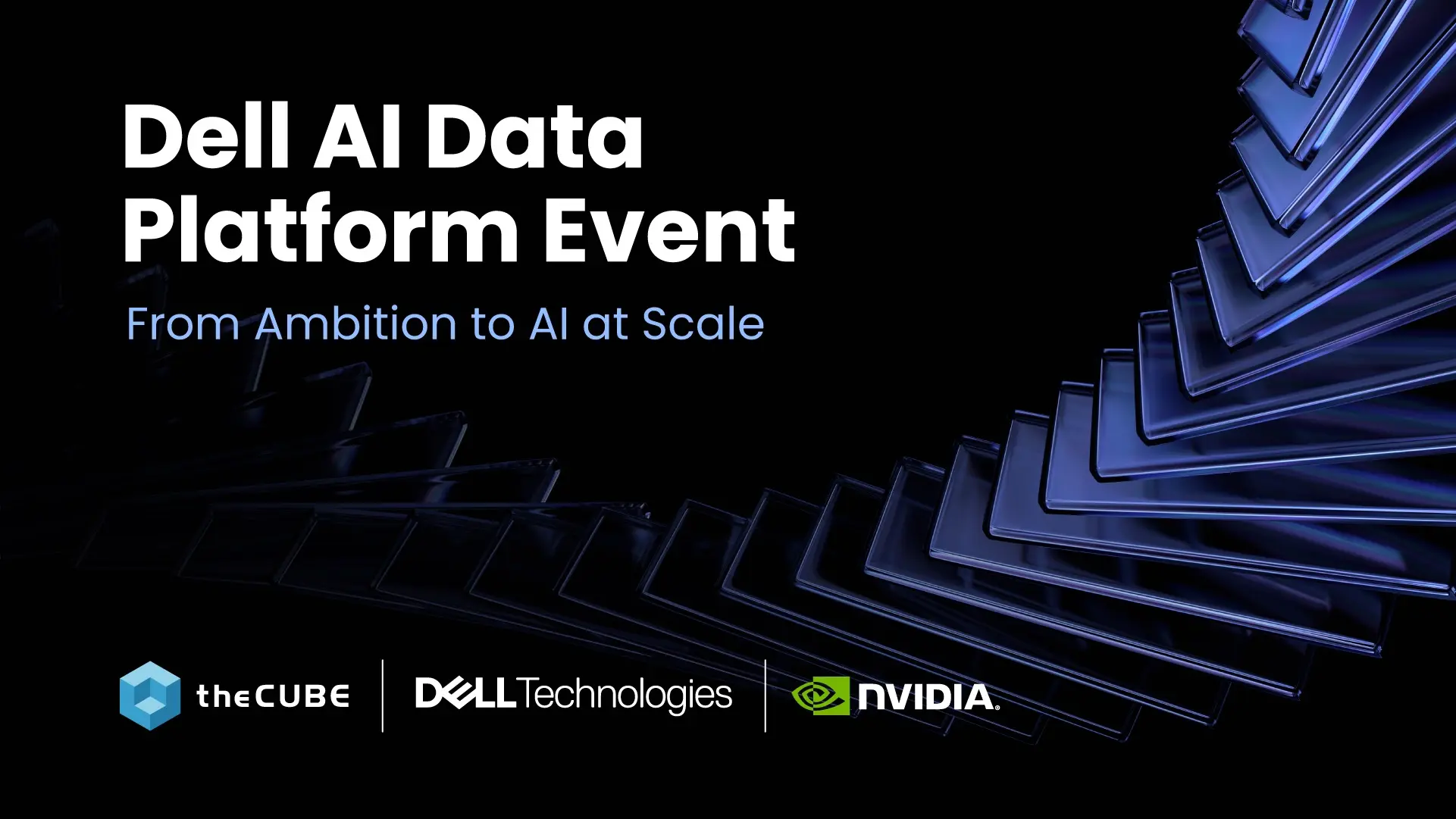
That challenge is at the center of Dell Technologies’ “AI Data Platform Event: From Ambition to AI at Scale” virtual event, which will examine how enterprises and neocloud providers can bring data management, storage, security, sovereignty and governance together as AI workloads expand. The event features Dell Technologies’ Arthur Lewis, David Noy, Vrashank Jain and Gaurav Chawla, along with Nvidia’s Jason Hardy, Elastic’s Sri Desikan, IREN’s Kambiz Aghili, CTBC Bank’s Peter Chu, and Orbital Studios executives, among others.
Join theCUBE Oct. 6–7 for exclusive interviews and analysis as theCUBE Research analysts Dave Vellante and John Furrier speak with practitioners and industry executives about what it takes to move enterprise AI from experimentation into operational systems. We’ll be broadcasting Oct. 6 in the Americas and Oct. 7 in EMEA and APJ. (* Disclosure below.)
Enterprises have spent heavily on models and accelerated computing, but the success of AI applications increasingly depends on whether those systems can reach the right data and use it effectively. Dell’s AI Data Platform addresses that challenge by bringing storage, data management and security together across environments where enterprise and neocloud AI workloads operate.
For developers, the issue goes beyond simply having access to more information. Nashawaty sees competitive advantage emerging from the ability to make trusted and governed data consistently available throughout the AI lifecycle.
“From an application development perspective, the competitive advantage is enabling developers to access trusted, governed data consistently across the AI lifecycle,” he said. “As enterprises move beyond pilots, the organizations that connect their data infrastructure to production-grade application delivery will be better positioned to turn AI investment into measurable business outcomes.”
The challenge becomes more complicated as agents reach beyond carefully maintained databases and warehouses. In a pre-event interview with theCUBE, Dell Technologies’ Vrashank Jain described agents as unpredictable in the data they may need, forcing enterprises to prepare far more information than they did for traditional applications.
“We’re shifting from a really predictable way to search things to a really unpredictable way of reasoning over loops,” Jain said.
As agents reach further into enterprise repositories, companies must prepare “a lot more data that they can cycle through,” he added.
That includes information stored across SharePoint, OneDrive, SaaS applications, legacy systems and other sources where data may lack structure, tagging or labeling. Jain argued that the longstanding problem of data preparation becomes much larger when agents require useful context from those previously difficult-to-use sources.
Getting data ready is only part of the equation. Enterprises also have to determine which information an AI system needs at a particular moment without overwhelming models with unnecessary context or driving token costs higher. That is pushing context engineering into the enterprise data architecture.
Elastic’s Sri Desikan described an emerging approach in which context is prepared before an agent needs it, rather than requiring models to repeatedly search across multiple back-end systems.
“How can you pre-build this context in a way that minimizes token costs and maximizes accuracy?” Desikan said. “Any answer to a question should be accurate, factual and, to the extent possible, be consistent, from person to person.”
The implications extend beyond retrieval. Structured and unstructured information may need to be combined, ranked and verified as agents reason through multiple steps. Desikan pointed to vector search, hybrid search and re-ranking as technologies increasingly suited to agent workflows, where software rather than a human must determine which results have the appropriate context.
Furrier framed the emerging context layer as the “connective tissue” between models and enterprise data. He also drew a clear distinction between promising demonstrations and systems that can withstand real workloads.
“Production grade is different than giving a good demo,” Furrier said. “As it moves into production, you’ve got to have the discovery, low latency. You’ve got to feed the engines, feed the math, feed the GPUs and CPUs and XPUs.
Jain pointed to data preparation as one of the most visible differences between the two. Production systems have to process continually changing information, rather than relying on the carefully curated datasets often used in demonstrations.
“The other part that I think turns from a demo to production is, can this keep up when new documents are coming?” Jain said. “Because this isn’t a one and done situation.”
The rise of agentic systems is also changing who, or what, interacts with enterprise data infrastructure. Instead of a human writing a single query or conducting a search, agents can make repeated requests, call multiple tools and reason across several steps before reaching an answer.
Desikan said those multi-step interactions raise the stakes for search accuracy. An error made early in an agent workflow can compound as the system continues reasoning, eventually undermining trust in the result.
“Every agent is, at the end of the day, searching for something,” he said. “And that search has to have the right recall and precision so that the error doesn’t compound in production.”
The change is also increasing the volume of queries hitting enterprise systems. Agents may repeatedly query structured data, evaluate the response and then issue another query until they reach the desired result.
“We’re seeing SQL query demand actually skyrocket because of this,” Jain said. “Agents write a query, look at the answer, they write the query again, they get another answer. They keep writing this until they’re really happy about the answer, which means that they’re firing 10 times more queries than before.”
That shift is leading to a broader change in how enterprises think about data-platform users.
“We don’t have traditional users anymore,” Jain said. “The agents are the users.”
More data access also increases the security stakes. AI workloads can span cloud, on-premises and edge environments while drawing on proprietary information that enterprises may not want copied, exposed or processed outside established governance boundaries.
“As AI moves into production, the security challenge expands beyond protecting models and infrastructure to protecting the data that gives AI systems context and value,” said Krista Case, principal analyst and practice lead for cyber resilience and security at theCUBE Research. “That data is distributed across clouds, data centers and edge environments, creating more places where sensitive information can be exposed, copied or governed inconsistently.”
Dell’s AI Data Platform reflects an architectural shift toward bringing AI closer to enterprise data while maintaining controls around security, governance and sovereignty. Those requirements become more important as agents interact with increasingly broad sets of structured and unstructured information.
For Case, cyber resilience ultimately comes back to visibility and control.
“For enterprises scaling AI, cyber resilience will depend on knowing where critical data lives, controlling how it is accessed and used, and ensuring it remains protected and recoverable throughout the AI lifecycle,” she said.
As companies move beyond pilots, the discussion is shifting from what models can demonstrate to whether the entire data foundation can deliver the accuracy, performance, governance and resilience required for everyday operations. The Dell AI Data Platform Event will put that transition under the microscope, with theCUBE examining how infrastructure, data architecture and agentic systems are coming together as enterprise deployments scale.
Don’t miss theCUBE’s coverage of Dell’s AI Data Platform Event, Oct. 6 for the Americas and Oct. 7 for EMEA and APJ. Plus, you can access theCUBE’s exclusive content on demand after the event.
We offer various ways for you to watch theCUBE’s coverage of Dell’s AI Data Platform Event, including theCUBE’s dedicated website and YouTube channel. You can also get all the coverage from this year’s events on SiliconANGLE.
SiliconANGLE’s “theCUBE Pod” is available on Apple Podcasts, Spotify and YouTube, which you can enjoy while on the go. During each podcast, SiliconANGLE’s John Furrier and Dave Vellante discuss the biggest trends in enterprise tech, including AI, cloud, cybersecurity and infrastructure, with context and analysis.
SiliconANGLE also produces our weekly “Breaking Analysis” program, where Vellante examines major developments in enterprise tech, combining insights from theCUBE with spending data from Enterprise Technology Research, available on Apple Podcasts, Spotify and YouTube.
At Dell’s AI Data Platform Event on Oct. 6–7, theCUBE will speak with Dell Technologies’ Arthur Lewis, David Noy, Vrashank Jain and Gaurav Chawla, along with Nvidia’s Jason Hardy, Elastic’s Sri Desikan, IREN’s Kambiz Aghili, CTBC Bank’s Peter Chu, and Orbital Studios executives.
(* Disclosure: TheCUBE is a paid media partner for Dell’s AI Data Platform Event. Neither Dell, the sponsor of theCUBE’s event coverage, nor other sponsors have editorial control over content on theCUBE or SiliconANGLE.)
Support our mission to keep content open and free by engaging with theCUBE community. Join theCUBE’s Alumni Trust Network, where technology leaders connect, share intelligence and create opportunities.
Founded by tech visionaries John Furrier and Dave Vellante, SiliconANGLE Media has built a dynamic ecosystem of industry-leading digital media brands that reach 15+ million elite tech professionals. Our new proprietary theCUBE AI Video Cloud is breaking ground in audience interaction, leveraging theCUBEai.com neural network to help technology companies make data-driven decisions and stay at the forefront of industry conversations.