 INFRA
INFRA
INFRA
INFRA


INFRA

Cisco Systems Inc. took to the stage at the annual Open Compute Project Global Summit today, unveiling a new suite of open silicon and optical networking systems as it delivered one of the event’s most eagerly anticipated keynotes.
The new innovations are designed to meet the growing demands of power- and data-hungry artificial intelligence workloads. They underscore Cisco’s longstanding commitment to fulfilling these needs with an open infrastructure stack that can be deployed by hyperscalers, neoclouds and enterprises alike.
Networking has become a major bottleneck in AI data centers. As frontier models become more powerful, they need to tap into enormous clusters made up of thousands of graphics processing units and other AI accelerators.
The challenge is to enable all of the chips within a cluster to act as one giant processor, and it’s not an easy one to solve. In order to scale these AI clusters, data center operators need a way to move significantly more data from chip-to-chip, without inflating the hardware costs or using too much power.
Cisco says the best way to do this is to rebuild the network as a coherent and programmable architecture that maintains open flexibility, allowing data center operators and enterprises to swap out various components from different vendors. This is why it’s building a new kind of “scale-across” architecture, which is designed to link distributed AI data centers into a massive, unified compute fabric based on more coherent optics and deep-buffered systems.
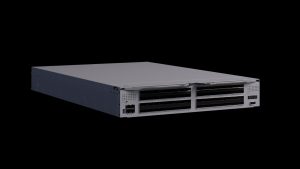
Central to this vision is Cisco’s newly updated Silicon One chip family. The company said its flagship 102.4-terabit Silicon One G300 chip is now being shipped to customers at volume, alongside the new Silicon One P200 systems. It’s all about raw speed, dramatically increasing the bitrate at which data can be transferred from one GPU to another.
The company also unveiled a new chip called the Silicon One G302 for the first time. It’s a 51.2-terabit top-of-rack networking switch featuring a 200-gigabit serializer/deserializer interface that’s able to convert single bitstreams of data into parallel data streams and vice versa to increase overall data flow across the network. It also supports direct-to-chip liquid cooling and up to 1.6-terabit optics, and will ship to customers before the end of the year.
After showcasing the new chips, Cisco invited engineers from Nvidia Corp. onto the stage to discuss their collaboration on a new Ultra-Dense Small Form Factor Repluggable optical module. It’s a new kind of transceiver that’s designed to handle 400-gigabit-per-second-per-lane electrical signals, enabling much faster data transmission speeds between Nvidia’s GPUs. Cisco said it packs 16 full-duplex lanes into a standard transceiver form factor to deliver up to 12.8 Tb-per-second of overall capacity, about four times the bandwidth density and 1.3 times the power efficiency of existing 200G optics.
The partners explained that the new pluggable optics also eliminate the need for complex embedded cooling circuits and introduce a two-dimensional array connector based on a two-step insertion design that aims to maximize signal integrity.
“Building the world’s largest AI factories starts with rethinking the smallest of connections,” said Nvidia Senior Vice President Gilad Shainer. “With USFP, Nvidia and Cisco are building an ecosystem to reinvent pluggable optics, connecting more computing with greater efficiency to power the next generation of AI factories.”
To streamline network recovery operations during outages, Cisco revealed a new and dedicated out-of-band network management system that’s powered by its Silicon One A100 chips. It’s called Cisco 8001, and it’s designed to rip out and replace the fragmented, legacy management tools used in today’s networks with a standardized and highly programmable environment that supports the rapid implementation of fixes when problems occur and take workloads offline.
Together with the new hardware, Cisco also announced major updates to its networking management software, including a new release of the open-source SONiC network operating system. SONiC’s biggest new addition is a Live Protect runtime security feature, which will be available next year to identify and remediate vulnerabilities in live AI workflows without causing any disruption.
Kevin Wollenweber, Cisco’s senior vice president and general manager of data center and internet infrastructure, said AI requires a new approach to scaling data center networks that incorporates the reality that many workloads are now distributed across multiple physical sites.
“It’s no longer just about individual data centers or clusters, but about how we connect compute at massive scale without compromising performance or resilience,” he explained. “Cisco’s strength across silicon, networking, optics, systems and security puts us in a unique position to deliver the open infrastructure customers need as AI continues to evolve.”
Support our mission to keep content open and free by engaging with theCUBE community. Join theCUBE’s Alumni Trust Network, where technology leaders connect, share intelligence and create opportunities.
Founded by tech visionaries John Furrier and Dave Vellante, SiliconANGLE Media has built a dynamic ecosystem of industry-leading digital media brands that reach 15+ million elite tech professionals. Our new proprietary theCUBE AI Video Cloud is breaking ground in audience interaction, leveraging theCUBEai.com neural network to help technology companies make data-driven decisions and stay at the forefront of industry conversations.