 AI
AI


AI

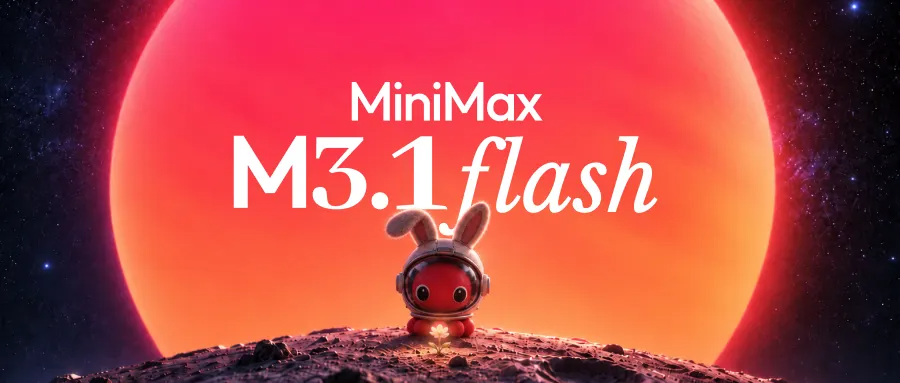
Chinese artificial intelligence developer MiniMax Group Inc. today released M3.1 Flash, a faster and cheaper update to the M3 large language model it launched in June.
The release takes aim at the cost of running AI agents, which often need dozens of model calls to finish a single job. MiniMax said Flash represents its “ongoing exploration of the balance between efficiency and capability.” Agentic tasks cost 70% less to run than on its previous model, the company said, and inference is close to three times as fast, with output at everyday peak topping 200 tokens per second.
Size has barely changed from M3. MiniMax’s developer guide for the preview release lists 428 billion parameters in all, and the launch post credits the extra speed to more aggressive sparsity at inference time. Reasoning stays on for every request, with developers choosing one of five effort levels from Low to Max. The model accepts text, image and video input, and prompts can run to 1 million tokens.
In MiniMax’s own testing, M3.1 Flash scored 61.7 on OSWorld V2, which tests how well a model can operate a computer, and the company said no Chinese model has done better. BankerToolBench, a banking workflow test, gave it 76.2.
For security work, MiniMax pointed to an 82% score on CyberGym. University of California at Berkeley researchers built that benchmark to test whether AI agents can reproduce real software vulnerabilities, and the company listed code auditing, penetration testing and malware analysis among the jobs M3.1 Flash can take on.
At a flat 15 cents per million input tokens, M3.1 Flash lines up directly against the V4.1-Flash model from Hangzhou DeepSeek Artificial Intelligence Basic Technology Research Co. Ltd., which charges the same rate off-peak. DeepSeek said over the weekend that its updated V4.1-Flash resolved 77% of tasks on the DeepSWE v1.1 software engineering test. M3.1 Flash managed 73.7%, and neither result has been checked independently.
MiniMax, which has traded in Hong Kong since a $619 million initial public offering in January, saw its shares fall after the original V4.1-Flash launched in September, Bloomberg reported.
The launch also settles who was behind Space Bunny, an anonymous model that turned up on OpenRouter Inc.’s model routing service in late September. Community testers soon linked it to MiniMax by probing its tokenizer, and the company confirmed today that Space Bunny was an early M3.1 Flash build. More than 200 trillion tokens went through it while its maker stayed unnamed, according to the launch post.
M3.1 Flash is available now through the MiniMax API, the company’s M Plan subscription and its MiniMax Code desktop app. Output costs 60 cents per million tokens and cached input 1.5 cents. The company said it will release the Flash weights later, and a more capable Pro model is also coming.
Support our mission to keep content open and free by engaging with theCUBE community. Join theCUBE’s Alumni Trust Network, where technology leaders connect, share intelligence and create opportunities.
Founded by tech visionaries John Furrier and Dave Vellante, SiliconANGLE Media has built a dynamic ecosystem of industry-leading digital media brands that reach 15+ million elite tech professionals. Our new proprietary theCUBE AI Video Cloud is breaking ground in audience interaction, leveraging theCUBEai.com neural network to help technology companies make data-driven decisions and stay at the forefront of industry conversations.