 APPS
APPS


APPS

Reflex, a startup that uses artificial intelligence agents to build, deploy and maintain custom business software for enterprises, said today it has closed on a $14 million Series A round of funding.
Standard Capital led the round, which saw participation from Databricks Ventures, Y Combinator, Lux Capital and Abstract Ventures.
The startup, which has now raised $19 million in total, is taking aim at what has long been one of the most widely accepted inefficiencies of enterprise software. Most businesses today have little option but to rely on generic, third-party software platforms that contain dozens of features they never actually use. But worse than that, they lack many of the specific, niche capabilities they do require.
Businesses generally get around this problem by purchasing overlapping subscriptions to multiple software platforms, so they can patch their capabilities together. If there are any gaps, these are usually filled with messy manual spreadsheets and repetitive manual workflows. Most companies have little choice but to do this, because it’s far beyond their capabilities to create bespoke, mission-critical software themselves. Such endeavors require access to teams of specialized and expensive software engineers that only the biggest companies can afford.
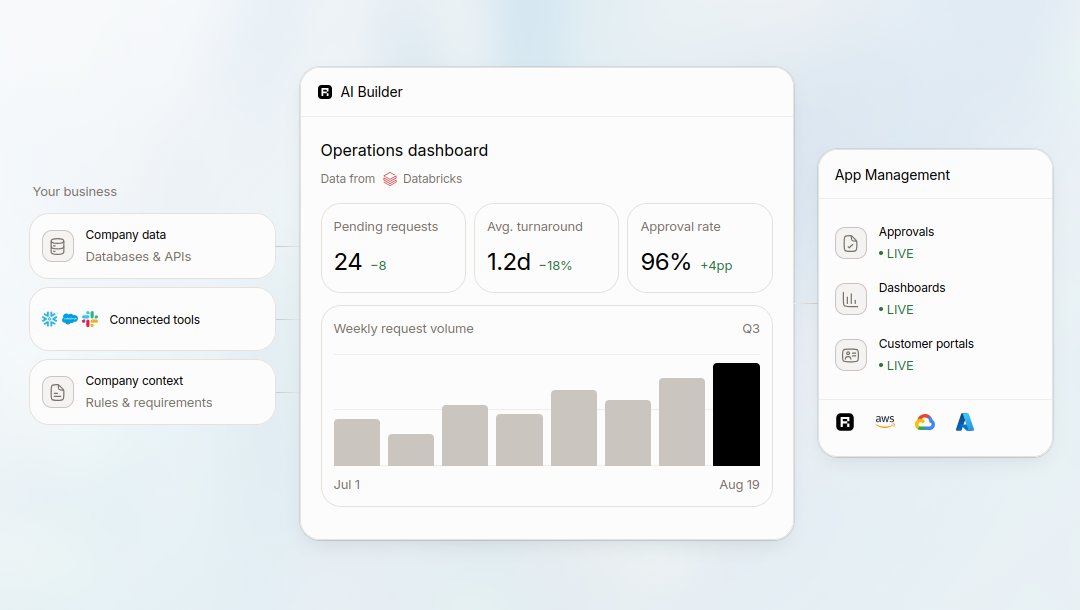
But the arrival of generative AI means that reality has changed. By pairing AI-assisted development with a unique “software factory” workflow, Reflex can help much smaller companies to identify, assemble, deploy and maintain highly customized business applications that are designed specifically for their unique operational processes.
What customers end up with is software that’s precisely optimized for their workflows, with all of the functionality required to get their work done in a single package. Companies no longer need to rely on expensive pre-packaged software with superfluous functionality that means nothing to them.
The biggest advantage of building custom business software is that companies get to fully own the applications they build. When they design their apps with Reflex, they can avoid getting locked into an expensive third-party ecosystem. Whenever new functions are needed, teams can describe the capability they want in natural language, iterate, tweak the design and so on until they get it just right.
Customers also get plenty of flexibility too, with Reflex’s software able to run in the public cloud, on-premises data centers or in highly secure air-gapped environments. This makes them more attractive to enterprises in tightly regulated industries such as financial services, healthcare and government, the startup says.
Reflex is led by its co-founder and Chief Executive Nikhil Rao (pictured, right), who previously served as one of the first engineers at the autonomous driving startup Drive.ai Inc. When that company was acquired by Apple Inc., he joined the iPhone maker’s Special Projects Group, where he helped to create many AI innovations. The startup’s other co-founder is Chief Technology Officer Alek Petuskey (left), who formerly worked as a machine learning engineer at Ancestry.com Inc. and a researcher at the National Aeronautics and Space Administration.
Rao and Petuskey originally developed Reflex as an open-source Python framework and only decided to build a company around it after seeing it explode in popularity. Within months, Reflex had built up a loyal developer community, racking up almost 30,000 GitHub stars and reaching 400,000 monthly downloads. To date, Reflex has been used to build over a million deployed applications globally, with its users including some of the world’s biggest organizations, including Amazon.com Inc., Walmart Inc., The World Bank and Dell Technologies Inc.
Dell used Reflex’s platform to design and build a dedicated server monitoring system that’s now being used by more than 6,000 of its staff. Meanwhile, an unnamed aerospace company used Reflex to rip out and replace its legacy manufacturing resource planning platform. With massive customers like these, it’s little wonder that Reflex has managed to grow its revenue more than 10 times in the past year.
Standard Capital’s Dalton Caldwell the popularity of AI coding has made many companies realize that there is an alternative to buying traditional software-as-a-service applications. “Most companies still run on software that was built for someone else’s business,” he said. “Nikhil and Alek built a platform companies already trust and an elite team that helps create production software for non-software companies.”
Reflex said the next thing on the agenda is to expand its engineering and sales operations teams to support the growing demand for its custom software platform in the traditional corporate and government sectors. It’s also putting the final touches on a new product called Workflows, which will use AI agents to automate multistep business operations.
Support our mission to keep content open and free by engaging with theCUBE community. Join theCUBE’s Alumni Trust Network, where technology leaders connect, share intelligence and create opportunities.
Founded by tech visionaries John Furrier and Dave Vellante, SiliconANGLE Media has built a dynamic ecosystem of industry-leading digital media brands that reach 15+ million elite tech professionals. Our new proprietary theCUBE AI Video Cloud is breaking ground in audience interaction, leveraging theCUBEai.com neural network to help technology companies make data-driven decisions and stay at the forefront of industry conversations.