


 EMERGING TECH
EMERGING TECH
EMERGING TECH
EMERGING TECH

A group of scientists has engineered artificial crystals that could potentially provide a more efficient way to cool computer equipment than materials used today.
The researchers, who hail from University of Illinois at Urbana-Champaign and the University of Texas at Dallas, will publish their discovery in an upcoming issue of the journal Science. A press release published on Thursday afternoon previewed the project’s findings and their potential significance for the future of electronics.
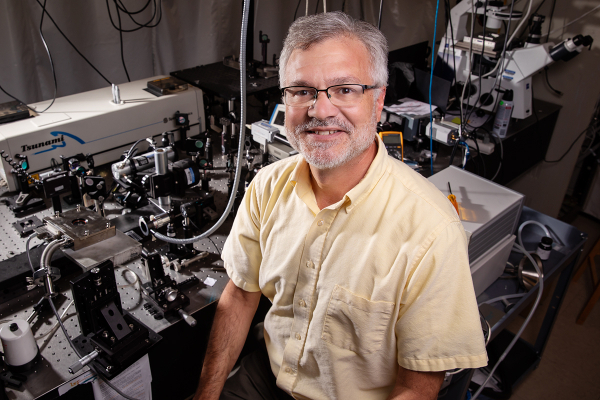
The crystals that were produced in the study are comprised of a semiconducting compound called boron arsenide. Arsenic is dangerous to humans on its own, but UT Dallas professor Bing Lv said the element becomes “nontoxic and stable” when combined with boron. Lv co-led the study with David Cahill (pictured), the head of UI Urbana’s materials science department.
The researchers mixed the arsenic with the boron through a process that involved vaporizing the two elements. In their gas form, the elements could be combined with one another and then condensed into small crystals via cooling.
Upon examination, the crystals were found to possess thermal conductivity of up to 1,000 watts per meter-kelvin, making them second only to diamond in heat absorption capacity. The researchers claim that this is about three times higher than the “best” materials used today in heat spreaders.
“Diamond has the highest known thermal conductivity, around 2,200 watts per meter-kelvin, compared to about 150 watts per meter-kelvin for silicon,” Lv explained. “Although diamond has been incorporated occasionally in demanding heat-dissipation applications, the cost of natural diamonds and structural defects in humanmade diamond films make the material impractical for widespread use in electronics.”
There’s a great deal of work to be done before boron arsenide crystals reach a stage where they might become viable for large-scale use, but the researchers are optimistic. “I think boron arsenide has great potential for the future of electronics,” Lv said. “Its semiconducting properties are very comparable to silicon, which is why it would be ideal to incorporate boron arsenide into semiconducting devices.”
Lv and his colleagues believe the crystals could lend themselves particularly well to cooling small, high-powered electronics. Such devices don’t have room for fans and often can’t use more compact, metal-based heat dissipation systems either because those are prone to causing short circuits. As processors continue to become smaller and more powerful, the need for an alternative heat dissipation method will likely only grow.
Support our mission to keep content open and free by engaging with theCUBE community. Join theCUBE’s Alumni Trust Network, where technology leaders connect, share intelligence and create opportunities.
Founded by tech visionaries John Furrier and Dave Vellante, SiliconANGLE Media has built a dynamic ecosystem of industry-leading digital media brands that reach 15+ million elite tech professionals. Our new proprietary theCUBE AI Video Cloud is breaking ground in audience interaction, leveraging theCUBEai.com neural network to help technology companies make data-driven decisions and stay at the forefront of industry conversations.