

 NEWS
NEWS
NEWS
NEWS
NEWS

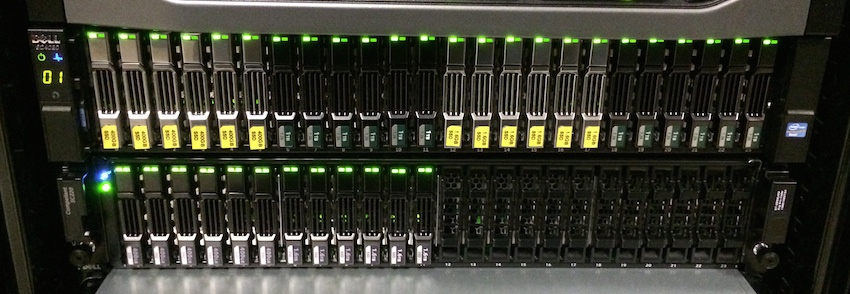
The marketing people at Dell Inc. scored a major victory this morning after its SC Series became the first all-flash array family from a major vendor to support 3D NAND thanks to the introduction of new backwards compatible drives featuring the ultra-dense TLC implementation. CIOs should take note.
Solid-state storage is superior to mechanical disk in practically every way, from power efficiency to density and even reliability, with the notable exception of price. Manufacturers have been trying to address that challenge by reducing the size the nanometer-scale silicon cells that make up their flash drives so to increase the amount of capacity that can fit on a drive and thus increase cost-efficiency, but that’s hardly ideal solution.
The problem lies with the fact that bits stored on flash are in actuality electrons arranged in one of two binary states corresponding to 1 and 0, that, unlike their digital counterparts, adhere to the laws of physics. The smaller a cell becomes, the less charge it is able hold, which reduces the number of electrons in a bit.
Since the technology to permanently trap a subatomic particle in silicon is not yet available, that makes the data more vulnerable to natural electron loss, which undermines the reliability and other properties that have positioned flash as such an attractive alternative to disk. The 3D NAND that Dell is now offering up for its customers sidesteps that limitation.
The technology draws its name from the arrangement of the individual cells, which are stacked on top of one another in a vertical formation that can number in the dozens of layers. That serves to significantly increases the number of electrons that can fit inside a single die, thus eliminating the two of the biggest barriers to the continued decrease in flash costs – reliability and density – with one fell swoop.
In practice, that means that Dell’s new 3D NAND drives will enable its SC4020 array to pack up to 90 terabytes in a 2U chassis, or 62 percent more than the previous-generation memory and six times as much as the comparably-priced 15,000-RPM disk drives traditionally used to support important applications. Needless to say, that’s quite an edge over alternatives.
Of course, the company’s rivals are bound to match that – and sooner rather than later, too – now that the technology is in mass production, which should level the playing field. But that’s ultimately good news for CIOs, who will have a wide choice in how to take advantage of the technology for their organizations as a result.
Support our mission to keep content open and free by engaging with theCUBE community. Join theCUBE’s Alumni Trust Network, where technology leaders connect, share intelligence and create opportunities.
Founded by tech visionaries John Furrier and Dave Vellante, SiliconANGLE Media has built a dynamic ecosystem of industry-leading digital media brands that reach 15+ million elite tech professionals. Our new proprietary theCUBE AI Video Cloud is breaking ground in audience interaction, leveraging theCUBEai.com neural network to help technology companies make data-driven decisions and stay at the forefront of industry conversations.