

 NEWS
NEWS
NEWS
NEWS
NEWS

A new survey of IT professionals indicates that cloud computing is growing faster in large organizations than in small ones.
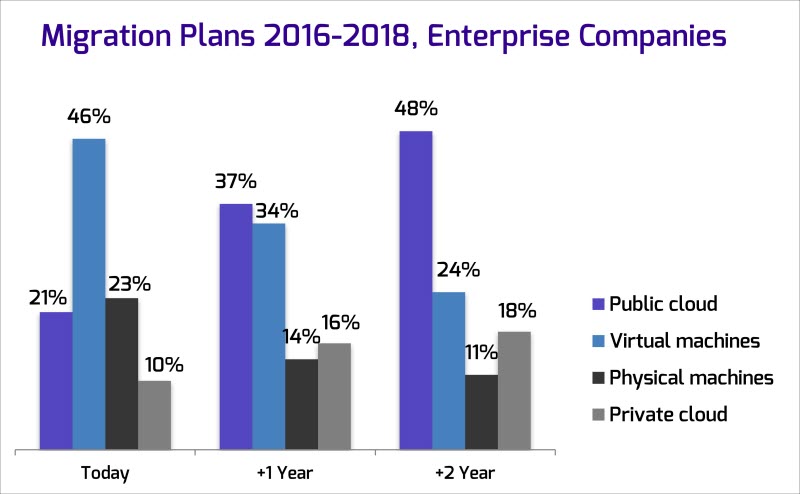
Use of public clouds at large companies will grow 52 percent annually over the next two years, while private cloud use will surge 31 percent per year during that same time, according an online survey conducted by CloudEndure Ltd., a cloud-based disaster recovery and data migration service provider. That growth comes at the expense of virtual and physical machines, whose usage is expected to shrink by 29% and 30%, respectively, during that time.
One of the reasons for the higher growth rate in enterprises is that they are starting from a smaller base. Only 21 percent of the computing workloads at companies with 1,000 or more employees are in the public cloud today, compared to 46 percent on virtual machines (VMs), the survey reported. Two years from now, however, these organizations expect nearly half of their capacity to be in the public cloud, with VM use dropping to 24 percent. Private clouds also show healthy growth during that time.
Online surveys should be taken with a grain of salt because of the lack of control over the respondent domain. CloudEndure said 36 percent of respondents to its survey – or 92 people – work at large companies. A survey by a cloud computing company may also disproportionately represent the opinions of cloud adopters.
Overall two-year growth plans among all companies surveyed was estimated to be 22 percent for public cloud and 15 percent for private cloud. The top three drivers of adoption respondents cited were high availability, reliability and cost saving.
Not surprisingly, Amazon Web Services LLC was the big winner in terms of platform adoption, snapping up 42 percent of the capacity. It’s followed by VMware Inc.’s vSphere at 29 percent. OpenStack dominates private cloud deployments with 54 percent of production workloads, followed in the distance by CloudStack at 14 percent.
Projecting out two years, respondents estimated that 64 percent of their computing resources will be cloud based in 2018, up by nearly half from today’s load. Physical machines are expected to fall from 20 percent of capacity today to just nine percent, or the same as private cloud.
When migration was segmented into phases, the execution phase lasted, on average, 27 “man-weeks” (weeks of labor multiplied by staff size) and close to half of a total project’s time. On average, migration took 59 man-weeks. More than 60 percent of the respondents said migration costs were less than $200 per server.
Support our mission to keep content open and free by engaging with theCUBE community. Join theCUBE’s Alumni Trust Network, where technology leaders connect, share intelligence and create opportunities.
Founded by tech visionaries John Furrier and Dave Vellante, SiliconANGLE Media has built a dynamic ecosystem of industry-leading digital media brands that reach 15+ million elite tech professionals. Our new proprietary theCUBE AI Video Cloud is breaking ground in audience interaction, leveraging theCUBEai.com neural network to help technology companies make data-driven decisions and stay at the forefront of industry conversations.