

 NEWS
NEWS
NEWS
NEWS
NEWS

 Big Data have been used to explore a range of unusual items, but the latest research might be a unique on its own – the hunt for Sasquatch.
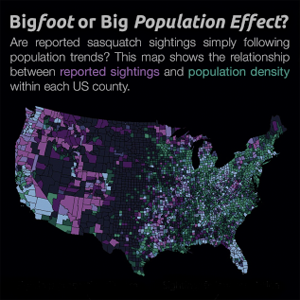
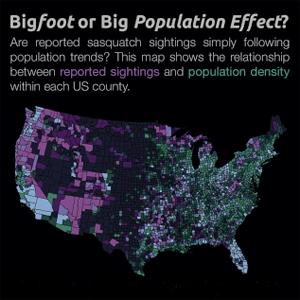
Josh Stevens, a PhD candidate at Penn State University, has compiled 92 years worth of data on Bigfoot, exhibiting where the legendary creature has reportedly been wandering and how a visualization of nearly a century of Sasquatch sighting reports in the US and Canada.
Stevens used data compiled by the Bigfoot Field Researchers Organization (BFRO), which tries to document “the presence of an animal, probably a primate that exists today in very low population densities” according to the group’s website. The doctoral candidate converted the BFRO data to an infographics and plotted 3,313 data points showing where human beings have claimed to see Bigfoot from 1921 to 2013.
Put together by Josh Stevens, the visualization shows a plethora of sighting in the central Florida, the Sierra Nevada mountain range, the Pacific Northwest, the Mississippi River Valley and the Ohio River Valley.

“At first glance, it looks a lot like a map of population distribution. After all, you would expect sightings to be the most frequent in areas where there are a lot of people. But a bivariate view of the data (right) shows a very different story,” Stevens said on his website. “There are distinct regions where sightings are incredibly common, despite a very sparse population. On the other hand, in some of the most densely populated areas, Sasquatch sightings are exceedingly rare. The terrain and habitat likely play a major role in the distribution of reports.”
Stevens’ analysis includes a chronological timeline showing the very first footprint was taken in 1951 but most Bigfoot sightings occurred in 70s and ’80s, where a lot of films and Television shows focused on the hunt. Another spike in reported Bigfoot sightings occurred between 2000 and 2009.
The most recent news came from an Ohio woman when she found a footprint in her backyard that measured 7.5 inches wide in Sept. 19. Just a day before, another women said she saw a creature resembling the description of Bigfoot.
The BFRO website listed Ohio as the fifth in the U.S. for Bigfoot sightings behind Washington, California, Florida, and Illinois. Stevens’ infographics states that a combination of environment and sightings could be feeding on that speculation.
However, he admits, there’s a potential flaw in that logic, since the population data in the study are based on the U.S. Census—and there’s no differentiation in sighting reports on whether they came from residents or from people vacationing in the area.
Of course, he doesn’t know if there’s an ape-like creature ever exist, but he said the fact that Jane Goodall believed in Bigfoot is at least worth putting on the map.
“Ultimately, I’m not convinced there’s a descendant of [giant ape] Gigantopithecus playing hide-and-seek in the Pacific Northwest,” Stevens said. “But if respectable folks like primatologist Jane Goodall believe there’s something more to the myth, I think it’s at least worth putting on the map.”
The famed primate researcher Jane Goodall in an interview broadcast on NPR in 2006 said, “I’m sure that they exist.”
So far, Big Data hasn’t provided a lot of insight into the existence of Bigfoot in our planet. Jeffrey Meldrum, professor of anatomy and anthropology at Idaho State University in Pocatello, have taken a big data scientific way to look for Bigfoot footprint, but to date, no hard evidence of any hominid creature has been validated.
Support our mission to keep content open and free by engaging with theCUBE community. Join theCUBE’s Alumni Trust Network, where technology leaders connect, share intelligence and create opportunities.
Founded by tech visionaries John Furrier and Dave Vellante, SiliconANGLE Media has built a dynamic ecosystem of industry-leading digital media brands that reach 15+ million elite tech professionals. Our new proprietary theCUBE AI Video Cloud is breaking ground in audience interaction, leveraging theCUBEai.com neural network to help technology companies make data-driven decisions and stay at the forefront of industry conversations.