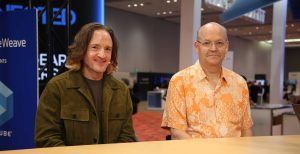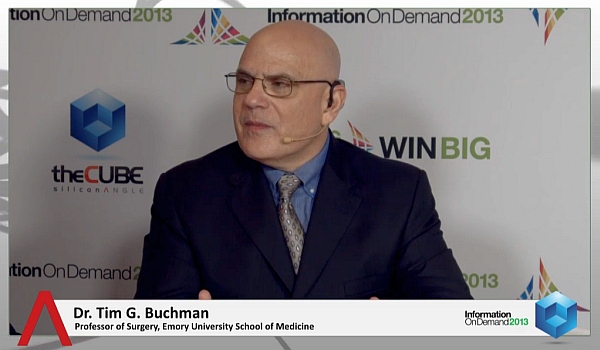












 John Furrier and Dave Vellante, theCUBE co-hosts, kicked off our coverage of IBM Information on Demand 2013 in Las Vegas by interviewing Dr. Tim G. Buchman, Professor of Surgery at the Emory University School of Medicine.
It’s a new era of business, admitted Buchman, because there’s the pressure to take care of more patients at lower costs. That can only be achieved by learning to use data to make decisions concerning patients in real time. “Technology is an enabler: the goal is to use high tech to enable high touch,” said Buchman.
Drawing a connection to GPS technology, Dr. Tim G. Buchman believes that Big Data is going to integrate the information into a more coherent picture and it’s going to help understand when the patient is going to veer off course.
“We are just beginning with the visualizations,” said Buchman noting this to be “still a new territory.” For instance, the bedside monitors only offer a 6 second snapshot of the patient – that is not enough to provide a full report on a patient’s status. However, “those are data in motion, providing vital information for the analytics process.” In order to make healthcare more productive, “it’s not enough to see it, but to understand it and to be able to make projections into the future.” Buchman, also a pilot, likened the situation to consulting the forecast for an area he intends to travel to in the future. Knowing what the future holds enables several safety mechanisms. “Those are the types of things we need to start doing in healthcare, and that’s what personalized medicine is going to be all about.”
The situation is more complex than meets the eye. Just like flying the plane also means managing the necessary systems, helping patients also means involving their families and friends in the process of caring. There are certain challenges and we’re ill prepared in the sense that “we are used to look at the health care as a doctor and a nurse.” Reverting to the example of aviation, Buchman noted that despite aviation safety had improved, accidents kept happening, “because we failed to communicate data effectively.” In his opinion, two things had to come into play to improve aviation safety:
.
1. we had to get data accurately
2. we had to get it in real time
Nowadays it’s not just the doctor and the nurse anymore – there are teams of medics using the data generated by sensors detecting the problems. With the help of Big Data analytics, people are going to have a better understanding of a patient’s status, with less uncertainties and resorting to less guessing.
Referring to another challenge, Dr. Buchman mentioned the nuisance of the systems’ alarms going off constantly, every few seconds. While 95 percent of them are nonsense, medical staff can’t tell the difference. He is hopeful that using the data analytics will help medical staff sort out which of the patients are having a real problem, releasing the caregivers of the burden of the noise, reducing the anxiety of the family who doesn’t understand the meaning of the alarms, and increasing the productivity of the nurses.
Joking that “Life is a disease with a 100 percent mortality,” Buchman noted that “the business value is operational.” One has to look at patterns to take advantage of the variations. During history, the progress has been incremental. Talking about IBM, Buchman is confident that the next frontier is not the little increment, but the vision of what can be done.
Support our mission to keep content open and free by engaging with theCUBE community. Join theCUBE’s Alumni Trust Network, where technology leaders connect, share intelligence and create opportunities.
Founded by tech visionaries John Furrier and Dave Vellante, SiliconANGLE Media has built a dynamic ecosystem of industry-leading digital media brands that reach 15+ million elite tech professionals. Our new proprietary theCUBE AI Video Cloud is breaking ground in audience interaction, leveraging theCUBEai.com neural network to help technology companies make data-driven decisions and stay at the forefront of industry conversations.