




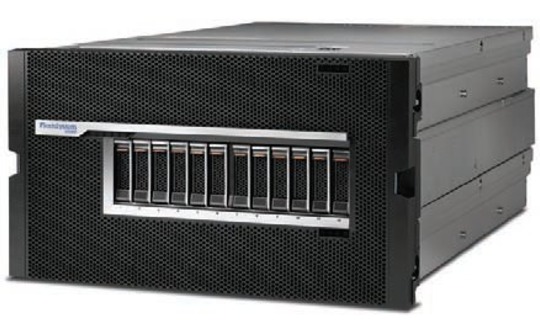
 IBM is back in the enterprise limelight with two new all-flash arrays that incorporate key innovations from its patent trove to up the ante against the competition. The systems are the first fruit of the $1 billion investment in software-defined storage that it revealed a few days prior.
The company’s new hardware-agnostic management platform featured prominently in the launch of the new FlashSystem V9000 (above) and FlashSystem 900, but the main attraction was another level down the stack. What sets the appliances apart from alternatives is a combination of technologies IBM collectively refers to as FlashCore that offers numerous improvements over the standard recipe.
At the heart of the suite is a homegrown controller that can handle multiple traffic streams in parallel and employs a specially programmed chip to sort out transmission errors without hurting processing speed. That customization extends all the way down to the compartments in the chassis.
The individual modules are up to 40 times denser than previous generations, which IBM says makes it possible to cram as much as four times more capacity into a rack than what EMC’s competing all-flash architecture. The space benefits become even more pronounced when compared to the high-end disk systems still powering many of the mission-critical workloads that the company is targeting.
Inside the compartments are multi-level cell (MLC) drives from Micron Technology Inc. of the kind found in consumer devices, as opposed to more expensive variants typically found in data centers. That lowers the cost at the expense of reliability, which FlashCore makes up for with a patented RAID variation that improves redundancy to address hardware failures more efficiently.
The FlashSystem 900, the base model of the new series, includes 12 modules that can accommodate between 2.7 terabytes and 57 terabytes of usable storage. The other option in the line, the FlashSystem V9000, is a blown-up configuration with a three-times bigger chassis and a clustering feature that enables organizations to stack multiple systems together for a total capacity of up to 32 petabytes.
“It’s a good box,” said Wikibon co-founder David Floyer. He noted that IBM, which largely ceded the disk array market to EMC years ago, sees flash storage as a technology inflection point that can enable it to get back in the game. The new flash arrays and unbundled management platform demonstrate impressive progress. “It makes IBM one of four companies that can take us into the next generation of flash arrays,” he said
Support our mission to keep content open and free by engaging with theCUBE community. Join theCUBE’s Alumni Trust Network, where technology leaders connect, share intelligence and create opportunities.
Founded by tech visionaries John Furrier and Dave Vellante, SiliconANGLE Media has built a dynamic ecosystem of industry-leading digital media brands that reach 15+ million elite tech professionals. Our new proprietary theCUBE AI Video Cloud is breaking ground in audience interaction, leveraging theCUBEai.com neural network to help technology companies make data-driven decisions and stay at the forefront of industry conversations.