











 NEWS
NEWS
NEWS
NEWS
NEWS

An increasing number of discussions and presentations revealing ways to effectively utilize Hadoop with regard to Big Data and efficiency improvement emerged during the second day of Hadoop Summit 2016 in Dublin, and finding points of divergence in these strategies is key to understanding individual company policies.
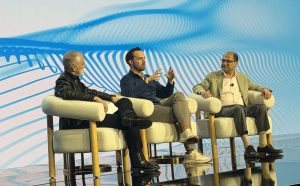
Tugdual Grall, technical evangelist at MapR Technologies, Inc., and Ted Dunning, chief application architect at MapR, joined Dave Vellante (@dvellante), cohost of theCUBE, from the SiliconANGLE Media team, to give their perspective on how the changing Hadoop ecosystem is affecting things for developers and users alike.
An early point of discussion in the conversation addressed how competing companies were eagerly attending each other’s shows, something that Dunning saw as indicative of larger trends. “I think that there’s a very interesting distinction in this marketplace, where we actually have a lot of interoperability, a lot of commonality. … By having this common basis, we’ve built a much bigger market,” he said.
However, even with such commonality, there’s still significant distinction in the approaches and market strategies of each company. As Dunning put it, “MapR’s strategy is a little bit different. We are builders of revolutionary technology, we incorporate that into products, and so we sell products. That’s different from a company that says they have no IP, other than logos and trademarks, and then they drive services.”
Dunning also addressed interoperability as a change in the developer’s realm, comparing the days of reliance on Linux, in which “there was very limited interoperability,” to what Hadoop has brought. He noted, “We have far more interoperability [with Hadoop] than we’ve ever seen in a major platform.” This has changed things for vendors, and “Vendors are nearly getting value from customers in proportion to the value they give to customers,” according to Dunning.
As Grall sees it, “What [developers] are asking for is to be able to develop a new type of application on a single platform, to make it easy to do the historical Big Data with analytics that you would use on machine learning, but also be able to view it on a single platform with real-time data.”
For effective development and deployment, clarity of implementation is a big key, Dunning felt, saying, “Common APIs are, we think, critical, because they are the interface through which developers code. And there’s a lot of them; there are some Hadoop-ish-centric APIs … but there are also traditional APIs … and those are the key things that developers absolutely need. And what we’re doing is converging all of these APIs into a single platform, a single coherent experience.”
There’s also an emphasis on avoiding organization that leads to “cluster sprawl.” And as Dunning said, “We think you need to take it to a single platform that has good multitenancy and multivalency in terms of multiple APIs. Revolution comes from implementation of good APIs, but standardization comes from APIs not dictating exactly which bits implement those APIs.”
Toward the end of the interview, things moved to consider the financial angle for companies delving into these practices. Dunning laid out the situation from his view, noting that while the bottomline of company revenue is affected, “Big Data actually attacks the topline as well … because it presents new opportunities. There’s a fundamental structural change in the economic of computing, where we have linear scalability, where before we had non-linear scalability, and this changes the shape and the geometry of the essence of what drives the economics of this. That change then creates new opportunities, and that’s why we’re seeing essentially a universal drive toward this new platforming of the enterprise.”
Watch the full interview below, and be sure to check out more of SiliconANGLE and theCUBE’s coverage of Hadoop Summit 2016 – Dublin. And make sure to join in during theCUBE’s live coverage during the event by joining in on CrowdChat.
Support our mission to keep content open and free by engaging with theCUBE community. Join theCUBE’s Alumni Trust Network, where technology leaders connect, share intelligence and create opportunities.
Founded by tech visionaries John Furrier and Dave Vellante, SiliconANGLE Media has built a dynamic ecosystem of industry-leading digital media brands that reach 15+ million elite tech professionals. Our new proprietary theCUBE AI Video Cloud is breaking ground in audience interaction, leveraging theCUBEai.com neural network to help technology companies make data-driven decisions and stay at the forefront of industry conversations.