

 CLOUD
CLOUD
CLOUD
CLOUD
CLOUD

Enterprises ramped up spending on networking gear in 2016 in order to build out their data centers, public and private cloud infrastructure, International Data Corp. said in its latest Worldwide Quarterly Cloud IT Infrastructure Tracker.
IDC’s report found that revenue from infrastructure gear, which refers to servers, storage and Ethernet switches, increased by 9.2 percent in 2016 to $32.6 billion. As such, total infrastructure spending accounted for 37 percent of all information technology spending in the fourth quarter of 2016, up from 33 percent one year ago. Private cloud spending grew fastest, up 10 percent, while public cloud spend grew by 5 percent. Spending on traditional data centers fell by 9 percent, however.
Enterprises had a big appetite for Ethernet switches in particular. Spending on switches for private cloud deployments grew 53 percent in the fourth quarter from one year ago, while spending on switches for public clouds was up 30 percent. However, spending on servers and storage grew at a much slower pace. Server revenue was up 9 percent for private clouds and 2.4 percent in public clouds, while storage spending grew 3.6 percent in private clouds and actually fell, by 2 percent, in public clouds.
“Network upgrades continue to be the focus of public cloud deployments, as network bandwidth has become by far the largest bottleneck in cloud datacenters,” Kuba Stolarski, research director for Computing Platforms at IDC, said in a statement. “After some delays for a few hyperscalers, datacenter build-outs and refresh are expected to accelerate throughout 2017, built on newer-generation hardware, primarily using Intel’s Skylake architecture.”
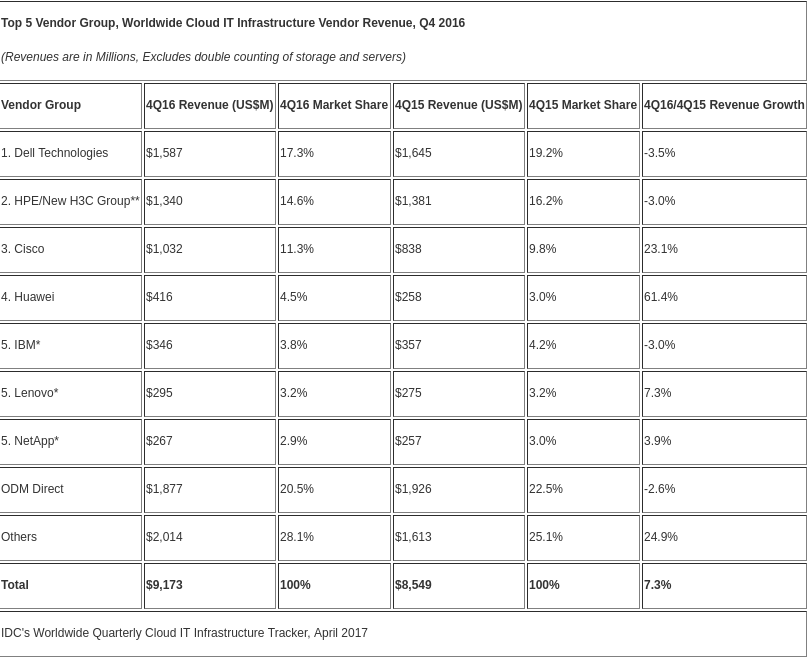
As far as vendors go, the biggest winners in the last year were Huawei Technologies Co. Ltd. and Cisco Systems Inc., with revenue growth of 61 percent and 23 percent, respectively.
However, Dell Technologies Inc. remains the largest Cloud IT infrastructure vendor with revenues of $1.58 billion in the fourth quarter of 2016, down 3.5 percent year on year. Hewlett-Packard Enterprise Co., including its H3C partnership in China, came in second overall with revenues of $1.34 billion in Q4 2016, down 3 percent from a year ago. Cisco and Huawei ranked third and fourth overall, with fourth-quarter revenues of $1 billion and $416 million respectively.
Source: IDC
It’s also worth noting that the “others” category, which includes white-box manufacturers that supply hyperscale web companies such as Google Inc. and Facebook Inc. commanded the most revenue overall, raking in $2 billion in the fourth quarter, representing a 28 percent share of the total cloud infrastructure market.
Support our mission to keep content open and free by engaging with theCUBE community. Join theCUBE’s Alumni Trust Network, where technology leaders connect, share intelligence and create opportunities.
Founded by tech visionaries John Furrier and Dave Vellante, SiliconANGLE Media has built a dynamic ecosystem of industry-leading digital media brands that reach 15+ million elite tech professionals. Our new proprietary theCUBE AI Video Cloud is breaking ground in audience interaction, leveraging theCUBEai.com neural network to help technology companies make data-driven decisions and stay at the forefront of industry conversations.