 WIKIBON
WIKIBON
WIKIBON


WIKIBON

A perfect storm of heightened regulation, advanced cyberthreats and greater business risk is creating a new imperative for Global 2000 organizations to rethink data recovery for high-value applications.
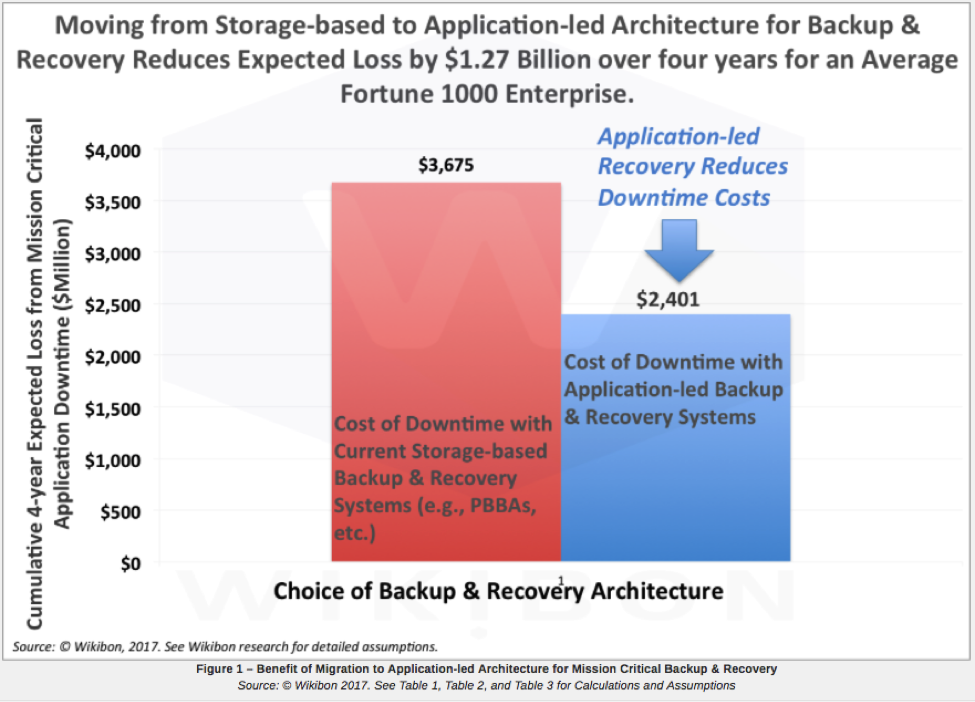
That’s according to new research by Wikibon analyst David Floyer. In a recent Wikibon research report (subscription required), Floyer introduces a new phrase, “application-led backup and recovery,” which takes a system view of recovery, versus a decades-old approach of relying on a storage-centric architecture to manage data protection and recovery. Wikibon argues that an application-led design can noticeably cut the cost of downtime relative to conventional approaches such as those typified by purpose-built backup appliances, or PBBAs (pictured).
Wikibon’s research underscores three major forces that it predicts will create a tipping point for change:
According to Wikibon, the average cost of downtime for mission-critical systems at large organizations equates to nearly 5 percent of revenue, or about $735 million per year. The researcher estimates that taking an application-led recovery approach can cut this by more than half over a four-year period, to 2.3 percent.
According to Wikibon, the old models of backup-and-recovery are rooted in the days of tape, which then moved to disk-based backup in the form of PBBAs, popularized by Data Domain in the mid-2000s. These solutions are storage-based, meaning that an application-consistent copy of a database and other files is taken at a point in time and a backup copy is created.
An application-led system, on the other hand, sends transactions from memory buffers (before flushing to disk), significantly reducing data loss exposure to a subsecond granularity level, as ongoing transactions are stored on the production database and simultaneously to a specialized appliance. To explain this process, Wikibon outlines in minute detail an example of an Oracle Corp. ZDLRA recovery appliance and how it works.
The benefit of this approach comes from an end-to-end view of the data, the ability to leverage large memories with integrated software and a dramatic simplification in the backup-and-recovery process. This last point is critical, according to Wikibon’s research. Specifically, the data Wikibon provides shows that organizations that take this approach and automate procedures can reduce the number of steps involved in backup and recovery from 80 to 14 over a period of time.
Are there really that many steps to reduce? Evidently, yes. These steps, according to Wikibon, include things like the following, many of which today are handled by unreliable scripts or manual/semi-automated processes:
According to Wikibon, there are dozens of these steps and substeps embedded in the backup and recovery processes of today. Importantly, these steps are associated with both failure management and compliance reporting, which dramatically increases complexity.
It is this very complexity, says Wikibon, that system vendors, such as Oracle today and others in the future, are attacking with new solutions that are integrated and specifically designed to protect the world’s most sensitive data files such as financial transactions, airline reservation data, retail transactions and more.
The Wikibon study puts out some other compelling statistics related to downtime associated with mission critical applications:
Talking about data protection is like discussing insurance. But in this digital age of always-on availability, security risks and high speed/high risk business velocity, data loss from downtime is only increasing. Wikibon challenges senior business executives at the board level to set a moonshot goal of cutting their cost of downtime in half by early next decade.
Shareholders, Wikibon says, should take notice too and demand that organizations make reducing data losses a board level agenda item.
Support our mission to keep content open and free by engaging with theCUBE community. Join theCUBE’s Alumni Trust Network, where technology leaders connect, share intelligence and create opportunities.
Founded by tech visionaries John Furrier and Dave Vellante, SiliconANGLE Media has built a dynamic ecosystem of industry-leading digital media brands that reach 15+ million elite tech professionals. Our new proprietary theCUBE AI Video Cloud is breaking ground in audience interaction, leveraging theCUBEai.com neural network to help technology companies make data-driven decisions and stay at the forefront of industry conversations.