

 INFRA
INFRA
INFRA
INFRA

INFRA

Software providers face rising demand for as-a-service delivery models. Digital subscription is even cropping up in businesses — like Fender Musical Instruments Corp. — far from the software core. All of these companies now require infrastructure like storage to scale with customers’ whims.
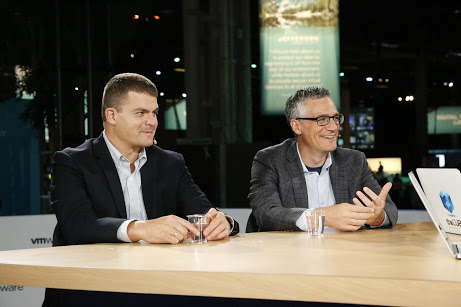
“They don’t really know what is going to be the next workload, how their workloads are going to change and scale over time,” said Eyal David (pictured, left), chief technology officer of Kaminario Inc.
Kaminario provides all-flash storage solutions to businesses that prioritize scale, agility, performance and cost-efficiency. These include mainly software as a service, or SaaS, providers, but also e-commerce, financial technology or healthcare technology businesses. These businesses need “flexibility to address their changing needs in capacity and performance, to address growth in customers, changes in workload applications — without too much pre-planning,” David said.
David joined Josh Epstein (pictured, right), chief marketing officer at Kaminario, in a live interview at the VMworld conference in Las Vegas, Nevada. They spoke with John Furrier (@furrier) and Dave Vellante (@dvellante), co-hosts of theCUBE, SiliconANGLE Media’s mobile livestreaming studio. (* Disclosure below.)
The rash of infrastructure incumbents trying to buy into the flash market through acquisitions can’t deliver this elasticity, according to Epstein. They push what he calls “retrofit flash … taking their old legacy architectures — their scale-up or scale-out architectures — and cramming flash into it,” he said. They simply can’t scale on demand the same way a built-for-flash offering can, Epstein added.
With two new announcements, Kaminario aims to put the agility of all-flash into customers’ hands with increased orchestration and management. Its next-gen platform K2.N, based on fully converged Non-Volatile Memory Express, or NVMe, over fabric on the back end “leverages the existing capability to disaggregate capacity and compute and take it to the next level,” David said.
Decoupling of storage capacity and compute is a hallmark of the cloud that K2.N brings inside the on-premise data center, David added.
Kaminario Flex is an orchestration platform that rides on top of K2.N and lets users dynamically compose virtual arrays out of NVMe-connected resources. This level of control serves as-a-service providers much better than older systems, according to Epstein.
“The classic notion of a monolithic shared storage array is going to die over time,” he said.
Watch the complete video interview below, and be sure to check out more of SiliconANGLE’s and theCUBE’s coverage of VMworld 2017. (* Disclosure: TheCUBE is a paid media partner for VMworld 2017. Neither VMware Inc. nor Kaminario Inc. have editorial control over content on theCUBE or SiliconANGLE.)
Support our mission to keep content open and free by engaging with theCUBE community. Join theCUBE’s Alumni Trust Network, where technology leaders connect, share intelligence and create opportunities.
Founded by tech visionaries John Furrier and Dave Vellante, SiliconANGLE Media has built a dynamic ecosystem of industry-leading digital media brands that reach 15+ million elite tech professionals. Our new proprietary theCUBE AI Video Cloud is breaking ground in audience interaction, leveraging theCUBEai.com neural network to help technology companies make data-driven decisions and stay at the forefront of industry conversations.