


 INFRA
INFRA
INFRA
INFRA
INFRA

Updated:
Hewlett Packard Enterprise Co. Wednesday announced its outlook for its fiscal 2018 year, saying it expects to generate lower profits than analysts had forecast.
In addition, the enterprise giant also pledged to return around $2.5 billion to shareholders in the next year, comprised of $2 billion in share repurchases and an additional $500 million in dividends.
The outlook, which initially appeared to have little impact on HPE’s shares, was delivered at the company’s annual meeting with analysts, where company officials said they were expecting modest revenue growth for the year when adjusted for sales to large cloud service providers. HPE said it expects to see a profit of between 43 cents and 53 cents through the year ending in October 2018, or between $1.15 and $1.25 per share after adjusting for certain expenses such as from stock compensation and acquisitions. The Wall Street Journal reported that analysts surveyed by Thomson Reuters were expecting slightly higher profits of 65 cents per share, or $1.19 on an adjusted basis.
In what looks like an effort to appease shareholders, HPE also said it plans to return most of its cash to shareholders. The company pledged to return about $2.5 billion during fiscal 2018. It also approved a 15 percent increase in its quarterly dividend, to 75 cents per share. However, on Thursday, investors decided that buyback, which was lower than some analysts expected, wasn’t enough, knocking the shares down more than 5 percent.
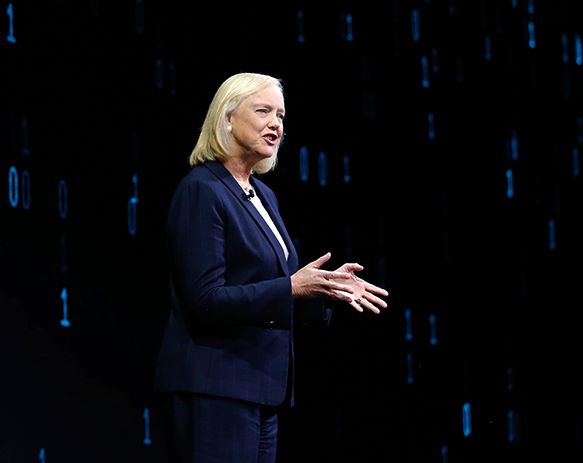
At the meeting, HPE Chief Executive Officer Meg Whitman (pictured) spoke about the firm’s three-year plan called “HPE Next,” which focuses on higher-margin services to boost profits. The same plan also calls for a number of cost-cutting measures.
Under HPE Next, which was announced in June, Whitman intends to devote more of the company’s resources to areas such as research and development, at the expense of other parts of its business such as its manufacturing operations. The company plans to reduce the number of manufacturing locations it operates from 17 to seven within the next three years. It also plans to narrow its operations to just 76 countries, from 160 now.
Company President Antonio Neri said at the meeting that reduction was appropriate because these 76 countries account for 99.5 percent of the firm’s revenue and all of its profit.
Neri also said the company will no longer sell customized commodity servers to what HPE calls Tier 1 service providers, meaning large cloud computing companies such as Microsoft Corp., which the company has said for some time is an unprofitable business. It will keep selling higher-end servers to those customers, though.
Under HPE Next, the company will realize gross cost savings of $1.5 billion, officials said. Some $700 million of that cash will be reinvested in sales, operational and R&D investments in key growth areas. As such, the company expects net cost savings of $800 million annually exiting fiscal year 2020.
HPE also said it intends to return at least 75 percent of its “normalized” free cash flow to shareholders, up from an earlier pledge of 50 percent.
“HPE’s strategy makes sense but long-term positioning remains a question,” Morgan Stanley analyst Katy Huberty wrote in a note to clients. “Nearly 80 percent of HPE’s revenue is threatened by accelerating cloud adoption. Continued pressure from workload migration to cloud drives further declines in legacy server and storage businesses.”
Support our mission to keep content open and free by engaging with theCUBE community. Join theCUBE’s Alumni Trust Network, where technology leaders connect, share intelligence and create opportunities.
Founded by tech visionaries John Furrier and Dave Vellante, SiliconANGLE Media has built a dynamic ecosystem of industry-leading digital media brands that reach 15+ million elite tech professionals. Our new proprietary theCUBE AI Video Cloud is breaking ground in audience interaction, leveraging theCUBEai.com neural network to help technology companies make data-driven decisions and stay at the forefront of industry conversations.