



 INFRA
INFRA
INFRA
INFRA

INFRA

When VMware Inc. was updating its database, the company needed new storage arrays that matched the performance of its all-flash SAP HANA-supported platform.
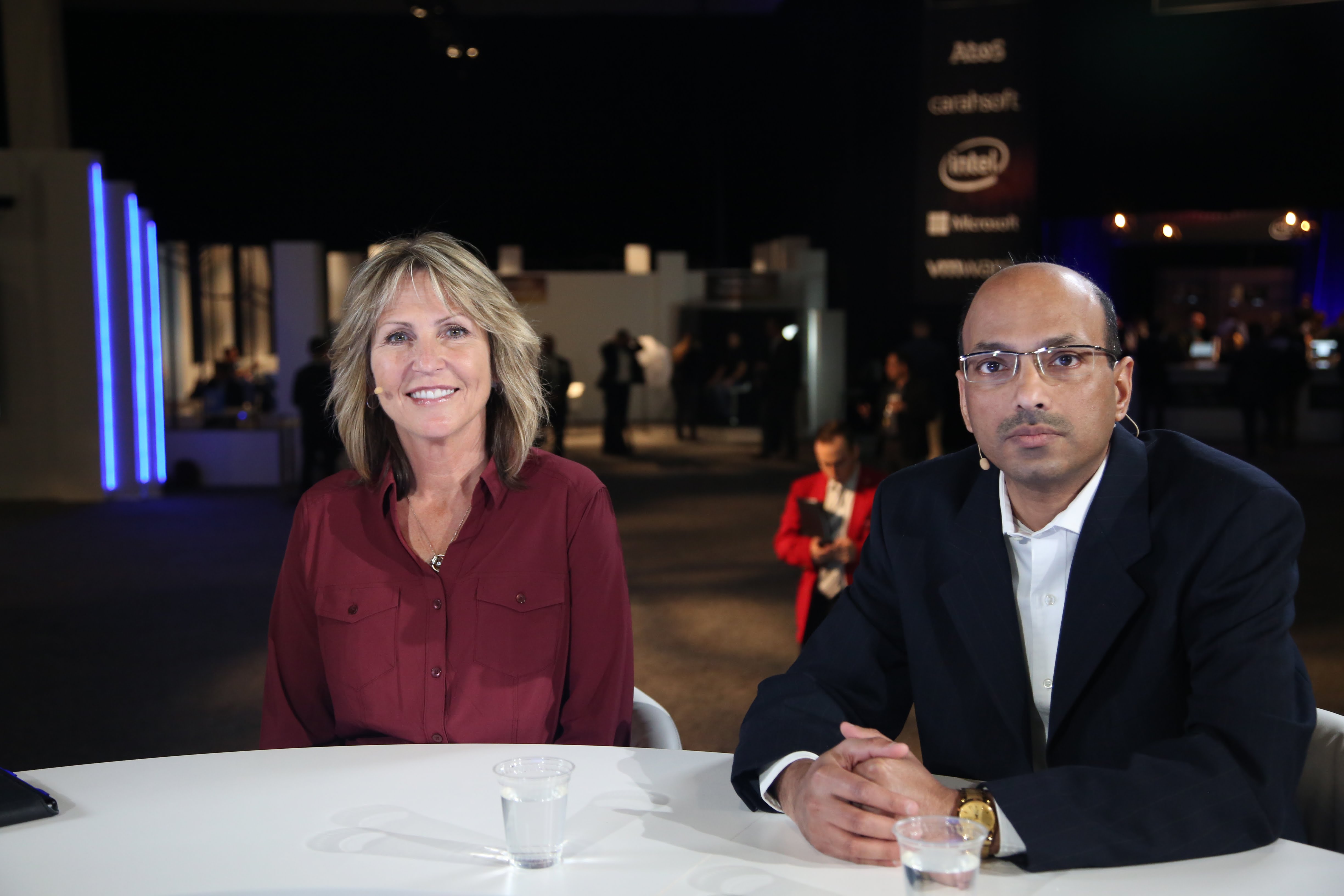
“If your database is all in memory, you can’t have a slow storage behind it. … You need a really fast back-end storage array, so XtremIO all-flash with sub-millisecond latency is a perfect fit,” said Kandy O’Mara (pictured, left), solutions architect at VMware.
O’Mara and Chhandomay Mandal (pictured, right), director of product marketing at Dell Technologies Inc., spoke with John Walls (@JohnWalls21), host of theCUBE, SiliconANGLE Media’s mobile livestreaming studio, and guest host Keith Townsend (@CTOAdvisor), principal at The CTO Advisor, during the Dell Technologies World event in Las Vegas. They discussed how VMware is using XtremIO X2 with SAP-HANA’s database, as well as the specifications and benefits of Dell EMC’s XtremIO all-flash storage array. (* Disclosure below.)
“XtremIO is built on metadata-centric, party-controller architecture coupled with intelligent software, delivering high performance, consistently low sub-millisecond latency, high storage efficiencies, integrated copy-data management at low cost. And … it’s pretty simple to deploy,” Mandal stated, explaining that the simplicity is thanks to consumer-grade intelligent HTML 5 virtual desktop infrastructure that provides complete enterprise functionalities.
Another of XtremIO’s benefits is snapshot technology. “We call it XtremIO actual copies [because] … snapshots, by definition, is a copy,” Mandal said. “When you take a snapshot, it’s an extremely fast operation, because all that we are doing is updating the metadata in memory.”
Unlike traditional databases where back-up copies consume a high percentage of storage space, XtremIO snapshots are managed as standard volumes in the cluster, making them space-efficient while retaining the high performance of production volumes. “That gives the customer a lot of value, not only in terms of infrastructure dollars, but also transforming the application workflows, improving the productivity of the developers and the storage admin, [virtual machine] admin in general,” Mandal stated.
One use-case for snapshots would be to create a read-only prediction copy for disaster recovery, but they can also be writable. VMware uses writable performance snapshots at their disaster recovery site: “What we’ll do there is mount those [writable snapshots] into a test bubble, and … instead of needing a separate [development] environment, we can mount, basically, in a little isolated bubble those writable snapshots, or copies, and test anything we want in our true little production environment and then toss it away when we’re done,” O’Mara said.
VMware tested performance by replicating a database using RecoverPoint on XtremIO with snapshots, versus XtremIO data replication. “[Snapshots] was eight times faster replicating the same amount of data,” O’Mara concluded.
Watch the complete video interview below, and be sure to check out more of SiliconANGLE and theCUBE’s coverage of the Dell Technologies World 2018 event. (* Disclosure: Dell Technologies Inc. sponsored this segment of theCUBE. Neither Dell EMC nor other sponsors have editorial control over content on theCUBE or SiliconANGLE.)
Support our mission to keep content open and free by engaging with theCUBE community. Join theCUBE’s Alumni Trust Network, where technology leaders connect, share intelligence and create opportunities.
Founded by tech visionaries John Furrier and Dave Vellante, SiliconANGLE Media has built a dynamic ecosystem of industry-leading digital media brands that reach 15+ million elite tech professionals. Our new proprietary theCUBE AI Video Cloud is breaking ground in audience interaction, leveraging theCUBEai.com neural network to help technology companies make data-driven decisions and stay at the forefront of industry conversations.